Seven Categories. Years of Waiting. One System to Keep Every Record in Order.
You just learned your child could qualify for the APD iBudget waiver — and that the pre-enrollment list stretches years into the future. A therapist, a hospital social worker, or another parent mentioned "APD" and "categories" in the same sentence, but nobody explained what the seven priority categories actually mean for your family, which documents APD is looking for, or what happens when the annual status letter arrives and you are not ready.
The state information is scattered across APD regional office pages, legislative text under Section 393.065, DCF's MyACCESS portal, and AHCA policy documents. Piecing it together takes hours, and one missed step — submitting incomplete diagnostic evidence, failing to update your address after a move, or not acting on an annual status letter — can leave APD without current contact information. APD's application form warns that failing to report address, email, or phone changes may mean an application is not processed or a case is closed.
The APD Waitlist Navigation System
This guide brings the entire iBudget waiver process into a single document with structured tracking tools — what we call the APD Waitlist Navigation System. It cannot skip the pre-enrollment line or promise an enrollment offer (no product can — priority is strictly statutory under Section 393.065(5), Florida Statutes). It is an organizational framework to keep diagnostic records organized, track contact updates with APD, and prepare documentation for each category review, for however long the wait takes.
What's Inside
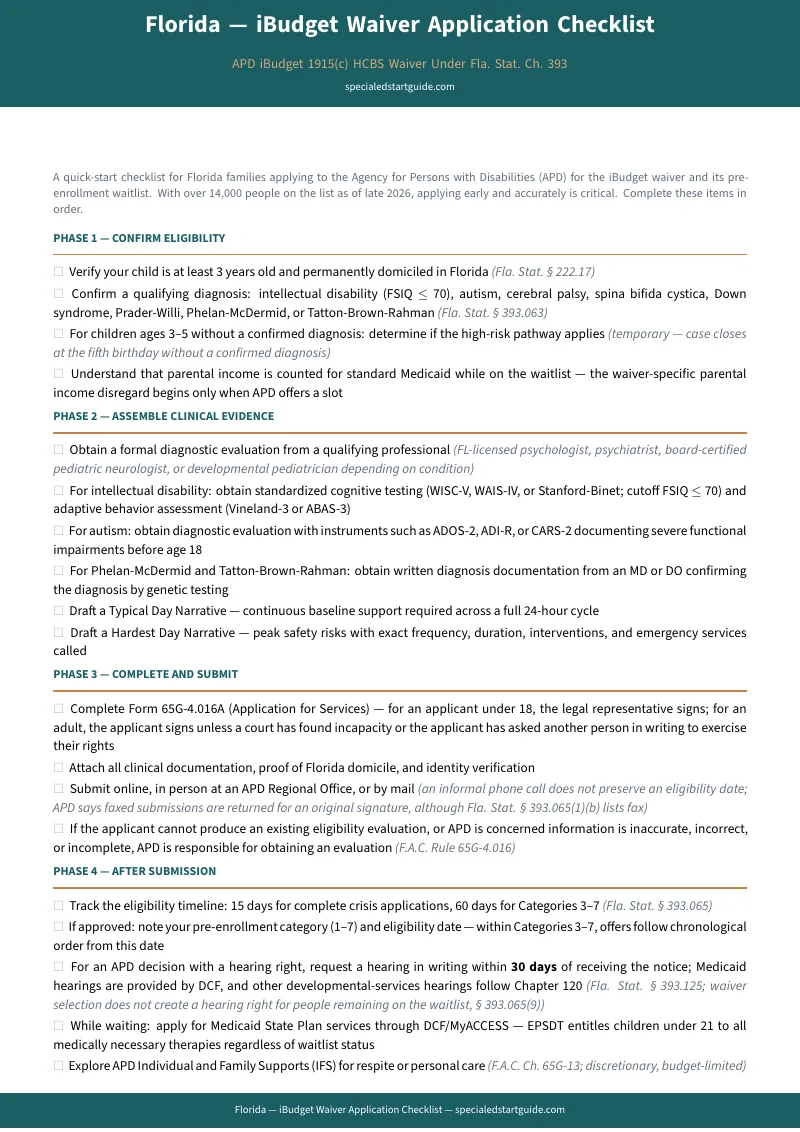
- APD Application Readiness Checklist — a step-by-step checklist of medical records, condition-specific testing where applicable, and the Florida residency information requested on Form 65G-4.016A, organized by qualifying disability to help you gather the evidence APD lists for each condition
- Pre-Enrollment Category Audit Log — a tracking worksheet aligned with all seven statutory categories under Section 393.065(5), so you can log life changes — a required caregiver turning 60 with no alternate caregiver, or a student expected to graduate within 12 months who needs qualifying transition support — and check your category against the statutory criteria
- Annual Status Notice Log — a record-keeping system for logging APD's annual update letters, your responses, and regional office contacts in one place
- Agency Communication Log — a running record of every contact with APD, DCF, AHCA, and service providers, including names, what was discussed, and commitments made — useful when preparing for a dispute or hearing
- Hearing Timeline and Evidence Tracker — deadline tracking for written non-Medicaid APD hearing requests, which must be received within 30 days after notice receipt under Fla. Stat. § 393.125, and the separate DCF route for Medicaid waiver-service disputes, with supporting-document checklists and referral contacts for Disability Rights Florida
- Financial Eligibility Document Organizer — track your child's countable income, resources, and ABLE account balance for DCF financial redeterminations through MyACCESS
- Financial eligibility explained — how the 1915(c) institutional-level calculation generally excludes parental income and resources for waiver enrollment after APD offers a slot and the child enrolls, versus family-related Medicaid State Plan rules while a child waits; pre-enrollment alone does not establish eligibility under the waiver group
- QSI assessment preparation — what the Questionnaire for Situational Information measures, the role it plays in determining iBudget allocations, and how to document daily care needs in the language evaluators actually use
- Interim services while you wait — step-by-step instructions for accessing Medicaid State Plan services, Florida KidCare, school district supports, and non-profit programmes that do not require waiver enrollment, because being on the pre-enrollment list does not mean going without help
- Adult transition roadmap — how APD eligibility, decision-making authority, and benefit pathways change at age 18 and again at high school exit, with hand-offs to dedicated sibling guides for SSI, guardianship alternatives, and vocational rehabilitation
Who This Is For
- Parents who just received a qualifying diagnosis — autism that meets APD's criteria, intellectual disability, cerebral palsy, Down syndrome, or another listed condition — and need to know how to apply to APD before the trail of referrals goes cold
- Families who applied years ago and have lost track of their category, their regional office contact, or whether their diagnostic records are still current
- Families with a required caregiver aged 60 or older and no alternate caregiver (Category 4), or a caregiver whose documented condition is expected to render them unable to provide care within 12 months when no alternate caregiver is available (Category 3)
- Families of teenagers approaching secondary school exit who need to prepare Category 5 documentation and plan the adult services hand-off
- Self-advocates and young adults with disabilities navigating APD as adults — the guide respects supported decision-making and less restrictive alternatives alongside guardianship
Why Not Just Read the APD Website?
You should — and the guide links to every official source. But APD publishes its rules across regional office pages, legislative text, administrative codes, and PDF forms. Much of what appears in search results conflates standard Medicaid income rules with waiver financial eligibility, presents IQ and adaptive testing as universal requirements for all conditions, or surfaces public housing portals instead of APD contact procedures. The guide compiles the current rules into structured action steps with tracking tools — a reusable system instead of a research project you have to restart every year.
What the guide does not do: it cannot skip pre-enrollment categories, guarantee eligibility, alter waitlist priority, or replace legal counsel. The free checklist includes the qualifying disability list and the basic application steps — they are never paywalled.
Satisfaction Guarantee
Full refund, no time limit. If the guide does not help you navigate the APD iBudget process, email [email protected] and we will refund your purchase — no deadline, no questions.
Get Started
Download the free checklist to get the eligibility questions, key documents, and step-by-step application instructions. If you need the full APD Waitlist Navigation System — the category audit log, the annual status notice log, the hearing timeline tracker, the QSI preparation worksheet, the financial eligibility organizer, and 13 chapters of plain-language process navigation — the complete guide will be available on this page for .
Frequently Asked Questions
What if the rules change after I buy?
We update the guide when the rules change. Email us any time, even years later, and we'll send you the current edition free.