Your child's IEP team just said "transition." Now what?
Connecticut starts transition planning at age 14 — two years before federal law requires it. That extra time is supposed to be an advantage. But for most families, it just means two extra years of confusion.
You sit through a PPT meeting where someone mentions postsecondary goals, and suddenly the conversation has shifted from reading levels and behavior plans to employment, independent living, and something called a "course of study." Nobody hands you a map. The school portal has forms. The state website has regulations. The advocacy center has webinars from three years ago that still reference the old age-21 cutoff.
Meanwhile, there are deadlines your family cannot afford to miss. Accept a regular diploma at the wrong moment, and your child's entitlement to a Free Appropriate Public Education ends — permanently. Miss the DDS application window, and the waiting list for adult services stretches into years. Forget to enroll in HUSKY C Medicaid by age 18, and the waiver funding that pays for day programs after school cannot be activated, even if a slot opens.
The Age-14-to-Exit Action System
This guide takes Connecticut's transition framework — the statutes, the agency timelines, the benefit thresholds, the legal notifications — and turns it into a single, chronological action plan. Not a collection of links to state portals. Not a webinar recap. A step-by-step system that tells you exactly what needs to happen, at what age, with which agency, and what to bring.
The difference between this and what you'll find for free is structural. State portals explain what the rules are. This guide explains what you need to do about them, in the order you need to do it, with the specific forms, questions, and decision frameworks that make each step actionable.
What's Inside
- The age-by-age transition timeline — every legal trigger, agency contact, and strategic decision from age 13 through the final school year at age 22, organized chronologically so nothing falls through the cracks
- Diploma vs. certificate decision framework — a structured walkthrough of how each pathway affects FAPE eligibility, including the transition-only services option where your child walks at graduation but defers the diploma to maintain services
- BRS Level Up coordination guide — how to connect with the Bureau of Rehabilitation Services at age 16 for pre-employment transition services, including job exploration, workplace readiness, and self-advocacy instruction
- DDS eligibility and HUSKY C enrollment steps — the exact application sequence for students with intellectual disabilities, from initial DDS intake through the Level of Need assessment and Medicaid enrollment that unlocks waiver funding
- Transfer of rights toolkit — the age-17 notification timeline, a walkthrough of Supported Decision-Making agreements, and the guardianship process for families who need it
- SSI and ABLE account protections — current benefit thresholds, asset limits, the Student Earned Income Exclusion, and how ABLE CT accounts protect savings without jeopardizing eligibility
- CT-SEDS navigation guide — how to read and verify your child's transition goals in Connecticut's IEP data system, including what properly documented PSOGS look like
- PPT preparation questions — a print-and-bring question sheet for every transition meeting, organized by your child's age and graduation pathway
- Summary of Performance guidance — what the school must provide before exit, what colleges and employers expect to see, and how to use the SOP to secure adult accommodations
- Multi-agency coordination tracker — a fillable worksheet to log contacts, deadlines, and application statuses across BRS, DDS, DSS, SSA, and your school district
- Diploma decision worksheet — a side-by-side comparison framework for evaluating the regular diploma vs. certificate pathway with your IEP team
- Record retrieval checklist — the 10 documents to request from the school before exit, with a request tracking log
- Benefit thresholds reference card — 2026 SSI, HUSKY C Medicaid, and ABLE CT dollar limits on one printable page
Who This Guide Is For
This guide is built for Connecticut families navigating the IEP transition process — whether your child is 13 and the team just mentioned postsecondary goals for the first time, or 19 and already in a transition program wondering what comes next.
- Parents deciding between a diploma and a certificate pathway and trying to understand what that choice actually means for services after graduation
- Families starting the DDS application process and trying to connect the dots between HUSKY C enrollment, the Level of Need assessment, and waiver funding
- Parents preparing for the transfer of educational rights at 18 and weighing guardianship against Supported Decision-Making
- Anyone who has spent hours piecing together information from CT.gov, CPAC, BRS, and school district websites — and wants it organized in one place with clear next steps
Why Not Just Use the Free Resources?
The Connecticut State Department of Education, CPAC, and BRS all publish useful transition information. But those resources are designed for compliance, not for families. They explain the regulations — they don't tell you what to do at your child's next PPT meeting.
Many of the most-shared free resources in this space still reference the old age-21 eligibility cutoff, even though Public Act 23-137 extended FAPE through the school year in which a student turns 22. Others lack the specific Connecticut details that matter — the CT-SEDS transition page format, the HUSKY C asset limit that determines whether DDS funding can be activated, the BRS Level Up referral process.
This guide does not replace your child's IEP team, attorney, or agency coordinators. It gives you the organized, current, Connecticut-specific reference that lets you show up to those conversations prepared — knowing what questions to ask, what documents to bring, and what decisions to push for.
The Free Checklist Gets You Started
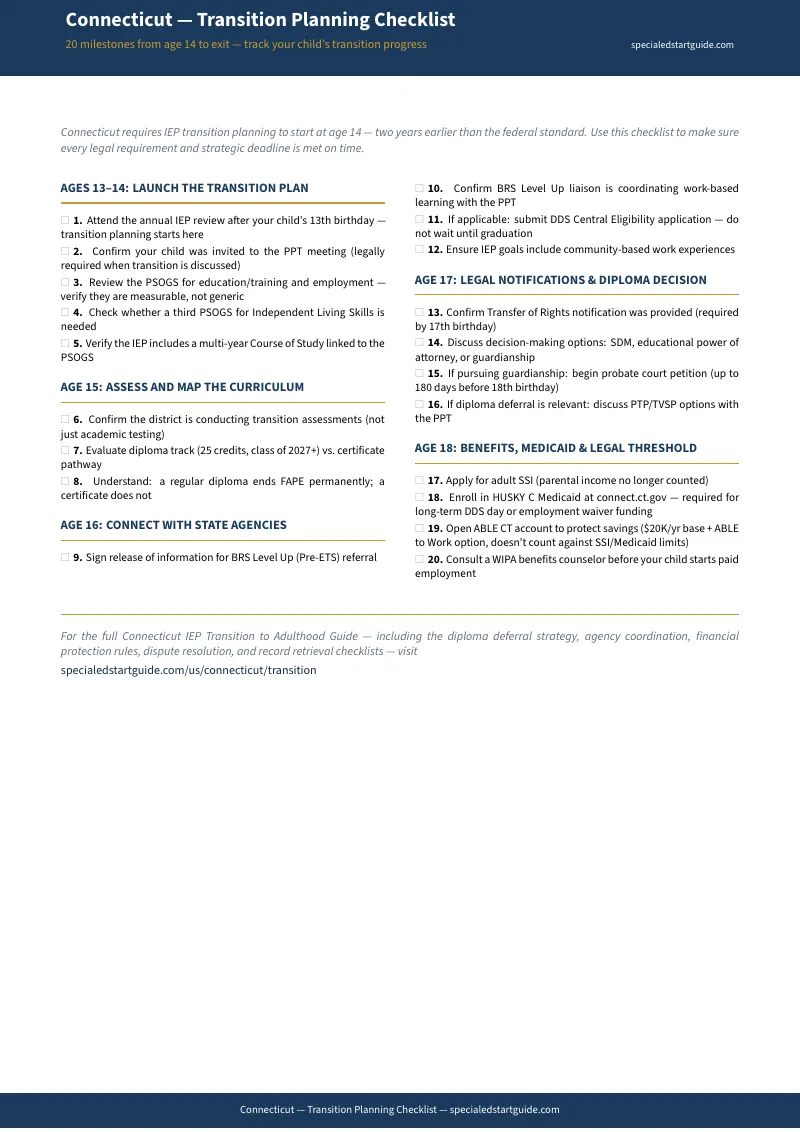
Not sure if you need the full guide? Download the free Connecticut Transition Planning Checklist first. It gives you a one-page overview of the key milestones from age 14 through exit — enough to see where your family stands and what's coming next.
If you find yourself wanting the step-by-step details behind each item on that checklist — the decision frameworks, the preparation worksheets, the agency coordination steps — the full guide is where that work is done.