Six Agencies. One Deadline. No Instruction Manual — Until Now.
Your child's 18th birthday is six months away and you just realized that everything changes at once. Legal decision-making transfers to them. Parental income stops counting for SSI. The Social Security Administration switches from the childhood disability standard to a stricter adult threshold that initially denies 60–70% of recipients. And Connecticut — unlike most states — won't automatically enroll your young adult in Medicaid even after SSI approval.
You call the Social Security office. They tell you to contact DSS. You call DSS. They tell you to apply for HUSKY C — but nobody explains that HUSKY C has a $1,600 asset limit, lower than the federal standard, and that a joint savings account you opened years ago could trigger a denial. You try to register with the Department of Developmental Services and learn that adult waiver slots are not an entitlement — there's a waiting list with over 1,200 people on it, and your young adult's position depends on a Level of Need score that nobody has explained how to prepare for.
Meanwhile, a school transition coordinator hands you a one-page handout with six phone numbers and tells you to "start making calls." Nobody maps the sequence. Nobody explains what filing order matters or which step unlocks the next. And nobody mentions that if you apply for HUSKY C before the SSI redetermination completes, the entire application can stall.
The Connecticut Adult Benefits Navigation System is the cross-agency coordination manual that maps every step — SSI redetermination, HUSKY C enrollment, DDS eligibility, waiver positioning, DAC benefits, ABLE accounts, BRS vocational rehabilitation, and the legal decision-making framework — in the sequence Connecticut requires you to do them, with the forms, evidence strategies, and decision tools for each agency.
What's Inside the Navigation System
The Age-18 Redetermination Blueprint
The SSA's age-18 review evaluates your young adult under the adult disability standard — the inability to perform Substantial Gainful Activity ($1,690/month in 2026). The guide breaks down the SSA-3368 (Adult Disability Report) and SSA-3373 (Function Report) field by field. It shows you exactly how to translate IEP goals, psychoeducational evaluations, and school-based transition assessments into the clinical language that satisfies the adult standard. If the redetermination results in a denial, the 60-day appeal timeline and evidence compilation strategy are mapped step by step.
The HUSKY C Application Sequence
Connecticut is a 209(b) Medicaid state. SSI approval does not automatically enroll your young adult in HUSKY Health. You must submit a separate W-1E application to DSS, and the guide walks you through it line by line — including the critical step of writing "HUSKY C" at the top of the physical form to prevent routing errors. It covers the $851/month income limit, the $1,600 asset threshold, the spend-down process for families slightly over the income cap, and how to navigate the ConneCT portal for annual re-determination.
The DDS Waiver Positioning Strategy
Adult developmental services in Connecticut are not an entitlement. They're priority-based, allocated by Level of Need (LON) score, and subject to active waiting lists. The guide includes pre-intake worksheets that help you document your young adult's support needs across the five LON domains — medical, behavioral, psychiatric, safety, and personal care — so the initial assessment reflects their actual needs. It explains the critical difference between the active Waiting List and the Planning List, and shows you how to document a change in circumstances that moves a case from Planning to Urgent status.
The DAC Benefits Cliff Protection Plan
When a parent retires, becomes disabled, or dies, a young adult with a disability onset before age 22 becomes eligible for Disabled Adult Child benefits — up to 50% of the parent's benefit (75% if deceased). The Social Security Fairness Act of 2025 repealed the WEP and GPO, meaning Connecticut public employees' families now receive full, unreduced DAC amounts. But higher DAC income can push your young adult over HUSKY C's income limit. The guide maps the Section 1634(c) protection pathway and Connecticut's legislative landscape for DAC-specific Medicaid exclusions so you can protect healthcare coverage during the transition from SSI to DAC.
ABLE Account and Special Needs Trust Coordination
Connecticut's Save with ABLE program allows your young adult to save up to $20,000 annually (or $35,650 with ABLE-to-Work contributions) without affecting SSI eligibility — as long as the balance stays under $100,000. The guide explains how to open the account, what counts as a Qualified Disability Expense, and how to coordinate ABLE with a first-party or third-party Special Needs Trust for savings above the ABLE threshold. It covers the expanded eligibility under the ABLE Age Adjustment Act (disability onset before age 46, effective January 2026) and how to structure Representative Payee accounts alongside ABLE to prevent accidental asset accumulation.
The Legal Decision-Making Toolkit
Connecticut probate courts must consider Supported Decision-Making before granting guardianship. The guide walks through the SDM agreement structure under Special Act 26-12, explains when limited or full guardianship is the appropriate path, and covers the 180-day pre-18 probate filing window. It includes a comparison framework so you can evaluate which option preserves the most autonomy while providing the support your young adult actually needs.
BRS Vocational Rehabilitation and Work Incentives
The Bureau of Rehabilitation Services offers Pre-Employment Transition Services (Level Up) starting at age 16 and adult vocational rehabilitation through age 22 and beyond. The guide explains how to request benefits counseling before accepting a job, how the SSI earned-income calculation works ($1 reduction for every $2 earned after the first $85), how the Student Earned-Income Exclusion shelters up to $2,410/month, and how MED-Connect protects Medicaid coverage for working individuals with disabilities at income levels far above standard HUSKY C limits.
Financial Tracking Worksheets
Fillable worksheets for tracking countable resources across SSI, HUSKY C, and ABLE simultaneously. Monthly wage-reporting templates for SSA. A room-and-board agreement template that documents the young adult's living arrangement to prevent in-kind income from reducing SSI payments. An action tracker that maps every deadline, filing, and renewal across all six agencies.
Who This Guide Is For
- Parents whose teenager is approaching 18 and who need to coordinate SSI redetermination, HUSKY C enrollment, DDS registration, and legal decision-making structures before the birthday — not after
- Parents who received the SSA age-18 redetermination letter and need to understand what evidence to compile, how to complete the Adult Disability Report, and what happens if the initial determination is denied
- Parents navigating the HUSKY C asset limit who need to understand spend-downs, ABLE accounts, and Special Needs Trusts before an inadvertent asset disqualification
- Families of Connecticut public employees — teachers, municipal workers, firefighters — whose DAC benefit calculations changed after the 2025 WEP/GPO repeal and who need to protect Medicaid eligibility against the resulting income increase
- Parents whose young adult wants to work but fears losing SSI and Medicaid — and who need to understand MED-Connect, the earned-income exclusion, and Trial Work Period rules
- Families whose young adult is aging out of special education (through age 22 under A.R. v. Connecticut) and who need to coordinate the school exit with DDS case manager assignment and BRS vocational intake
Why Not Just Use the Free Resources?
Connecticut has strong free transition resources. The DDS publishes a guardianship-and-benefits PDF. CPAC runs transition workshops. Disability Rights Connecticut offers advocacy materials. The SSA website explains federal rules. Here's the problem with assembling your plan from these sources:
- Each agency explains its own process in isolation. The SSA doesn't mention HUSKY C. DSS doesn't explain how SSI approval interacts with waiver eligibility. DDS doesn't cover the DAC benefits cliff. No single free resource maps the cross-agency sequence — which step unlocks which, and what order prevents administrative delays.
- Free resources don't teach evidence strategy. The SSA form instructions tell you which boxes to check. They don't tell you how to translate a psychoeducational evaluation into the clinical language that satisfies the adult SGA standard, or how to document functional limitations in the way that the Disability Determination Services examiner is trained to score.
- Asset limit rules are scattered and contradictory. The SSI resource limit is $2,000. The HUSKY C asset limit is $1,600. ABLE accounts are excluded up to $100,000. MED-Connect allows up to $20,000. Each program's rules are published on a different state website, using different terminology, and none of them explain how the limits interact when you're enrolled in multiple programs simultaneously.
- Legislative changes move faster than agency websites. The WEP/GPO repeal fundamentally changed DAC benefit calculations for public employee families. The ABLE Age Adjustment Act expanded eligibility to disability onset before age 46. Multiple 2026 bills proposed changes to HUSKY C asset limits and MED-Connect income caps. Free resources routinely lag these changes by months or years. This guide reflects verified 2026 law.
The guide doesn't replace a Certified Elder Law Attorney or a special education advocate. It prepares you so that if you do hire one, you've already organized the clinical records, asset documentation, and agency paperwork — and you spend their hourly rate on strategy, not on explaining the basics.
What You Get
- The Full 16-Chapter Guide — Step-by-step navigation across SSI, HUSKY C, DDS, DAC, ABLE, BRS, and the probate decision-making framework, with form-by-form instructions and evidence strategies
- Financial Planning Worksheet — Fillable income inventory, asset inventory, program eligibility quick check, and 12-month wage reporting log
- Month-by-Month Action Tracker — A consolidated deadline and filing tracker with checkboxes and date columns covering all six agencies
- SSA Form Prep Checklist — Evidence checklist for the Adult Disability Report and Function Report, with space to draft your answers before the official forms
- HUSKY C Application Checklist — Required documents, application steps, and an eligibility pre-check for the Connecticut Medicaid application
- DDS Level of Need Preparation Worksheet — Pre-intake documentation across all five LON assessment domains, with a daily support log template
- Room-and-Board Agreement Template — Fillable agreement and monthly payment log to prevent the SSI in-kind support reduction
- Key Contact Directory — One-page directory of every agency, portal, and helpline, with space for your caseworker contacts
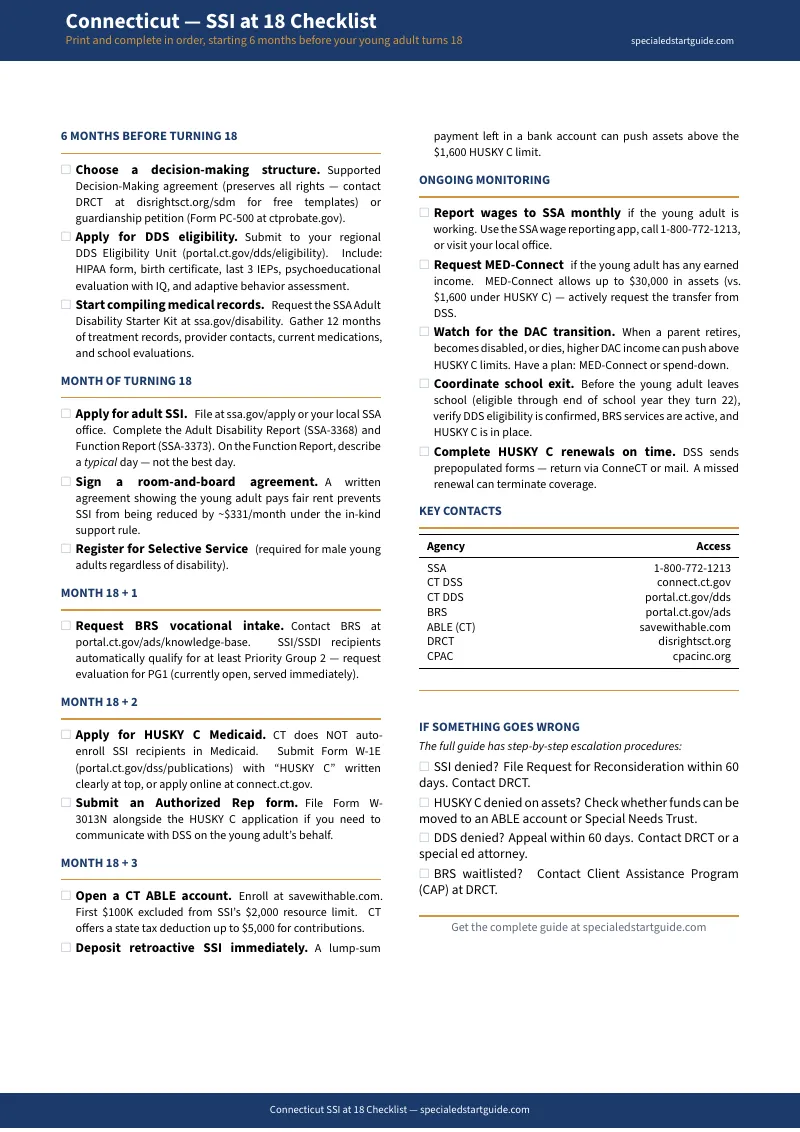
- The Free Checklist — A chronological timeline covering the full age-18 transition sequence, available as a standalone download
Everything is formatted as downloadable, fillable PDFs — 9 documents total. No subscriptions, no recurring charges — buy once and keep the files permanently.
The no-time-limit satisfaction guarantee applies. If the guide doesn't help you navigate Connecticut's adult benefits system more confidently, email [email protected] for a full refund. No hoops.
The free checklist gives you the sequence. The full guide gives you the system — every form, every evidence strategy, every cross-agency coordination point, in the order Connecticut requires.