Your Child's IEP Says "Transition." Now What?
When the IEP team introduces postsecondary goals at your child's age-15 meeting, it feels like the system is telling you something has changed. It has. Your child is moving from an entitlement — the school district must serve them — to a world of eligibility, where every adult agency requires a separate application, a separate determination, and often a separate waitlist.
The school coordinator sitting across the table is a valuable ally, but their authority ends at the schoolhouse door. They cannot place your child on Colorado's DD waiver waitlist. They cannot file for adult SSI. They cannot establish a supported decision-making agreement or open a tax-advantaged ABLE account. Those tasks fall to you — and many carry deadlines that, if missed, cannot be made up.
The Transition Command Center
The Colorado IEP Transition to Adulthood Guide is a single document that replaces the patchwork of CDE toolkits, HCPF waiver manuals, DVR referral forms, and advocacy organization pamphlets that families are currently expected to stitch together on their own. It translates compliance language into a step-by-step family calendar — organized by the age your child needs each action completed, not by the agency that happens to administer it.
Where the state's Pathways to Possibilities toolkit is built for school compliance officers, this guide is built for your kitchen table. You do not need to study ECEA regulations. You just need to know what to do this week.
What's Inside
- Age-by-Age Transition Timeline — Every milestone from age 14 (DD Determination and Safety Net waitlist) through age 21 (FAPE exit, Summary of Performance), with the exact agency, form, and deadline for each step.
- Diploma vs. Certificate Decision Framework — A regular diploma terminates FAPE immediately and irreversibly. A certificate of completion preserves services through the end of the semester your child turns 21. The guide walks you through the calculation so the decision is deliberate, not accidental.
- Case Management Agency Navigator — Colorado's Case Management Redesign replaced the old CCB structure with designated CMAs operating in defined catchment areas. The guide explains how to find your county's CMA, what a Developmental Disability Determination involves, and how to secure waiver enrollment before your child ages out.
- DVR and Pre-ETS Enrollment Walkthrough — Pre-Employment Transition Services start at age 15 in Colorado. The guide covers all five core Pre-ETS activities, the School to Work Alliance Program (SWAP), and the shift to individualized DVR services for longer-term employment support.
- Medicaid Waiver Application Maps — Clear guidance on the DD waiver, SLS waiver, and the new Community First Choice (CFC) program, including application timing (initiate at 17 years and 9 months), HCPF's caregiver hour limits, and decline-and-re-entry rules.
- Transfer of Rights Planner — Colorado splits legal majority (age 18) from educational rights transfer (age 21). The guide provides templates for Supported Decision-Making agreements and walks you through guardianship alternatives so you can preserve your child's autonomy while keeping them protected.
- Financial Protection Toolkit — Adult SSI application procedures, the Disabled Adult Child (DAC) benefit, Colorado ABLE account rules (including the 2026 eligibility expansion and contribution limits), and the interaction between savings and benefit eligibility.
- Dispute Resolution Playbook — State complaints, mediation, due process, and the new SB26-125 grievance pathway — with escalation sequences so you know which tool to use when.
- Five Printable Worksheets — Agency Communication Log, Decision-Making Readiness Worksheet, IEP Meeting Preparation Checklist, Benefits Tracking Worksheet, and the Age-by-Age Timeline — designed to be printed and filled in with a pen.
Who This Guide Is For
- Parents approaching the age-15 IEP — Your child's first transition-active meeting is coming and you want to understand the multi-year timeline before you sit down at the table.
- Families mid-transition (ages 16–19) — The IEP lists postsecondary goals, but no one has explained who is responsible for making them happen after graduation. You need a roadmap for coordinating DVR, the CMA, Medicaid waivers, and financial planning across overlapping systems.
- Parents of students in 18–21 programs — Your child declined the diploma and is continuing to receive services, but the final exit is approaching and you need to ensure the adult services handoff is airtight.
Why Not the Free State Resources?
Colorado's Department of Education publishes the Pathways to Possibilities Secondary Transition Toolkit, and it is genuinely comprehensive. It is also written for educators, compliance officers, and transition coordinators — structured around school district accountability indicators rather than a family's daily planning needs. PEAK Parent Center offers excellent training modules, but they are dispersed across separate webinars and subpages with no unified digital calendar. Disability Law Colorado focuses on legal rights and systemic advocacy — indispensable if you are in a dispute, but not a proactive planning tool.
This guide takes the information scattered across all of those sources, adds the non-education systems they do not cover (Medicaid waivers, SSI, ABLE accounts, guardianship alternatives), and organizes everything into a single chronological workflow with fill-in worksheets. The state toolkits tell you what the rules are. This guide tells you what to do about them, and when.
Satisfaction Guarantee
If the guide does not give you a clearer picture of your child's transition path within the first thirty minutes of reading, email us and we will refund the purchase — no questions, no forms, no waiting period.
Start Planning Tonight
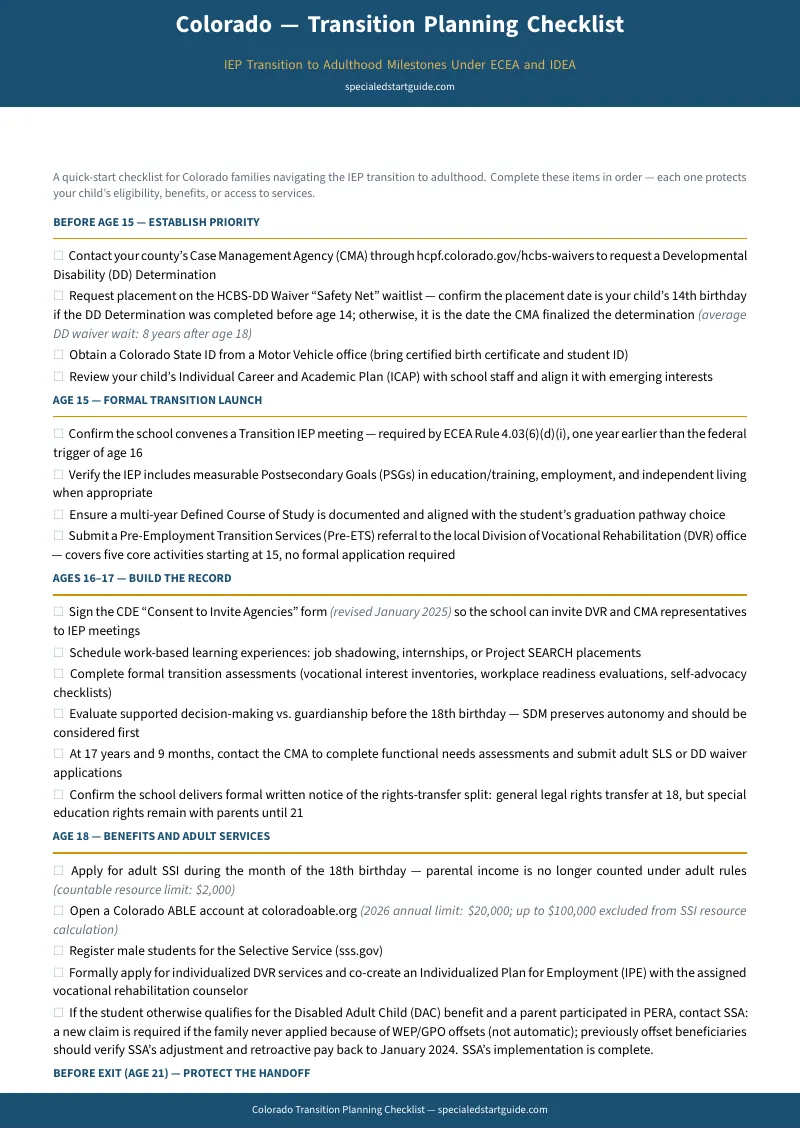
Download the free Colorado Transition Planning Checklist to see the milestone timeline at a glance. When you are ready for the full walkthrough — with worksheets, agency navigation, and decision frameworks — the complete guide is waiting.
Get the Colorado IEP Transition Guide
Frequently Asked Questions
What if the rules change after I buy?
We update the guide when the rules change. Email us any time, even years later, and we'll send you the current edition free.