Your Child May Qualify — Regardless of What You Earn
You just learned about the Children's Extensive Support waiver. Maybe a therapist mentioned it. Maybe a hospital social worker handed you a pamphlet on the way out. Now you're staring at state regulation codes, conflicting forum posts, and a PEAK portal that never quite tells you what to do next.
The single biggest misconception families face is that their household income disqualifies their child. It doesn't. Under federal 1915(c) rules, parental income is completely waived for CES eligibility — the state looks only at the child's own income and assets. But almost nothing you'll find online explains that clearly, and the state's own materials bury it in regulatory language.
The CES Evidence Roadmap
This is the Colorado CES Waiver Guide — a plain-language roadmap that takes you from "I think my child might qualify" through every step to enrolled services, including the evidence the state actually needs to see.
Eligibility isn't just a diagnosis. The state requires proof that your child needs direct human intervention — more than a verbal reminder, redirection, or brief observation — at least once every two hours during the day and on a weekly average once every three hours at night. Most families don't know this until their assessment, and by then they haven't been tracking what the assessor is looking for. This guide changes that by showing you exactly what to document, how to log it, and when to present it.
What's Inside
- The parental income rule, in plain English — how federal 1915(c) waivers disregard your household income, what does count (the child's own income under $2,982/month and assets under $2,000), and how to report it correctly on PEAK
- A dual-track application walkthrough — the developmental disability determination and the functional needs assessment, broken into the exact sequence your Case Management Agency follows after the July 2024 redesign
- The line-of-sight supervision log — a standalone printable 24-hour tracking worksheet with daily tables (daytime and nighttime) and a weekly summary sheet, built to match the ICF/IID level-of-care criteria (every two hours during the day, every three hours on a weekly average at night, and at least four nighttime interventions on four or more nights per week), so your evidence speaks the assessor's language
- The CMA navigation chapter — updated for the Case Management Redesign that transferred case-management duties from Community Centered Boards to regional Case Management Agencies, with guidance on intake phone screenings, the Care and Case Management (CCM) system, and what happens when staff turnover stalls your case
- Services, caps and the new Community First Choice option — what CES pays for (respite, habilitation, specialised medical equipment, Community Connectors and more), what the annual and five-year caps are, and how CFC services layered in from July 2025 let your child access personal care and homemaker services without drawing down the waiver budget
- Renewals and Continued Stay Reviews — a step-by-step preparation checklist for annual CES eligibility reassessments as Colorado phases in the Single Assessment (CSA)
- The appeal and fair hearing chapter — how to read a Notice of Action (Form LTC-803), the 60-day State Fair Hearing deadline, the earlier deadline for requesting continued services, and how to structure your case
- The age-18 transition timeline — a year-by-year map starting at age 15 for moving from CES to adult waivers (HCBS-SLS or HCBS-DD), coordinating SSI, and understanding guardianship alternatives like supported decision-making
- Six standalone printable worksheets — a 24-hour supervision log, an application document checklist, an annual renewal countdown tracker, a service authorization and PAR log, an NOA and appeal deadline tracker, and an agency communication log to organize records for a hearing
The guide cites relevant sections of 10 CCR 2505-10 and applicable federal regulations so you can verify key rules independently.
Who This Guide Is For
- Parents who have just heard about CES from a therapist, hospital social worker or another family and need to know whether it applies to their child
- Families preparing for their first CMA intake or functional needs assessment who want to show up with organised, objective evidence
- Parents facing a service denial or reduction who need to understand the appeal process and deadlines
- Kinship carers and foster families coordinating with county caseworkers through additional child-welfare layers
- Families of teens approaching 18 who need to plan the transition to adult services years before the waiver ends
Why Not Just Use the Free State Resources?
You absolutely should. HCPF's website has the official rules, your Case Management Agency handles intake and assessments at no charge, and organisations like PEAK Parent Center and Disability Law Colorado offer free advocacy support. We link to all of them in the guide.
What the state doesn't give you is a single document that connects the dots: which sections of the PEAK portal trigger the LTSS screening, what your CMA assessor is actually scoring when they visit, how to structure a 24-hour supervision log that matches the level-of-care criteria, and when a hearing request made within 10 days after the intended action date can continue or reinstate services under specified conditions. The guide synthesises hundreds of pages of regulatory code into a structured plan you can follow from the kitchen table — with six standalone printable worksheets that do the organising for you.
The Free Checklist
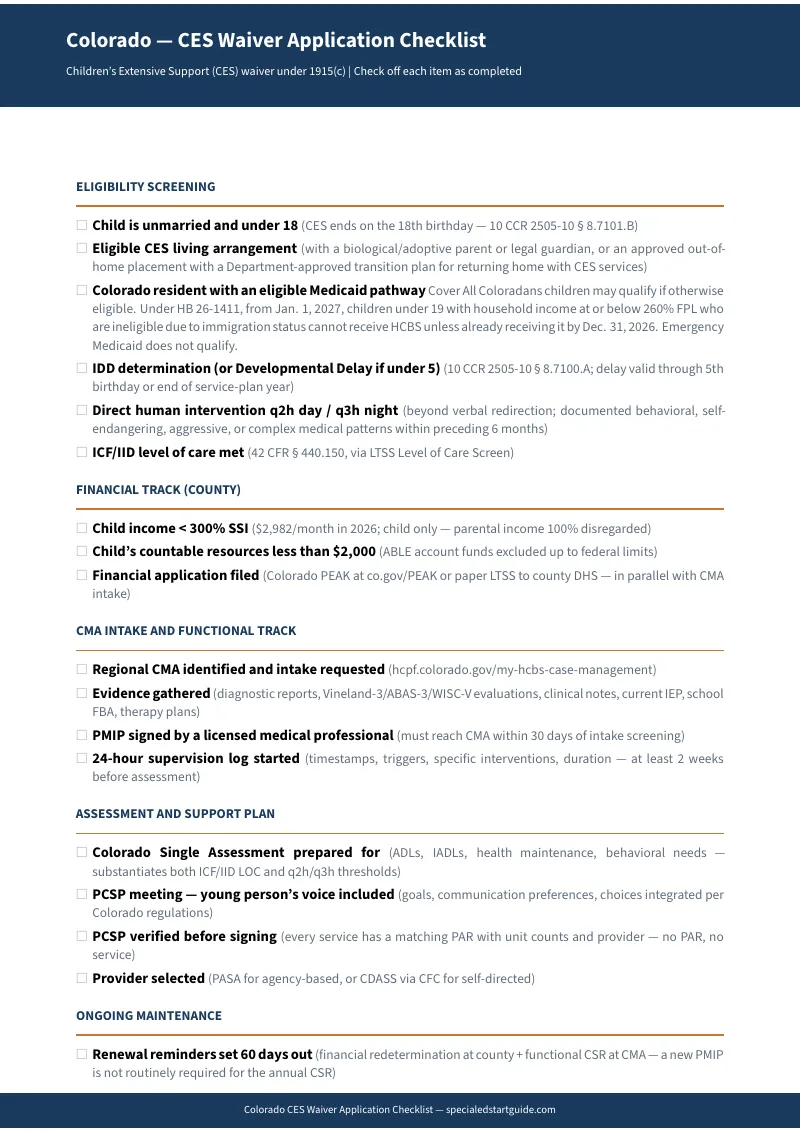
Not sure whether the full guide is right for your family? Download the free two-page checklist first. It covers the eligibility questions, the documents you'll need, and the basic application steps — enough to get oriented before you decide whether the full guide would save you time.
Satisfaction Guarantee
Every purchase comes with a full refund, no time limit. If the guide doesn't help your family's situation, email [email protected] and we'll refund you in full.
This is an independently published educational resource. It is not affiliated with or endorsed by HCPF, any Case Management Agency, or any government body. It does not guarantee eligibility, services, or any state determination.
Frequently Asked Questions
What if the rules change after I buy?
We update the guide when the rules change. Email us any time, even years later, and we'll send you the current edition free.