The letter says services are stopping. File within 30 days — and before the action takes effect.
You just opened a Notice of Action from your regional center. It says your son or daughter's services will be reduced, changed, or denied — and somewhere at the bottom it mentions an appeal process. The form names are unfamiliar. The statutes read like a foreign language. And the 30-day clock for Aid Paid Pending has already started.
Most families lose their first week to confusion alone. They confuse a WIC § 4731 rights complaint with a Lanterman Act fair hearing and file in the wrong channel — which does not pause or extend their real deadline. They search for forms and find the old DS 1805, which is no longer the current appeal form. They read attorney blogs that still cite an outdated 10-day rule. By the time they find the right form (DS 1821), the right agency (DDS, not OAH), and the right filing method, half their window is gone.
The California Regional Center Fair Hearing and IPP Appeal Guide is a self-advocacy filing system built around the statutory timeline, not around generalities. You fill in your dates, track your filings, organize your evidence, and walk into the hearing room with everything indexed and receipted.
What's Inside the Guide
- Appeal Timeline Tracker — fill in the date you received the Notice of Action, then write your 30-day Aid Paid Pending deadline (and the requirement to file before the action takes effect), the 60-day appeal limit, the 10-day informal meeting, the 30-day mediation window, the 50-day hearing deadline, and the 10-business-day decision deadline
- Notice of Action Receipt Log and Filing Receipt and Proof-of-Service Log — structured worksheets for proving when you received every document and when you responded, because "I sent it" means nothing without a receipt
- Evidence Portfolio Index and Daily Incident and Care Log — exhibit numbering plus dated hazard and care rows that turn lived experience into the kind of organized, weighted proof that administrative law judges actually weigh
- Dispute Pathway Decision Guide — the three options on Form DS 1821 (informal meeting, state mediation, OAH fair hearing) with space to elect each path and write why it fits
- Hearing Preparation Worksheet and Implementation Tracker — opening statement, witnesses, and evidence-exchange checkboxes before the hearing; the 30-day WIC § 4713.5 compliance clock after a decision
- Self-Advocacy Decision Worksheet — built for the young adult to write their goals, service needs, and preferences in their own voice at IPP meetings and mediations, with a supported decision-making framework that respects less restrictive alternatives to conservatorship
- Free-Help Directory — OCRA (1-800-390-7032 Northern CA / 1-866-833-6712 Southern CA), Disability Rights California (1-800-776-5746), the DDS Ombudsperson (1-877-658-9731), Family Resource Centers, and the State Council on Developmental Disabilities, plus write-in lines for your local names
Who This Is Built For
- Parents who just got a Notice of Action and need to file within 30 days and before the action takes effect to keep services running during the appeal
- Families denied regional center eligibility who want a clear path through the appeal without hiring a $400-per-hour disability attorney
- Young adults with intellectual or developmental disabilities who want to prepare for and lead their own IPP meetings — with their voice at every step, not someone else's
- Anyone stuck in an IPP stall — your service coordinator keeps saying "I'll talk to my supervisor" and weeks go by with no written decision and no plan
Why the Free Resources Aren't Enough on Their Own
California has a strong public infrastructure for regional center disputes. The Office of Clients' Rights Advocacy (OCRA) has a Clients' Rights Advocate for each of the 21 regional centers. Disability Rights California publishes Rights Under the Lanterman Act, a comprehensive free reference. DDS runs an appeals portal and an ombudsperson office. All of that is real and valuable — the guide links to every one of those resources and encourages families to use them.
But OCRA operates under caseload limits and cannot represent every consumer who requests a fair hearing. The DDS ombudsperson facilitates but cannot overturn decisions. Rights Under the Lanterman Act explains what the law says in 300+ pages of plain-language guidance — it does not hand you a blank timeline, a filing receipt log, or an evidence index you can fill in with your own dates and documents.
The gap this guide fills is organizational, not informational. The statutes are public. The forms are free. What doesn't exist elsewhere is a step-by-step filing system that keeps every deadline, every receipt, and every exhibit in one binder — so nothing falls through the cracks while you're also managing care, coordinating with school, and running a household.
What This Guide Is Not
This guide is independently published and is not affiliated with, endorsed by, or sponsored by the California Department of Developmental Services, the Office of Administrative Hearings, or any California regional center. It does not provide legal advice, financial advice, or guaranteed outcomes. It does not replace professional representation — a family heading to an OAH hearing with complex clinical evidence should consider a disability rights attorney or requesting representation from OCRA.
Purchasing this guide does not accelerate regional center processing times, bypass vendor waitlists, or guarantee appeal victories. It is a self-advocacy organizational tool — nothing more, nothing less.
Your Purchase, Your Terms
The guide comes with a full refund, no time limit. If it's not what you need, email [email protected] and we'll refund you — no questions, no deadline.
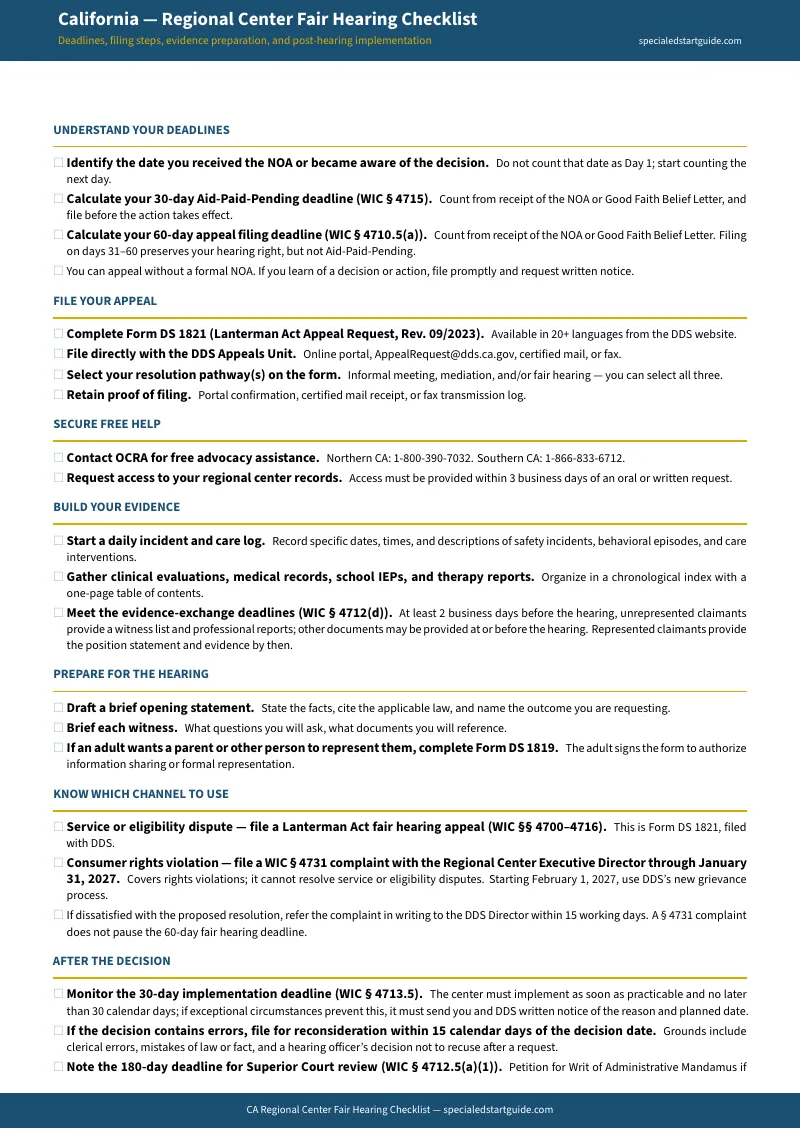
The free California Regional Center Fair Hearing Checklist covers the deadlines and the contact numbers on two printable pages. If that's all you need right now, download it at no cost. The full guide is there when you're ready to build a complete filing system.
Frequently Asked Questions
What if the rules change after I buy?
We update the guide when the rules change. Email us any time, even years later, and we'll send you the current edition free.