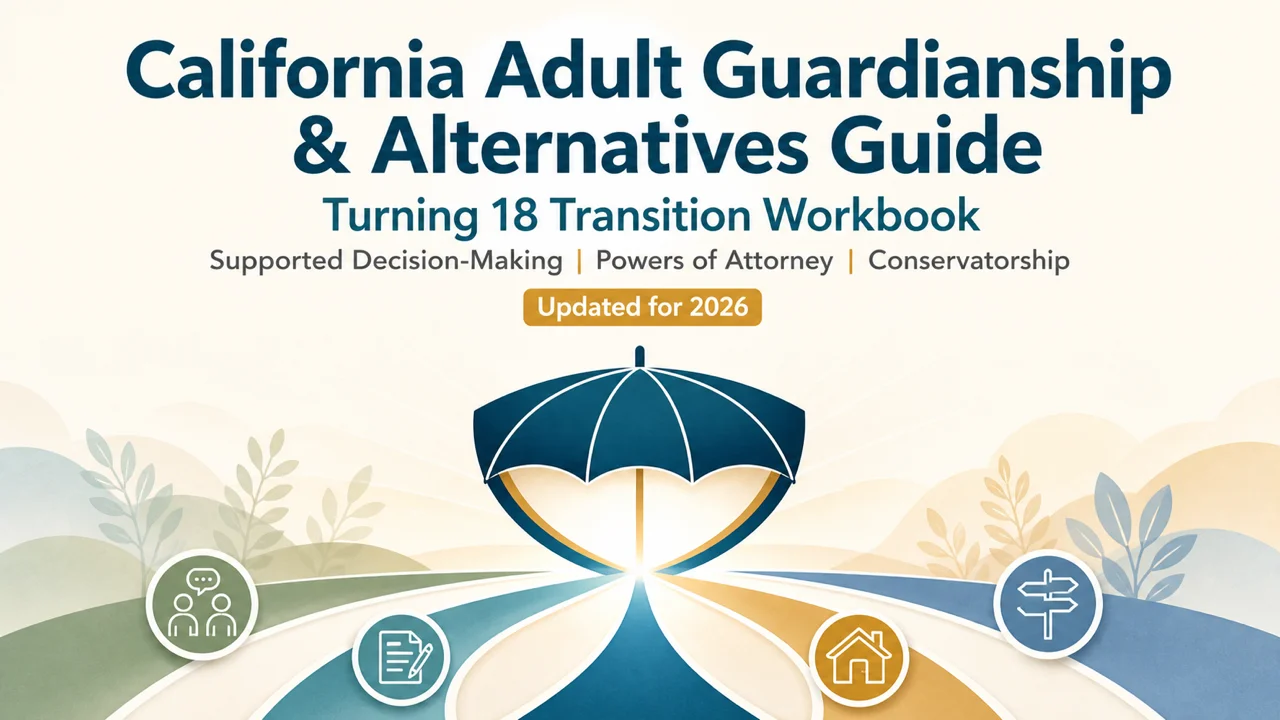
Your child turns 18. Your legal authority vanishes. Now what?
One day your child has an IEP team, a pediatrician who knows their history, and a parent who can make decisions in an emergency. The next day — their 18th birthday — all of that legal authority disappears. The ER doctor can't share test results with you. The school district can exclude you from IEP meetings. A predatory lender can hand your child a binding contract.
California families face this cliff every year, and most get the same unhelpful advice: "just file for conservatorship." But conservatorship is expensive, invasive, and — thanks to California's 2023 supported decision-making law — often unnecessary.
The Transition Authority Planner — every option mapped, every form explained
The California Adult Guardianship & Alternatives Guide is a step-by-step planning workbook that maps every legal tool California gives you for the turning-18 transition. Not just conservatorship — the full spectrum, from supported decision-making agreements to powers of attorney to advance health care directives, with the court process covered for families who genuinely need it.
Where free resources give you a list of options and leave you to figure out which one fits, this guide walks you through a structured capability assessment, compares each tool against your child's specific support needs, and gives you the actual planning documents and filing checklists to execute your choice.
What's inside
- Capability Assessment Worksheets — structured exercises that document how your young adult communicates preferences and makes decisions, so you can demonstrate capacity to any institution that questions it
- Supported Decision-Making Agreement Builder — customizable templates meeting California's WIC § 21005 statutory requirements, with checkpoint fields for housing, medical, financial, social, and educational support domains
- Complete Private Planning Toolkit — fillable templates for Advance Health Care Directives, Durable Powers of Attorney for finances, HIPAA Medical Releases, and Assignment of Educational Decision-Making Authority forms
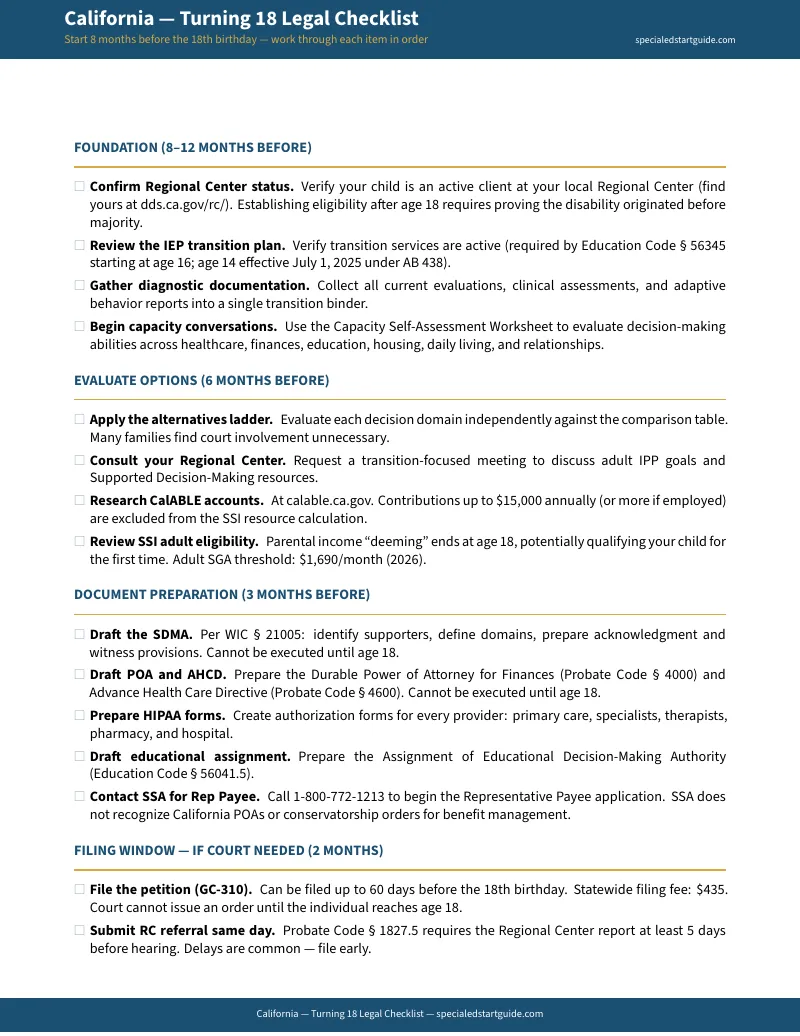
- Court Process Companion — when conservatorship is the right call, the guide maps every filing step: Judicial Council forms, personal service requirements, Regional Center notification deadlines, court investigator preparation, and hearing checklists
- Fee Waiver Instructions — step-by-step guidance on the FW-001-GC fee waiver that most families qualify for but don't know exists, based on the proposed conservatee's household income (not the parent's)
- Benefits Protection Roadmap — SSI adult redetermination walkthrough, representative payee setup, CalABLE account guidance, and how each legal structure affects Medi-Cal eligibility
- 9 Standalone Planning Worksheets — printable tools you can bring to meetings and complete with your support team, including a document distribution tracker, agency communication log, alternatives comparison worksheet, and cost comparison tool
Who it's for
This guide serves three families in particular:
- The autonomy-first family — your young adult is verbal, expresses clear preferences, and you want to honor their independence while ensuring they have support for complex medical, financial, and legal decisions. You need SDM agreements and powers of attorney, not a courtroom.
- The structured-support family — your young adult needs significant help with daily decisions but can participate in the process with the right supports. You're weighing whether a robust multi-supporter SDM agreement is enough or whether a limited conservatorship better fits their needs.
- The high-support family — your young adult has complex medical needs and limited communication. You know court involvement is likely necessary, but you want to understand exactly which powers to request and which to leave alone, and you want to minimize the cost and intrusiveness of the process.
Why not free resources?
Disability Rights California publishes thorough guides on conservatorship alternatives — but they're dense legal PDFs that don't give you a planning workflow or fillable documents. The California Courts self-help site lists every required form — but doesn't help you decide which legal path fits your child. Your Regional Center caseworker may mention supported decision-making — but caseworker training varies wildly across California's 21 regional centers, and many still default to "just file for conservatorship."
This guide connects the dots that free resources leave scattered. You get a decision framework that starts with your child's capabilities, maps to the right legal tools, and gives you the actual documents and checklists to put those tools in place — without paying a special needs attorney thousands of dollars for work you can do yourself in straightforward cases.
Satisfaction guarantee
If the guide doesn't give you a clear path forward for your child's turning-18 transition, email us and we'll refund you — no conditions, no time limit.
The full guide is yours for — a fraction of what a single attorney consultation costs. The free checklist is also available if you want to start with the basics.