Your child qualifies on their own — but nobody explained how
Your child has a severe disability. A therapist or social worker mentioned TEFRA. You looked it up and found policy manuals written for administrators, blank forms with no instructions, and parent forum posts from people who waited eight months and still didn't have an answer.
You're stuck on three questions: Does our income really not count? What evidence does the Medical Review Team need? And what are we supposed to write on that Social Report form?
The state helpline gives you hold music. The DHS website gives you a 72-page policy manual. Neither one walks you through the process from start to finish.
The TEFRA Application Organiser — every step, every form, every calculation in one place
The Arkansas TEFRA Medicaid Guide for Children with Disabilities takes the entire TEFRA process — from the first eligibility question through renewal and appeals — and puts it in the order you actually need it. No legal jargon. No assumptions about what you already know. Just the steps, the forms, the deadlines, and the worksheets to track it all.
This is the guide that the DHS application packet should come with but doesn't.
What's inside the guide
- The three-part eligibility test, explained — age and residency, the child's own financial limits ($2,000 resource cap, $2,982 monthly income cap), and the disability standard. A worked example walks through each step for a real scenario so you can see exactly how the test applies to your child.
- The four DHS form roles and evidence process — Form DCO-0004 (application), DHS-4000 (information release), DMS-2602 (physician assessment), and DCO-108C (social report). The guide provides detailed clinical and Social Report guidance, including how to document your child's daily care needs for the Medical Review Team.
- The institutional level-of-care evaluation — what Hospital, Nursing Facility, and ICF/IID criteria actually mean, how the MRT assesses them, and how to document bathing, dressing, mobility, feeding, safety supervision, and medical interventions so the evidence matches the criteria.
- Sliding-scale premium calculation — the tier structure from 0% (when adjusted income is at or below 150% FPL for the household size, or annual household income is $25,000 or less) through the $458/month maximum ($5,500/year), which household deductions count ($600 for each biological or adopted child, including the TEFRA child, who lives in the home and is listed as a dependent on the parents' federal tax return, plus excess medical and dental expenses itemized on Schedule A), and a worked calculation showing how reporting your deductions correctly can drop you a tier or more.
- TEFRA vs. CES Waiver vs. PASSE — what each program does, which one has a waiting list, how a child can be on TEFRA and the CES Registry of Unmet Needs at the same time, and how PASSE managed care fits into the picture.
- Private insurance coordination — how TEFRA works as secondary coverage alongside a commercial plan, what providers need from you, and how to handle the billing confusion that happens when retroactive TEFRA coverage overlaps with denied commercial claims.
- Renewals and the lockout trap — the annual recertification timeline, what documents to have ready, and the three-month non-payment rule that can terminate coverage and lock your child out of re-enrolment.
- Denials and fair hearings — your right to reconsideration, the fair hearing request process, deadlines for submitting additional medical evidence, and what to expect at the hearing itself.
- The transition at 18 — what happens when TEFRA ends on the 19th birthday, the SSI application timeline, AR ABLE accounts, vocational rehabilitation, and supported decision-making as an alternative to guardianship.
Plus: 7 printable worksheets
The guide comes with standalone PDFs you can print and fill in by hand — an application document tracker, a daily care log for drafting Form DCO-108C, a premium calculation worksheet, a renewal timeline planner, an appeal and fair hearing tracker, an agency communication log, and an age 18 transition checklist. Each worksheet is a self-contained tool designed to sit next to your paperwork, not buried inside the guide.
Plus: the free checklist
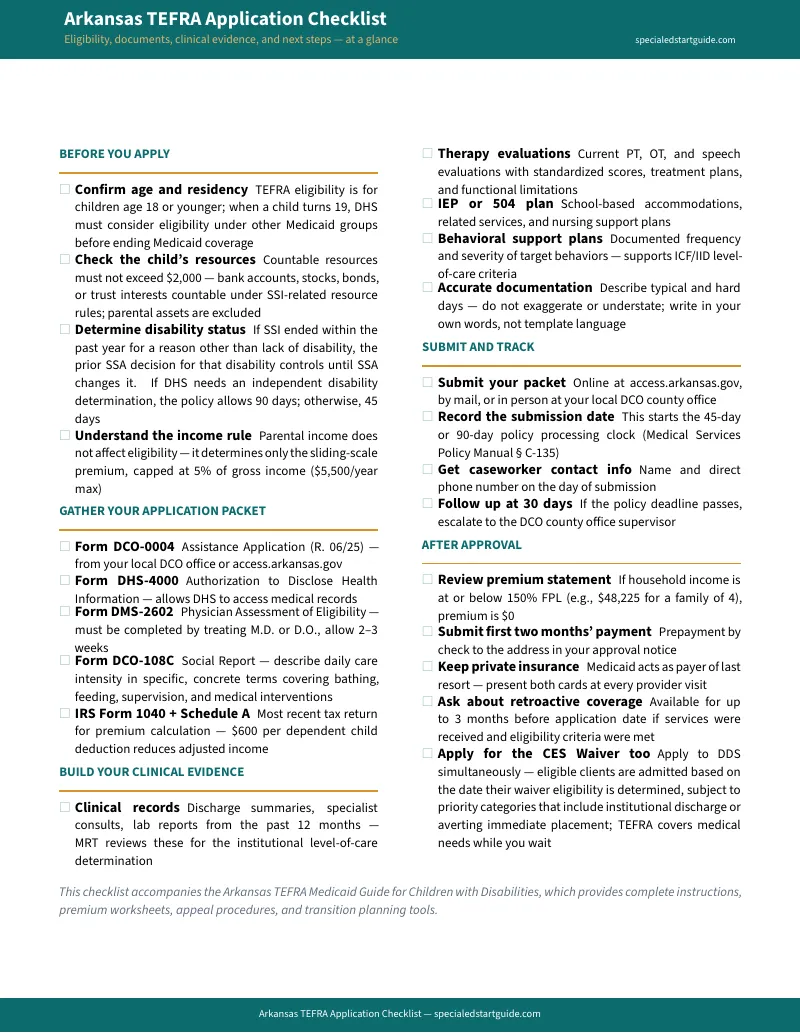
Not sure you need the full guide yet? Start with the free Arkansas TEFRA Application Checklist — a one-page summary of the required documents, eligibility rules, and key contacts including the DHS Division of County Operations, Disability Rights Arkansas, and The Center for Exceptional Families. Download it now, no purchase needed.
Who this guide is for
- Parents who just got a diagnosis — your child's therapist or hospital social worker mentioned TEFRA, and you need to know whether your child qualifies and how to apply without spending months on hold with the county office.
- Families hitting insurance caps — your commercial plan limits therapy visits to 30 per year, and your child needs speech, OT, or PT every week. TEFRA can serve as secondary coverage so your child doesn't lose services.
- Current TEFRA families at renewal time — the annual recertification packet arrived, your household income changed, and you need to calculate the new premium and verify your deductions before the deadline.
- Parents and young adults approaching 18 — TEFRA coverage ends on the 19th birthday, and you need a step-by-step transition plan covering SSI, adult Medicaid categories, AR ABLE, and vocational rehabilitation.
Why not just use the free resources?
You should. The DHS Division of County Operations (statewide: 1-855-372-1084), Disability Rights Arkansas, The Center for Exceptional Families, and Legal Aid of Arkansas all provide valuable free help. This guide lists each organization and its website.
What they don't provide is a single document that puts the full process — forms, evidence standards, premium calculations, renewal timelines, appeal procedures — in the order a family actually encounters them. The state publishes the rules across dozens of policy manuals. The advocacy organisations provide training and representation. This guide fills the gap in between: an organised, step-by-step self-help tool you can work through on your own schedule.
What this guide is not
This is an independently published educational resource. It does not provide legal, medical, or financial advice. It is not affiliated with or endorsed by the Arkansas Department of Human Services, CMS, or any government agency. It does not guarantee eligibility, approval, or any particular outcome. All official forms referenced in the guide are available free from DHS; the guide identifies each form and explains its role.
Full refund, no time limit. If this guide doesn't help your family, email [email protected] for a full refund.
Frequently Asked Questions
Does our household income disqualify our child?
No. Parental income and assets are completely excluded from TEFRA eligibility. Only the child's own income (up to $2,982/month) and resources (up to $2,000) are tested. Parental income is used only after eligibility to calculate the sliding-scale monthly premium. The maximum premium is $458 per month ($5,500 per year), and a family's total annual out-of-pocket cost-sharing cannot exceed 5% of gross household income.
Is there a waiting list for TEFRA?
No. TEFRA is an uncapped entitlement. Every eligible child is enrolled. The CES Waiver — a separate program for home and community-based services — has a capped waitlist (the Registry of Unmet Needs). The guide explains the difference and how both programs can run in parallel.
How long does the application take?
The standard application-disposition limit is 45 days when no disability determination is needed, or 90 days when one is required. A prior SSA decision controls for the same disability if the child received SSI within one year before applying and SSI ended for a reason other than lack of disability. Some families report real-world timelines of six to eight months. The guide covers how to track progress and escalate delays.
What if our child is denied?
You have the right to request reconsideration and a fair hearing. The guide walks through both procedures — deadlines, what additional evidence to submit, and what to expect at the hearing.
Can we have TEFRA and private insurance at the same time?
Yes. TEFRA Medicaid serves as secondary coverage behind your commercial plan. The guide includes a chapter on insurance coordination — what to tell your providers, how to handle the claims order, and what to do when retroactive TEFRA coverage creates billing confusion with previously denied claims.
Is this guide from the state government?
No. This is an independent publication. It is not endorsed by or affiliated with DHS, CMS, or any government agency. It compiles publicly available policy information into a step-by-step format with worksheets, and lists relevant official forms and support contacts.
Frequently Asked Questions
What if the rules change after I buy?
We update the guide when the rules change. Email us any time, even years later, and we'll send you the current edition free.