Children's services are ending. The council says apply for adult support. Where do you even start?
Your child is approaching 18. The letter from Children's Social Care says the case will close. You have heard about the Care Act transition assessment, but nobody has explained what it actually involves, when you should have started, or what happens if the council drags its feet.
Meanwhile, the EHCP annual review mentioned "Preparing for Adulthood" but said nothing about adult social care funding. You are not sure whether the EHCP covers your child after 18, whether the council is supposed to assess them now, or what you lose if you wait.
Free advice from SENDIASS and charities is essential — but appointments are limited, fact sheets cover the high-level rights without showing you how to build your case, and no single source puts the full Care Act transition process in the order you need it.
The Transition Evidence System: a structured path through every stage of the Care Act assessment
The England Care Act Transition Assessment at 18 Guide takes the Care Act 2014 (Sections 58–67), the Mental Capacity Act 2005, the statutory guidance, and published Ombudsman decisions, and turns them into a step-by-step process you can follow from first request to funded care plan — or through complaints and appeals if things go wrong.
This is not a summary of your rights. It is a working system: chapter by chapter, it tells you what to do, what evidence to gather, and what the council is legally required to do at each stage. Every recommendation is grounded in the statute and in real Ombudsman rulings against councils that got the process wrong.
What's inside the guide
- The four service systems explained — how Children's Social Care, Adult Social Care, Education (EHCPs), and NHS Continuing Healthcare overlap at transition, and why none of them automatically passes your child's file to the next
- When to request and the two statutory tests — the Section 58 triggers (likely need and significant benefit), the consent conditions, and what to do when the council says "too young" or "not yet"
- A referral that cannot be ignored — exactly what a strong written request must contain, where to send it, and how to track the council's response from day one
- Evidence that reflects real life — the nine wellbeing domains the assessment must cover, the "hardest day" method for describing needs accurately, and how to separate the young person's needs from the care you currently provide (the carer-blind rule)
- The young person's voice and rights — the five Mental Capacity Act principles, how capacity is assessed (a diagnosis alone never determines it), when the council must appoint a free independent advocate under Section 67, and supported decision-making frameworks
- What happens after 18 — the legal changes on the 18th birthday (parental responsibility ends), the three routes for parents who need to stay involved, benefits transitions at 16 and 18, and Court of Protection basics
- The three-stage eligibility test — how the 2015 Regulations work in practice: source of need, inability to achieve two or more of ten outcomes, and significant impact on wellbeing
- The Section 66 continuity bridge — when children's services must not stop at 18, what happens when the council tries to end them early, and a worked timeline showing how the bridge operates
- Personal budgets and direct payments — what the personal budget statement must show, eligible adult care services, what the council cannot fund, and how to manage direct payments
- Charging and means-testing — the financial assessment, the capital and income thresholds, and the absolute rule that parental income does not count
- EHCP alongside adult social care — when the EHCP runs in parallel with a care plan, when it ends, and how to navigate three systems at once including NHS Continuing Healthcare
- Complaints, Ombudsman, and Judicial Review — the formal complaint steps, what remedies the Local Government and Social Care Ombudsman can recommend, and when a Judicial Review claim must be filed
- Eight printable worksheets — a 14-day daily support log, a nine-domain wellbeing evidence worksheet, an eligibility self-mapping worksheet, a Section 67 advocacy self-assessment, a Section 66 continuity tracker, an assessment request tracker, an escalation chronology builder, and a financial assessment preparation checklist
Who this guide is for
- Parents and carers of a disabled teenager in England approaching 18, whether children's social care has mentioned transition or not
- Young adults who want to understand their own rights and lead the assessment process themselves
- Families whose council has refused or delayed a transition assessment and need to know the next step
- Anyone supporting a young person whose EHCP is about to interact with adult social care for the first time
Why not piece it together from free sources?
You could read the Care Act 2014 on legislation.gov.uk, work through 400 pages of statutory guidance, search the Ombudsman's decision database for precedents, cross-reference the eligibility regulations, and build your own tracking system from scratch. Some families do. It takes weeks, and the information is spread across government websites, charity fact sheets, and local authority portals that sometimes explain their own policies as though they were the law.
The guide does that synthesis for you. It puts every stage of the process in order, tells you what the law actually says (not what the council's internal policy says), and gives you printable tools to gather and organise your evidence before each meeting. Free advice services like SENDIASS are essential — but their appointment time is limited. The guide helps you arrive prepared so you can use that time on the questions only an advisor can answer.
Built on the law, not on opinion
Every chapter cites the specific section of the Care Act 2014 or the Mental Capacity Act 2005 it relies on. The escalation guidance draws on published Ombudsman decisions against councils that delayed or refused transition assessments. The guide is not legal advice and does not replace a community care solicitor if a dispute reaches that stage — but it gives you the structured evidence and statutory knowledge to handle the process yourself before it gets there.
Full refund, no time limit. If the guide does not help, email [email protected] for a refund — no form, no deadline.
What you get today
The full guide (14 chapters, key contacts and resources) plus eight printable worksheets and a standalone transition-assessment checklist — 10 instant-download PDFs you can read on any device or print for meetings.
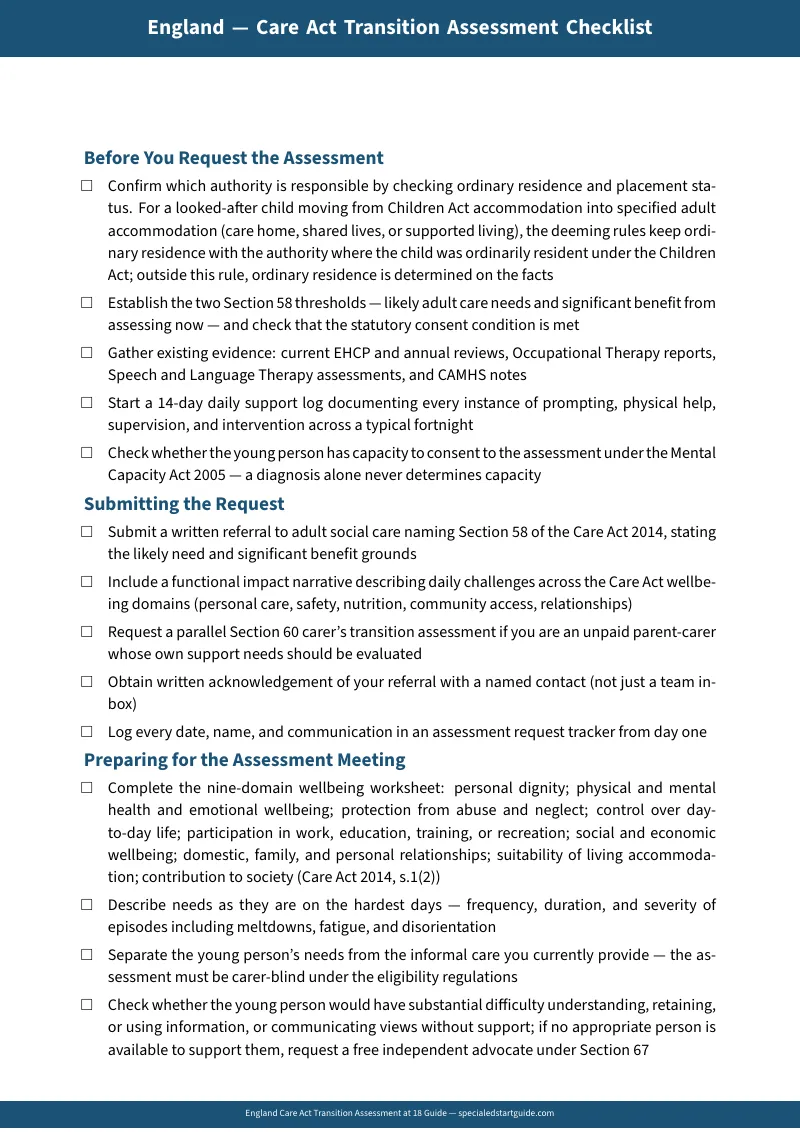
Download the free checklist to see the structure for yourself. When you are ready for the full system — the evidence worksheets, the referral framework, the eligibility walkthrough, the complaints process, and every statutory citation — the complete guide is waiting for you.
Frequently Asked Questions
What if the rules change after I buy?
We update the guide when the rules change. Email us any time, even years later, and we'll send you the current edition free.