
The School Said Your Child Is Fine. The Educational Psychologist's Report Says Otherwise. You Cannot Read the Report.
You finally got the Educational Psychologist assessment — after months of chasing, begging, and one tearful phone call to SENDIASS that went to voicemail. The report arrived as a 14-page PDF full of numbers you have never seen before. Standard Score 78. Percentile Rank 7. Scaled Score 4. Processing Speed Index 81. Working Memory at the 3rd centile. You read every word three times and understood almost none of it.
Then you sat in the school meeting and the SENCo said, "As you can see, your child is broadly within the low average range." You nodded. You did not know that a Standard Score of 78 falls below the 7th percentile — meaning 93% of children your child's age perform better. You did not know that "low average" is not a clinical classification used by any psychometric assessment. You did not know that the 22-point gap between your child's Verbal Comprehension and Processing Speed meets widely accepted thresholds for significant cognitive discrepancy. You accepted "low average" because nobody taught you the language the system uses to minimise your child's needs.
The United Kingdom SEN Assessment Decoder is the Assessment Translation System — the only guide that teaches you how to read the clinical data in EP reports, convert those numbers into legally binding demands for provision, and navigate the four different assessment frameworks operating across England, Wales, Scotland, and Northern Ireland. It does not explain what an EHCP is. It teaches you how to secure one — and how to know when the authority is using your confusion against you.
What's Inside the Decoder
The EP Report Translation Engine
A visual, plain-English breakdown of every metric used in Educational Psychology reports. Standard Scores, Percentile Ranks, Scaled Scores, T-Scores, Age Equivalents, Confidence Intervals, and the Bell Curve — explained not as abstract statistics but as weapons. You will learn that a Standard Score below 85 places a child in the "below average" classification, that below 70 is "extremely low," and that when a SENCo describes either as "nothing to worry about," they are contradicting the test publisher's own scoring manual. The decoder includes the exact phrases to use in meetings and letters when the school's interpretation of the data does not match the data itself.
The Four-Nation Assessment Comparison
England's EHC needs assessment follows a 20-week statutory timeline. Wales gives schools 35 school days for an IDP. Scotland allows 16 weeks for a Co-ordinated Support Plan — but only 0.4% of children identified with Additional Support Needs actually receive one. Northern Ireland operates a 26-week statutory assessment and is mid-transition from a five-stage to a three-stage Code of Practice. The Decoder maps every step, timeline, threshold, and decision point side by side across all four systems — so you know exactly which process governs your child, which deadlines the authority is legally bound by, and what to do when they miss them.
The Evidence Architecture
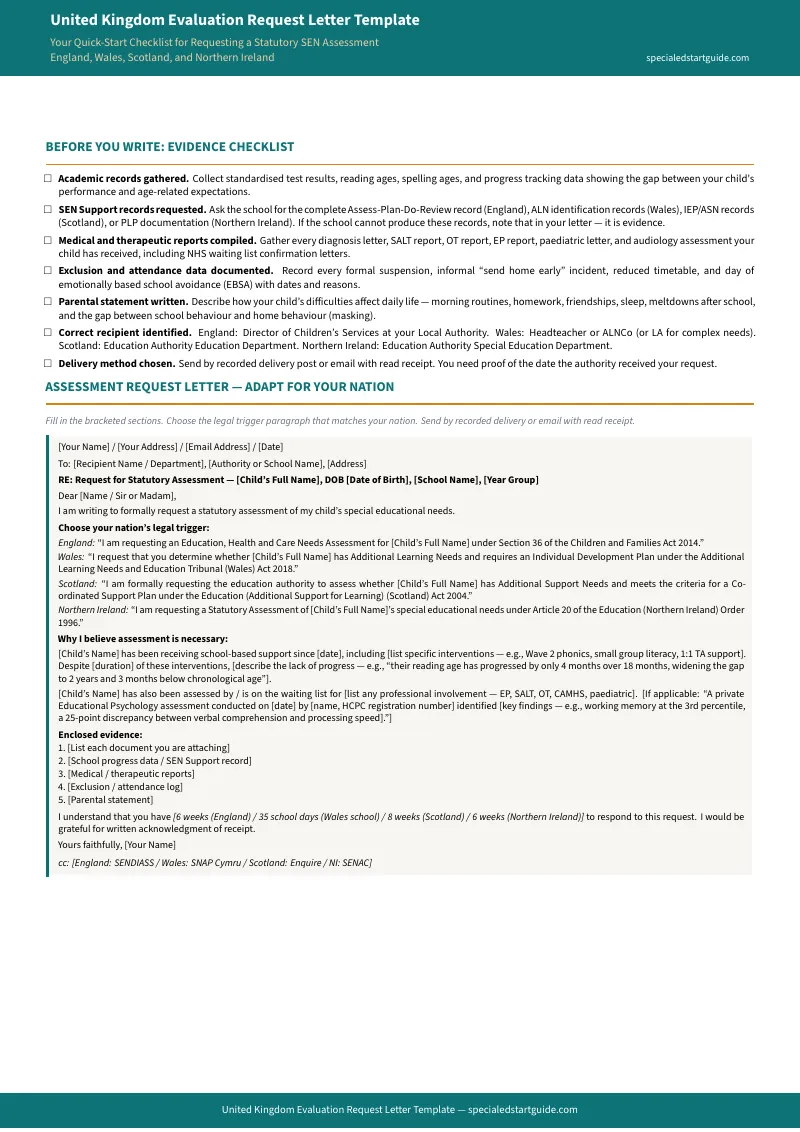
The most common reason assessment requests are refused is insufficient evidence — not because the child does not need support, but because the parent did not present the evidence in the format the authority requires. The Decoder gives you the pre-request evidence checklist: academic progress data, SEN Support records (Assess-Plan-Do-Review logs, IEP records, or PLP documentation depending on your nation), medical and therapeutic reports, exclusion and attendance records, and the parental statement structure that reframes your child's daily reality as unmet statutory need. Build this portfolio before you request, and the authority loses its most reliable grounds for refusal.
The Assessment Request Templates
Four jurisdiction-specific letter templates citing the correct legislation. England: Section 36 of the Children and Families Act 2014. Wales: the ALNET Act 2018. Scotland: the Education (Additional Support for Learning) (Scotland) Act 2004. Northern Ireland: Article 20 of the Education (Northern Ireland) Order 1996. Each template includes the legal trigger phrase that starts the statutory clock, the evidence summary format, and the follow-up structure that forces a written response. Insert your child's name, the specific difficulties, and the supporting evidence. The statutory language is already built in.
The Refusal Playbook
In England, 25.2% of EHC needs assessment requests were refused in 2024. In some local authorities, the refusal rate exceeds 60%. The Decoder explains exactly what happens after a refusal: mediation (and when to skip it), tribunal deadlines, the evidence required for appeal, and the critical distinction between a refusal to assess and a refusal to issue a plan. It includes the data showing that parents who appeal to the SEND Tribunal succeed in the vast majority of cases — and explains why authorities rely on parents not knowing this.
The Private Assessment Strategy
Private Educational Psychologists in the UK charge £670 to £800 for a full assessment. But spending that money without preparation is a gamble. Local authorities routinely deprioritise independent reports that do not follow their preferred assessment tools, do not use HCPC-registered practitioners, or do not explicitly address the statutory threshold for assessment. The Decoder tells you exactly what to verify before commissioning a private EP, how to ensure their report carries maximum legal weight, and how to force the authority to consider it — using the statutory obligation under Section 36(8) of the Children and Families Act 2014.
The Cross-Border Transfer Rules
Moving between UK nations means your child's statutory plan ceases to have legal effect. An EHCP does not transfer to Scotland. A Welsh IDP is not recognised in England. A Northern Ireland Statement has no standing in Wales. The Decoder explains the receiving nation's obligations during transition, the documents you must compile before you move, and the re-application process for each nation — with specific guidance for Armed Forces families facing mandatory postings.
Who the Decoder Is For
- Parents holding an Educational Psychologist report full of numbers they cannot interpret — who need to know whether those numbers support a legal demand for statutory assessment, or whether the school is right that everything is "within the normal range"
- Parents whose school dismissed an EP report as showing "low average ability" — who need to understand that the Standard Scores in that report may actually demonstrate clinically significant weaknesses that the school is underplaying
- Parents preparing to request an EHC needs assessment, IDP, CSP, or Statement — who need to build the evidence portfolio that survives the local authority's initial screening and triggers a statutory obligation to assess
- Parents whose assessment request has been refused — who need the appeal timeline, the tribunal route for their nation, and the data showing that most parents who appeal succeed
- Parents considering a private Educational Psychologist assessment costing £670 to £800 — who need to ensure that money is not wasted on a report the authority will dismiss on a technicality
- Military families and civilians relocating between England, Wales, Scotland, and Northern Ireland — who need the cross-border transfer playbook before the move, not after their child loses a term of provision
- Parents in Wales navigating the ALN transition — unsure whether the new IDP framework changes how assessments are requested, what evidence is required, or what happens to an old SEN Statement
- Parents in Scotland who have been told their child needs a diagnosis before the school will act — and who do not know that Scotland explicitly does not require a medical diagnosis to identify Additional Support Needs
Why Not Just Use IPSEA?
IPSEA is the gold standard for English SEND law. Their legal guides are accurate, their template letters are reliable, and their tribunal representation is outstanding. Here is what they do not do:
- IPSEA covers England only. Their website explicitly states that advice "relates to the law as it applies in England." Parents in Wales, Scotland, and Northern Ireland — or families about to relocate across a UK border — need a resource that covers all four systems. IPSEA is not that resource.
- IPSEA does not decode EP reports. Their guides explain the legal process for requesting an assessment. They do not teach you how to read the psychometric data in the assessment itself. If you cannot interpret Standard Scores, Percentile Ranks, and cognitive discrepancy profiles, you cannot challenge a school that is minimising the clinical findings.
- IPSEA provides legal information, not negotiation strategy. There is a critical gap between knowing the law and deploying it effectively in a hostile school meeting. IPSEA tells you that Section 36 gives you the right to request an assessment. The Decoder teaches you how to structure your evidence so the authority cannot legally refuse it.
- SENDIASS, SNAP Cymru, Enquire, and SENAC are at capacity. These services are chronically underfunded. Callbacks take weeks. They cannot provide the sustained, case-specific strategic support that a protracted dispute demands. This Decoder gives you the knowledge to advocate independently — and saves significant time if you do eventually need their intervention.
Free resources explain the law within one nation. The Decoder teaches you how to weaponise the clinical data and navigate the assessment process across all four.
— Less Than Thirty Minutes of a Private EP's Time
Private Educational Psychologists charge £670 to £800 for a full assessment. Independent SEND consultants charge £110 per hour. SEN solicitors bill £142 to £319 per hour. For less than half an hour of any of their time, this Decoder gives you the clinical translation tools, assessment navigation strategy, and jurisdiction-specific templates that most of those professionals would charge hundreds of pounds to explain.
Your download includes 6 PDFs — the complete 11-chapter Assessment Decoder, four standalone printable reference sheets, and the Evaluation Request Letter Template.
- Complete Assessment Decoder Guide — 11 chapters covering the assessment crisis and refusal statistics, the four-nation statutory assessment comparison (England EHCPs, Wales IDPs, Scotland CSPs, Northern Ireland Statements), the EP Report Decoder with Standard Scores and psychometric translation, the evidence-building architecture, assessment request strategy, the refusal and appeal playbook, private assessment commissioning, cross-border transfer rules, and special situations including military families, home education, and looked-after children
- EP Report Decoder Reference Card — a printable 2-page Psychometric Rosetta Stone with colour-coded Standard Score classifications, Percentile Rank conversions, Scaled Scores, T-Scores, Confidence Intervals, and Discrepancy Analysis — designed to bring alongside your child's EP report to every meeting
- Four-Nation Assessment Comparison Matrix — a 1-page side-by-side reference card covering legislation, plan types, statutory timelines, assessment thresholds, appeal tribunals, and school coordinators for England, Wales, Scotland, and Northern Ireland
- Refusal and Appeal Quick-Reference Guide — a printable 2-page guide covering tribunal routes, appeal deadlines, mediation requirements, ombudsman contacts, and the Letter Before Action structure for each UK nation
- Key Contacts Fridge Sheet — a 1-page directory of every major SEN support organisation across all four nations with phone numbers, websites, and what each service can do for your case
- Evaluation Request Letter Template — the printable evidence checklist, fill-in-the-blank assessment request letter with nation-specific legal trigger phrases for England, Wales, Scotland, and Northern Ireland, plus the follow-up checklist and appeal deadline reference
Instant PDF download. Print the letter template for your nation tonight. Send it tomorrow morning.
Money-back guarantee, no time limit. If the Decoder does not change how you read assessment data and advocate for your child's statutory rights, email us for a full refund. No questions asked.
Not ready for the full Decoder? Download the free United Kingdom Evaluation Request Letter Template — a printable evidence checklist, assessment request letter with legal triggers for all four UK nations, and the follow-up procedure. It is enough to submit a properly structured assessment request tonight, and it is free.
Your child's EP report contains the evidence. The law says the authority must assess. The Decoder teaches you how to read the evidence and enforce the law — whichever nation you live in.