The Nurse Filed the Health Plan. The School Filed It Away. This Toolkit Gives You the Enforceable Protections That Actually Follow Your Child Into Every Classroom, Field Trip, and Standardized Test.
You handed the school a letter from your child's endocrinologist, neurologist, or allergist. The nurse created an Individual Health Plan. Everyone nodded. And then your child's CGM phone was confiscated under the zero-tolerance policy. The field trip form came home requiring a parent chaperone "for medical reasons." A substitute teacher didn't know your child carries an EpiPen. The coach told your child they couldn't participate in the away game because "no one is trained to handle that."
An Individual Health Plan is a nursing document. It sits in the nurse's office. It binds no one outside that office — not the substitute teacher, not the bus driver, not the PE coach, not the testing coordinator. When the nurse is at another building, the plan is effectively invisible.
A Section 504 Plan is a civil rights protection. It binds the entire district to provide the accommodations your child needs — in every classroom, on every trip, during every test, on the bus, and in after-school programs. And your child qualifies regardless of their grades, because Section 504 protects anyone whose physical condition substantially limits a major bodily function. The endocrine system. The neurological system. The immune system.
Free templates from the American Diabetes Association and Epilepsy Foundation explain the medical condition to school staff. Etsy sells meeting prep binders for $12. None of them tell you what to say when the school refuses to train staff on nasal glucagon, claims your child "doesn't need a 504 because they're doing well academically," or insists that a parent must attend every field trip as a medical chaperone. Special education advocates who carry those tools charge $100 to $300 per hour.
The Medical 504 Plan Toolkit is the Medical Rights Enforcement System — the complete tactical framework that turns an unenforceable nursing document into a legally binding protection plan covering diabetes, epilepsy, and severe allergies. Condition-specific accommodation banks, trained-staff delegation scripts with state law references, CGM and medical device exemptions, emergency action plan checklists, and verbatim pushback responses for every institutional excuse — across the US, UK, Canada, and Australia.
What's Inside the Toolkit
The 504 vs. Health Plan Decision Framework
Most parents don't know there's a difference — because the school isn't going to explain it. This section lays out exactly what an Individual Health Plan covers, what it doesn't, and why a Section 504 Plan fills the gaps that leave your child exposed during nurse absences, staff changes, field trips, and standardized testing. Side-by-side comparison of legal enforceability, who is bound, what happens when the plan is violated, and how to request the conversion. Equivalent frameworks for the UK (IHP vs. EHCP escalation), Canada (provincial medical accommodation plans), and Australia (Disability Standards for Education adjustments under the NCCD).
Condition-Specific Accommodation Banks
Not a generic list of "preferential seating and snack breaks." Three complete accommodation banks — one each for type 1 diabetes, epilepsy, and severe allergies — with pre-written, customizable language ready to paste directly into a 504 Plan. The diabetes bank covers CGM and insulin pump access, trained staff for glucagon and insulin administration, blood sugar check timing, snack and hydration access, nurse absence coverage, and academic protections during hypo/hyperglycemic events. The epilepsy bank covers seizure action plans, post-ictal recovery protocols, rescue medication delegation, PE and water safety modifications, cognitive recovery testing accommodations, and substitute teacher notification requirements. The allergy bank covers cafeteria and classroom allergen management, field trip food safety, classroom party protocols, science experiment restrictions, trained staff for epinephrine administration, and post-reaction recovery procedures.
Trained Staff Delegation Scripts
When the school says "only a nurse can give that medication," the law in most states says otherwise. This section provides copy-paste request letters requiring the district to train designated non-nursing staff to administer insulin, glucagon (including Baqsimi nasal spray), seizure rescue medication (Nayzilam and Valtoco nasal sprays), and epinephrine (including neffy nasal spray). Each letter references the applicable delegation authority — because the pushback dissolves when the parent cites the specific statute that permits trained layperson administration. Includes a summary table of US state medication delegation laws and equivalent UK, Canadian, and Australian frameworks.
CGM, Insulin Pump, and Medical Device Protections
School-wide cell phone bans are the single most common threat to diabetes management in schools today. This section provides specific accommodation clauses that exempt continuous glucose monitors, automated insulin delivery system receivers, and seizure detection applications from zero-tolerance device policies. The language establishes that these are medical devices, not personal electronics — and that confiscating them creates a direct physical safety risk. Includes template emails for requesting the exemption and escalation language when the district claims the policy "applies equally to all students."
Emergency Action Plan Checklists
Condition-specific emergency protocols designed to be attached directly to the 504 Plan — so every adult in the building knows their role without relying on the nurse being present. Hypoglycemia response (mild, moderate, severe — including when to use Baqsimi). Hyperglycemia response with ketone monitoring protocols. Seizure response with post-ictal recovery steps, including when to administer rescue medication and when to call emergency services. Anaphylaxis response with epinephrine administration steps, second-dose timing, and post-reaction observation requirements. Each checklist names the specific trained staff members responsible and their backup sequence.
Field Trip, Transportation, and Extracurricular Access
"A parent must attend as medical chaperone" is the single phrase that effectively excludes children with medical conditions from school life. This section provides enforceable accommodation language that eliminates mandatory parent chaperoning by requiring the school to send trained staff on every trip and bus route. Covers overnight trips, sports teams, after-school clubs, and summer programs. Includes the legal basis for equal access — because Section 504 doesn't protect your child only inside the classroom.
Testing and Attendance Protections
A blood sugar of 55 during a standardized test doesn't just feel bad — it impairs cognitive function in a way that makes the score meaningless. A seizure followed by three days of post-ictal recovery isn't truancy. This section provides accommodation language for blood sugar checks during exams, snack and hydration access during testing, extended time during medical events, makeup testing after seizures or allergic reactions, and attendance protection clauses that prevent medical absences from triggering truancy consequences or loss of course credit.
The Pushback Script Library
Five fill-in-the-blank scripts for the institutional language schools use to deny medical accommodations. When they say "a parent must attend the field trip" — you invoke the equal access requirement. When they say "the phone policy applies to everyone" — you explain why a CGM receiver is a medical device, not a phone. When they say "there is no nurse for transportation or field trips" — you request trained backup staff. When they say "an IHP is already in place" — you cite the 504 procedural safeguards that a health plan does not provide. When they say "staff can't administer medication" — you cite the state's delegation law. Each script includes the specific legal citation that transforms a request into a requirement. Academic-performance denials ("grades are fine") are covered in the eligibility chapter with the OCR-aligned language to take to the meeting.
Co-Occurring Conditions Chapter
Children rarely have just one condition. Diabetes with celiac disease means the cafeteria plan needs to address both blood sugar and gluten. Epilepsy with asthma means the PE modification plan needs to account for both seizure triggers and respiratory limits. Severe allergies with exercise-induced anaphylaxis means sports accommodations need a protocol that most coaches have never seen. This chapter shows you how to build a unified 504 Plan that covers every condition your child lives with — so nothing falls through the gap between two separate nursing files that were never designed to talk to each other.
Cross-Jurisdiction Legal Reference
One toolkit, four legal systems. US families work through Section 504 of the Rehabilitation Act and the ADA. UK families work through the Supporting Pupils with Medical Conditions statutory guidance, with an EHCP path when complex special educational needs coexist. Canadian families navigate provincial medical accommodation policies that vary by province and school board. Australian families use the Disability Standards for Education 2005, with adjustments tracked under the NCCD framework. A terminology glossary maps equivalent concepts — 504 Plan, IHP, IHCP, reasonable adjustments — so the advocacy strategies work regardless of where you live.
Dispute Escalation Roadmap
When the school won't move, you need to know exactly where to go next — and most parents don't, which is why schools count on the request dying at the principal's desk. This section maps the escalation path from informal written request through formal district complaint, OCR Section 504 complaint (US), Local Government Ombudsman referral (UK), provincial complaint mechanisms (Canada), and disability discrimination complaint (Australia). Each step includes the documentation template and the specific trigger that tells you it's time to escalate.
Who This Toolkit Is For
- Parents of a child with type 1 diabetes, epilepsy, or life-threatening food allergies who have an Individual Health Plan from the school nurse — but no enforceable protections when the nurse is absent, a substitute is covering, or the class goes on a field trip
- Parents whose child's CGM phone, insulin pump receiver, or seizure detection app has been confiscated or restricted under a school-wide device ban
- Parents told they must attend field trips, sports events, or bus rides as a medical chaperone — effectively excluding their child from anything the parent can't attend
- Parents whose child has been told "you don't qualify for a 504 because your grades are fine" — as though Section 504 only protects students who are failing
- Parents whose school claims staff "cannot" or "are not allowed to" administer glucagon, seizure rescue medication, or epinephrine — when the applicable delegation law says otherwise
- Parents of a child with multiple conditions — diabetes and celiac, epilepsy and asthma, allergies and exercise-induced anaphylaxis — whose accommodation plans address each condition in isolation
- Parents in the UK working with an Individual Healthcare Plan who aren't sure whether an EHCP is the right next step when the IHP isn't being followed
- Parents who have priced special education advocates at $100 to $300 per hour and need to handle this themselves — at least for the initial 504 request
Why Not Free Resources?
Free resources from major medical foundations are clinically excellent. They are also designed to educate schools, not to equip parents for the moment the school says no. Here is where each one stops short:
- The American Diabetes Association's Safe at School campaign provides model 504 plans, DMMP templates, and state medication law summaries — but it is written as a legal reference, not a parent action toolkit. The ADA tells you that your child has a right to a trained staff backup. It doesn't give you the email template to request one, or the escalation script when the district says the budget doesn't allow it. The toolkit converts the ADA's legal standards into copy-paste parent communications.
- The Epilepsy Foundation provides seizure action plans, first aid training posters, and school nurse protocols — but focuses almost entirely on the clinical emergency. It covers what to do during a seizure. It doesn't cover what to do about the three school days missed during post-ictal recovery, the testing accommodations your child needs when cognitive function is impaired after a seizure cluster, or the PE modifications required when certain activities are seizure triggers. The toolkit covers the academic, attendance, and extracurricular protections that sit outside the clinical response.
- FARE (Food Allergy Research & Education) provides cafeteria safety protocols and allergen mitigation guidelines — but offers minimal advocacy tools for when the school refuses to train staff on epinephrine. FARE tells the school what it should do. The toolkit tells you what to say when the school won't do it.
- Breakthrough T1D (formerly JDRF) provides introductory school kits and teacher awareness materials for newly diagnosed families — but these are onboarding guides, not enforcement tools. They help a cooperative school understand your child's condition. They don't help you when the school is cooperative in principle but refuses specific accommodations in practice.
- Etsy sells meeting prep binders, accommodation checklists, and fillable PDF templates for $5 to $15 — designed for organization, not advocacy. These products help you show up to the meeting with a neat folder. They do not provide the verbatim response when the coordinator says your child's phone policy exemption would "set a precedent they can't allow," or the specific state law that permits non-nursing staff to administer nasal glucagon.
Free resources explain the medical condition to the school. This toolkit gives you the exact accommodation language, legal citations, and pushback scripts for when the school understands the condition but refuses to act on it.
— Less Than Thirty Minutes of an Advocate's Time
Professional special education advocates charge $100 to $300 per hour. A single records review and meeting preparation session costs more than this entire toolkit. A legal retainer for a Section 504 complaint can exceed $5,000. This toolkit provides the same accommodation banks, request templates, and negotiation frameworks those professionals use — so you can establish the medical protections your child needs without paying professional fees for a process most families can handle themselves.
Your download includes the complete guide plus standalone printables you can use immediately:
- Medical 504 Plan Toolkit (guide.pdf) — 14 chapters, 49 pages, covering 504 vs. IHP comparison, condition-specific accommodation banks for diabetes, epilepsy, and severe allergies, trained staff delegation with state law summaries, CGM and medical device protections, emergency action plan checklists, field trip and extracurricular access, testing and attendance protections, pushback scripts, co-occurring conditions, cross-jurisdiction legal reference (US/UK/CA/AU), dispute escalation, worksheets, and resources
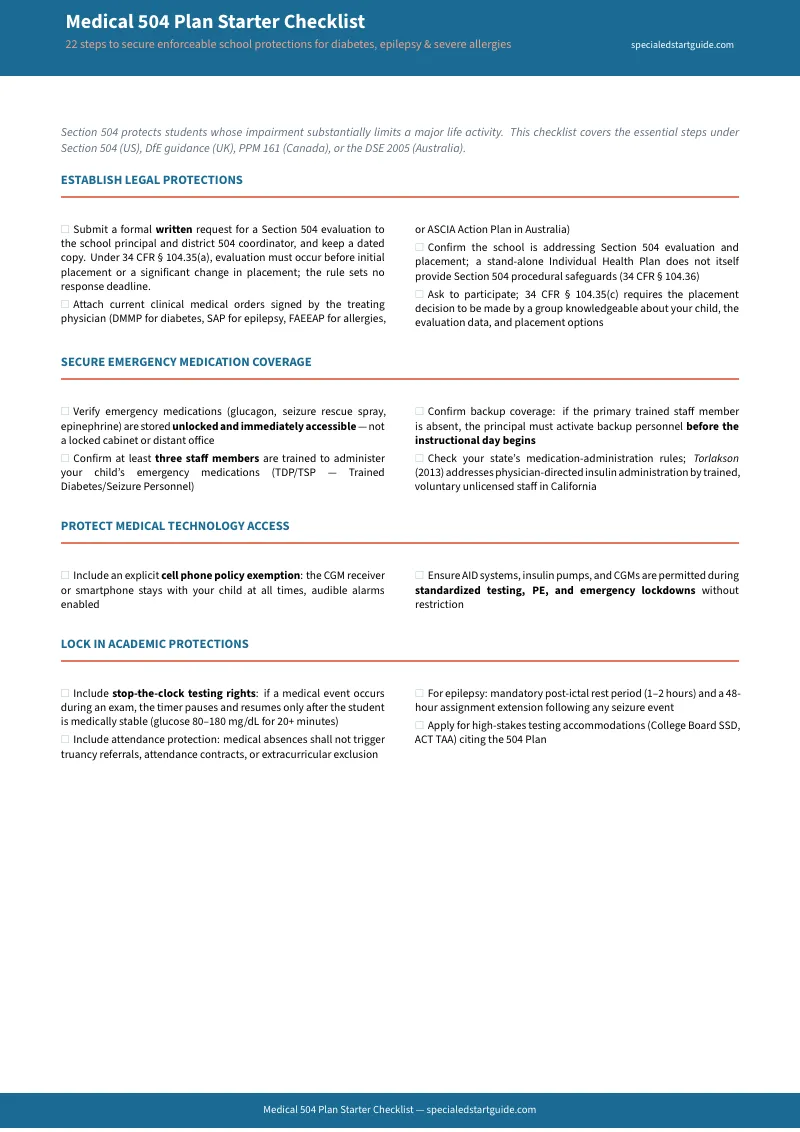
- Medical 504 Plan Starter Checklist (checklist.pdf) — two-page printable of the 22 protections, trained-staff questions, and emergency plan elements to request at your first meeting
- 504 Plan Request Letter (504-plan-request-letter.pdf) — fill-in letter to the principal and 504 coordinator
- Accommodation Bank Worksheet (accommodation-bank-worksheet.pdf) — check-the-clauses sheet to paste into the plan
- 504 Meeting Preparation Checklist (504-meeting-preparation-checklist.pdf)
- Emergency Medication Location Log (emergency-medication-location-log.pdf)
- Agency Communication Log (agency-communication-log.pdf)
- Accommodation Compliance Tracker (accommodation-compliance-tracker.pdf)
- Pushback Script Library (pushback-scripts.pdf) — five fill-in emails
- Emergency Action Plan Checklists (emergency-action-plan-checklists.pdf) — diabetes, seizure, and anaphylaxis fill-in protocols
Full refund, no time limit. If the toolkit doesn't give you the tools you expected, email [email protected] and we'll refund you immediately.
Get the Medical 504 Plan Toolkit →
Already downloaded the free checklist? Get the full Toolkit →