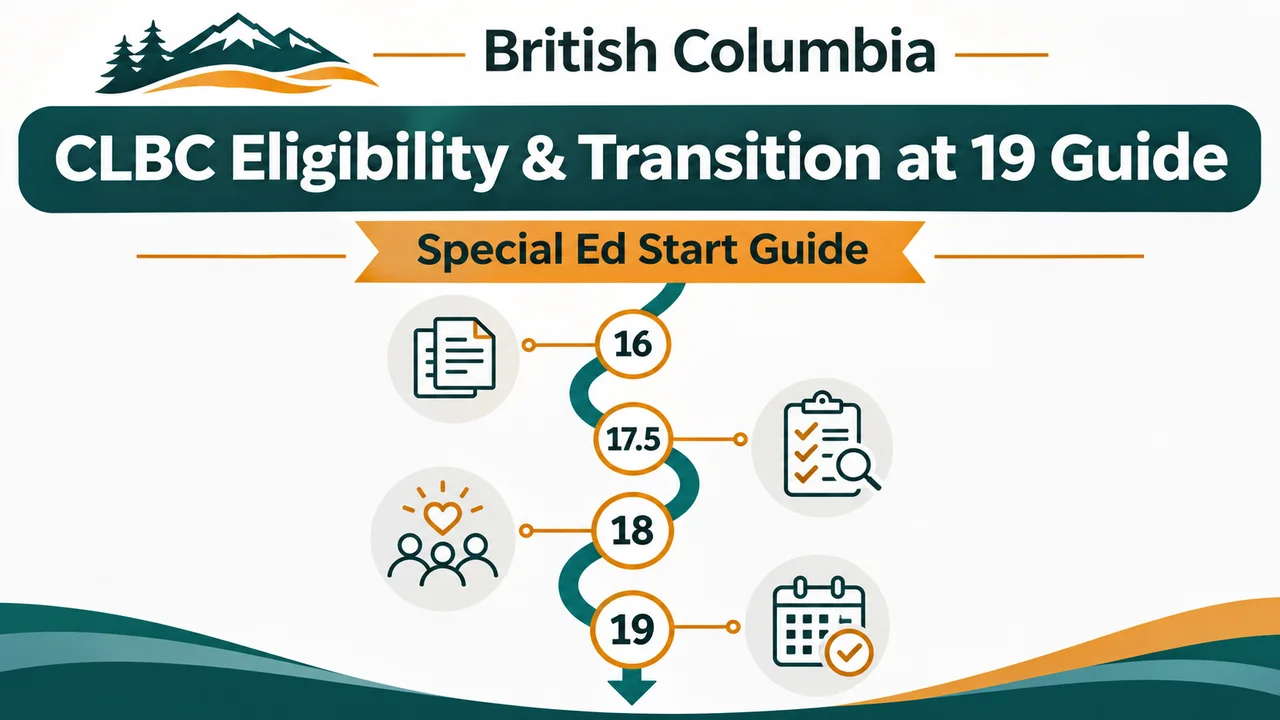
Child and adult supports change at different ages. The adult system doesn't pick up where they left off.
In British Columbia, At Home medical benefits end on the last day of the month in which a youth turns 18, and public-school eligibility continues through the end of the school year in which a student turns 19. During the transition to new CYSN benefits and services, current supports remain in place until each family is transitioned. CLBC adult supports require a separate eligibility process and are available to eligible adults from age 19.
Most families hear about this transition once, in a school meeting, and are left to piece together the rest from scattered ministry websites, overloaded community navigators, and parent forums. The administrative burden is real: coordinating psycho-educational assessments, adaptive-behaviour evaluations, Persons with Disabilities applications, Representation Agreements, and CLBC intake documents across separate organization websites, each with its own forms, timelines, and vocabulary.
The Cross-Ministry Transition Binder
The British Columbia CLBC Eligibility and Transition at 19 Guide is an independent administrative workbook that puts the entire multi-year transition process in one place. It connects the four agencies families need to navigate — MCFD, CLBC, MSDPR, and your regional Health Authority — into a single, sequential workflow from the first application at age 16 through funded adult services.
This is not a motivational pamphlet or a collection of government links. It is a structured binder that maps every milestone, every piece of evidence the reviewers look for, and every step in the complaints process if something goes wrong — so your family can prepare thoroughly and use limited meeting time with government navigators effectively.
What's Inside
- Both eligibility streams in plain language — the Developmental Disability stream (IQ threshold, adaptive requirement, onset) and the Personalized Supports Initiative for ASD and FASD (the 3-standard-deviation adaptive cutoff explained with real-world functional examples, not just statistical language)
- The transition calendar from 16 to 19 — what to file at 16, what opens at 17.5, what to prepare at 18 for legal planning from 19, and what services can begin at 19, with the cross-ministry handoffs mapped month by month
- An evidence audit framework — how to check your existing psycho-educational assessment and adaptive reports against what CLBC actually requires, so you catch gaps before submission rather than during a request for additional documentation
- The Guide to Support Allocation explained — how the GSA evaluates disability-related needs across ten daily living domains, how the Service Request Tool prioritises funding, and how to present your family's authentic daily support needs without under-reporting
- Services and funding after approval — residential supports, community inclusion, employment-first programs, individualized funding, respite, and how the Request for Service List works
- Representation Agreements and legal planning — Section 7 and Section 9 agreements explained for families, why supported decision-making usually serves the young person better than committeeship, and links to the Nidus Personal Planning Resource Centre for self-help templates
- Complaints, reviews, and escalation — the 3-stage CLBC complaints resolution process, the Advocate for Service Quality, and the BC Ombudsperson, with guidance on what to document at each step
- The young person's voice throughout — self-advocacy prompts and goal-planning sections designed for the young adult, not just the parent, because under BC law the person is the central decision-maker from age 19
Who This Is For
- Parents and carers of a teenager with a developmental disability, autism spectrum disorder, or FASD diagnosis who is approaching age 19 in British Columbia
- Families whose child currently receives MCFD CYSN supports and needs to transition to adult services through CLBC
- Young adults preparing to navigate the CLBC process themselves, with or without family support
- Families in rural or remote BC where access to CLBC facilitators, STADD navigators, and qualified assessors is limited
Why Not Just Read the Government Websites?
You can. All official legislation, application forms, and policy documents are free and publicly available. The guide does not sell government forms or secret information.
What it does is solve the fragmentation problem. Right now, the information families need is split across the CLBC site, the MSDPR site, the MCFD CYSN pages, and multiple Health Authority portals — each with its own terminology, its own application process, and its own timeline. Synthesising all of that into a coherent sequence, figuring out what to file when and in what order, and making sure nothing gets missed in the handoff between agencies — that's the work this guide has already done for you.
Government navigators like STADD and community advocates like the Family Support Institute and Disability Alliance BC deliver essential free support. The Family Support Institute says connecting a family with a Resource Parent/Peer volunteer can take up to seven business days; DABC notes high demand for one-to-one advocacy assistance. The guide acts as a personal coordination binder so your family arrives at those meetings prepared, with documentation organised and questions ready.
What This Guide Is Not
This is an independently published educational resource. It is not affiliated with Community Living BC, MCFD, MSDPR, or any provincial body. It does not provide legal advice, medical diagnoses, or official eligibility determinations. Purchasing a guide cannot alter provincial funding allocations, change Service Request Tool priority scores, or move your family up a waitlist. Official applications and government navigation services are free.
Included with Your Purchase
- The full guide — 47-page PDF covering eleven chapters, from system architecture through complaints resolution
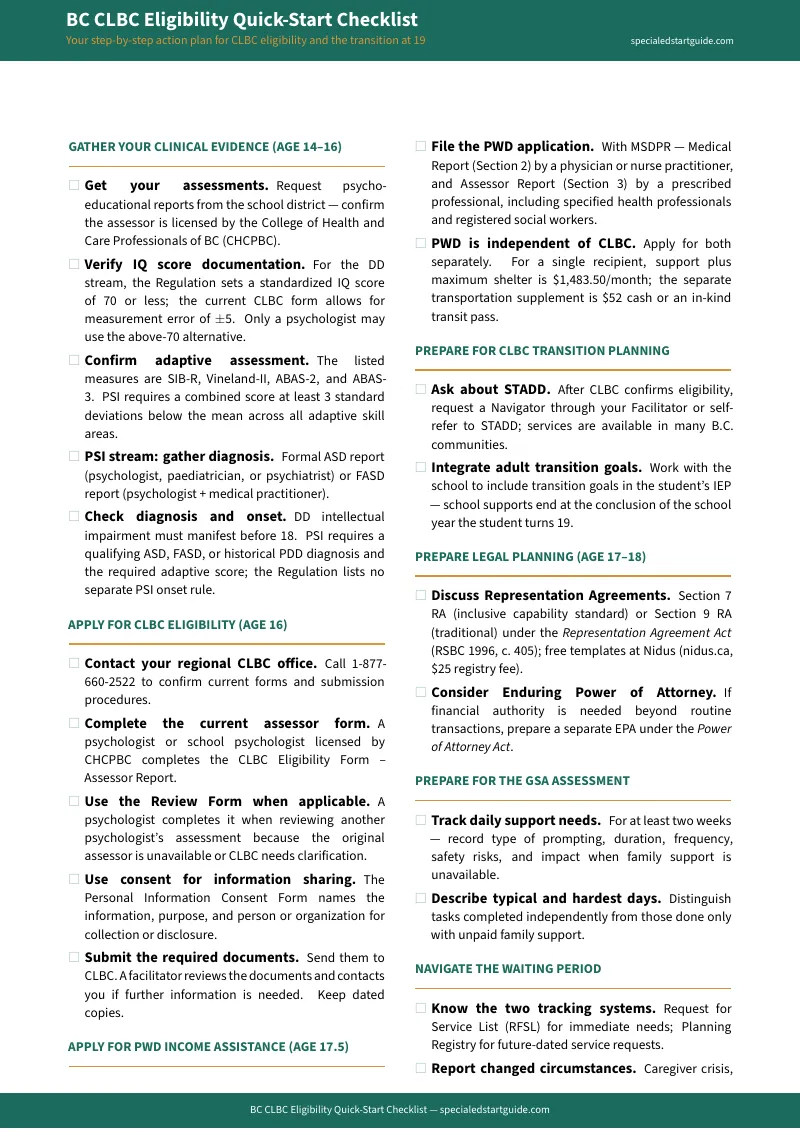
- CLBC Eligibility Checklist — a printable quick-reference of the eligibility rules, evidence requirements, and key agency contacts
- Document Tracking Checklist — one-page matrix for tracking every document across CLBC, PWD, and legal planning
- Assessment Audit Worksheet — check your existing psycho-educational and adaptive reports against CLBC requirements before submission
- Daily Living Needs Log — structured log for recording authentic daily support needs across GSA domains
- Transition Timeline Planner — year-by-year milestone tracker from age 14 to 19 across all agencies
- ISP Meeting Preparation — pre-meeting checklist covering everything to prepare before the Individual Support Plan meeting
- Agency Communication Log — running record of every contact with CLBC, MCFD, MSDPR, school district, and Health Authority staff
- Complaint Resolution Tracker — step-by-step tracking sheet for the CLBC three-stage complaints process and external escalation
- Representation Agreement Planner — decision-making guide for choosing the right legal planning instrument
Ten PDFs, one digital purchase. Download them, print the worksheets, and use them throughout the transition process.
Satisfaction Guarantee
Full refund, no time limit. If the guide doesn't help your family, email [email protected] and we'll refund you — no questions, no deadline.
Frequently Asked Questions
What if the rules change after I buy?
We update the guide when the rules change. Email us any time, even years later, and we'll send you the current edition free.