
Your child turns 18. Wyoming law treats them as a fully independent adult. What's your plan?
On that birthday, every legal right you've held since birth transfers to your child — medical decisions, financial control, educational authority, all of it. The school sent the transfer-of-rights notice. The pediatrician's office warned about HIPAA. You started researching guardianship and found attorney fees of $2,500 to $7,000, a court system that varies by county, and enough legal jargon to fill a law school course.
But most Wyoming families don't need court-ordered guardianship — and getting one in Wyoming is uniquely risky. Wyoming uses a preponderance of the evidence standard for guardianship, the lowest civil threshold in the country. That makes it easy to obtain, but it strips your child of the right to vote, marry, choose where to live, and refuse medical treatment. And it comes with the most demanding reporting schedule in the nation: written status reports filed with the court every six months, indefinitely.
The real question isn't "do we need a guardian?" It's "which combination of legal tools matches our child's actual needs?" That's the question no one walks you through.
The Virtual SDM Transition System
Wyoming hasn't enacted a formal Supported Decision-Making statute. Most national guides stop there — telling you that SDM "isn't available" in your state. But that's not the full picture. This guide is built around a practical framework we call the Virtual SDM system: a legally enforceable combination of Wyoming's existing statutory tools that achieves the goals of supported decision-making without requiring new legislation.
Instead of defaulting to court guardianship because no SDM statute exists, the guide helps you construct a tiered decision-support structure using instruments that Wyoming banks, hospitals, and schools are already legally required to recognize — starting with the least restrictive option and moving toward court intervention only when the evidence genuinely demands it.
What You Get
Fillable decision worksheets that replace guesswork with structure. The kit's Capacity Assessment Worksheet walks you through your child's capacity across five domains — medical, financial, educational, residential, and social — and the Decision-Support Comparison Planner maps each domain to the right legal tool. No more defaulting to plenary guardianship because a school administrator or well-meaning relative told you it was the only way.
The complete Durable Power of Attorney walkthrough. Since January 1, 2018, every power of attorney executed in Wyoming is durable by default under the Uniform Power of Attorney Act (W.S. § 3-9-104) — meaning it survives your child's subsequent incapacity unless the document explicitly says otherwise. The guide covers the execution requirements (signed by the principal and notarized — no witnesses required for financial POAs), the critical difference between immediate and springing authority, the capacity threshold your child must meet to sign, and what to do when a financial institution refuses to honor the document.
An Advance Health Care Directive toolkit that addresses Wyoming's specific requirements. Governed by the Wyoming Health Care Decisions Act (W.S. §§ 35-22-401 to -416), the agent designation requires the principal's signature plus either notarization or two qualified adult witnesses. The guide explains who can serve as a witness (unlike many states, blood relatives and heirs are not disqualified), who cannot (the named agent, treating providers, facility employees), and how to pair the directive with a HIPAA authorization so your child's medical team actually cooperates after the birthday.
Educational delegation decoded. After 18, your child can execute a written delegation of educational rights authorizing you to continue attending IEP meetings, signing modifications, and accessing records — without a court order. But schools don't always explain this clearly. The guide covers the delegation process, how to coordinate it with your other legal instruments, and what to do if a school district pushes back.
The representative payee alternative. Families often assume they need conservatorship to manage their child's SSI payments. They don't. The Social Security Administration has its own federal program — and it doesn't recognize state court guardianship orders as automatic authority over benefits. The guide covers the representative payee application, ongoing duties, and why this free federal designation often eliminates the need for a costly court conservatorship.
The court process, step by step — when you actually need it. If guardianship is genuinely necessary after completing the least-restrictive-alternative analysis, the guide walks you through every stage: securing the clinical evaluation, preparing the petition, the $160 filing fee ($110 county + $40 automation + $10 legal services), personal service through the county Sheriff, the Guardian ad Litem investigation, the evidentiary hearing, and receiving Letters of Guardianship. The kit's Court Filing Cost Calculator and Agency Communication Log keep every dollar and every phone call on record. No surprises at the courthouse.
Six-month reporting compliance mapped out. Guardianship doesn't end at the hearing. Wyoming's biannual status reports — the most frequent reporting schedule in the country — must be signed, written, and filed with the District Court every six months for the entire duration of the guardianship. The kit includes a fillable Guardian Status Report Tracker that organizes each reporting period as it happens, so you don't miss a deadline and trigger the automatic show-cause contempt proceedings.
Benefits protection that prevents the $2,000 trap. SSI, Medicaid, WyABLE accounts, special needs trusts, and the Community Choices Waiver each have their own rules — and one wrong move can disqualify your child from the benefits they depend on. The guide covers the WyABLE account setup ($100,000 shelter limit without affecting SSI), the SSI redetermination at 18, and how to coordinate benefits with whichever legal structure you choose.
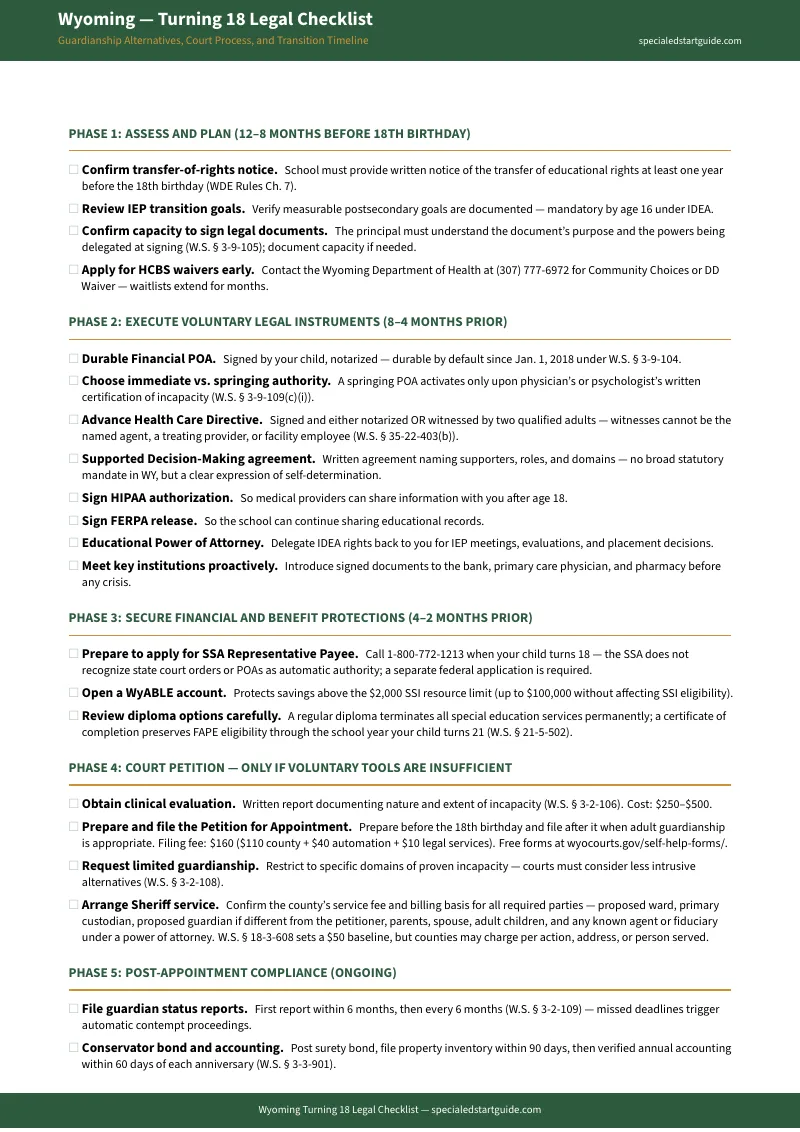
The eight-month timeline. A chronological planning sequence from eight months before the birthday (screening and planning) through the birthday itself (executing voluntary instruments) and beyond (ongoing compliance). Every deadline, every application window, every filing — in order.
Who This Is For
- Parents who received the transfer-of-rights notification and need to determine whether their child needs guardianship — or whether a combination of durable POA, advance health care directive, and educational delegation preserves their autonomy while still protecting them
- Families whose child can make many decisions independently but needs structured support with medical, financial, or educational choices — and who need that support to hold up when a hospital or bank asks for documentation
- Parents in frontier counties where the nearest disability attorney is two hours away and charges $280 to $309 per hour, who need a practical self-directed roadmap for navigating the district court or executing voluntary instruments
- Anyone who's been told "just get guardianship" and wants to understand the alternatives before committing to a process that strips civil rights and imposes biannual court reporting indefinitely
- Families navigating SSI redetermination at 18, representative payee designation, and WyABLE account setup alongside the guardianship decision
Why Free Resources Don't Solve This
The Wyoming Judicial Branch publishes free guardianship form packets. The Wyoming Protection & Advocacy System provides rights-focused information. The Wyoming Parent Information Center offers IEP training. All of these are excellent resources — but they solve different problems.
The court forms tell you how to file a guardianship petition. They don't tell you whether you should. WyP&A explains the civil rights implications of guardianship but doesn't provide a step-by-step construction guide for building the alternative. WPIC covers IEP rights but doesn't extend into probate law, medical POAs, or benefit coordination. And none of these sources synthesize the voluntary-instrument path, the court path, and the federal benefits timeline into a single planning sequence.
This guide connects every tool into one framework: the capacity assessment that determines your starting point, the Virtual SDM system that gives you non-court protection, the district court process when it's genuinely necessary, and the benefits coordination that runs in parallel. That's the integration gap — and it's the reason families end up with forty bookmarked tabs and no plan.
Satisfaction Guarantee
If the guide doesn't help you build a clearer plan for your child's 18th birthday transition, email us and we'll refund your purchase — no conditions, no time limit.
Get Started
Download the free Wyoming Turning-18 Legal Checklist to see the 22-item chronological sequence for your child's transition. When you're ready for the worksheets, decision framework, court process walkthrough, and the Virtual SDM construction guide that turns that checklist into a plan, the full guide is waiting.