The School Sent Home a Notice About Transfer of Rights. Here's What Nobody Explains Next.
Sometime before your child's 17th birthday, the school hands you DPI Forms M-7 and M-8 — the notice that under Wis. Stat. § 115.807(3), every educational, medical, and financial decision-making right you've held since birth transfers automatically to your child on their 18th birthday. No hearing, no evaluation, no grace period.
You started searching. Disability Rights Wisconsin has solid information — scattered across separate PDFs, with no chronological sequence. The Guardianship Support Center helpline can explain the statutes — but they're legally barred from helping you fill out court forms or giving individualized advice. The Arc Wisconsin offers future planning worksheets — high-level, without the county-specific procedures and GAL deposits that determine what the process actually costs. And every special-needs attorney you called quoted $2,500 to $10,000 before you even know whether court is necessary.
Here's what the fragmented resources won't tell you: guardianship is not a yes-or-no decision. Wisconsin enacted comprehensive Supported Decision-Making legislation in 2018, and circuit courts are required to consider less-restrictive alternatives before granting guardianship. Between "do nothing" and "full guardianship," there are at least six legal frameworks — SDM agreements, healthcare Powers of Attorney, financial Powers of Attorney, educational releases, Representative Payee designations, and limited guardianship — and the right answer depends on your child's specific capabilities across different life domains.
The Wisconsin Adult Guardianship & Alternatives Guide is the Transition Authority Planner — the structured decision system that walks you through the full legal authority spectrum so you choose the right framework before the birthday arrives, not after a crisis forces your hand.
What's Inside the Guide
The Capability Evaluation Worksheets
Before choosing a legal framework, you need an objective assessment — not a gut feeling, not a one-paragraph doctor's letter. The worksheets evaluate your child's decision-making across four domains: medical consent (can they understand treatment options and communicate preferences?), financial management (can they handle a bank account and avoid exploitation?), educational decisions (can they participate meaningfully in IEP and transition planning?), and residential choices (can they evaluate housing options?). Each domain maps directly to Wisconsin's available legal tools. The result tells you whether an SDM agreement resolves the need, whether layered Powers of Attorney fill the gaps, or whether the evidence points toward court.
The Chapter 52 SDM Agreement Workbook
Wisconsin's Supported Decision-Making Agreement is the least restrictive option available — your child retains full legal capacity while naming trusted supporters who help gather information, attend meetings, and communicate decisions. But execution has strict requirements: the agreement must be voluntary, in writing, and signed before either a notary or two adult witnesses who aren't the designated supporters. The workbook walks you through DHS Form F-02377 step by step — choosing life areas, defining the supporter's role, meeting the witness or notarization standard — and includes scripts for presenting the agreement to hospital administrators who've never seen one, banks that don't know what it authorizes, and school staff who confuse it with guardianship.
The Power of Attorney Toolkit
For families whose child can sign a contract but needs delegated authority in specific domains, the toolkit covers Healthcare POA (Chapter 155) and Financial POA (Chapter 244). A Healthcare POA is typically "springing" — the agent's authority activates only when two healthcare professionals certify in writing that the individual lacks capacity. A Financial POA can be structured as immediate or springing. The toolkit explains which combinations address which gaps, how to deposit a financial POA with the Register in Probate for the $8.00 safekeeping fee, and why pairing POAs with an SDM agreement creates a more complete support system than either tool alone.
The Court Process Blueprint
If guardianship is necessary, the guide maps every step of the Chapter 54 petition: filing Form GN-3100 with the county circuit court (available once the proposed ward is 17 years, 9 months old), preparing the examining physician's report (GN-3130, filed at least 96 hours before the hearing), the mandatory Act 97 guardian training through UW-Green Bay (free, self-paced), filing the training certificate (GN-3135), and the complete hearing process including the Guardian ad Litem's role and the evidentiary standard. The guide also breaks down the real costs — GAL deposits that vary from $200 in Lincoln County to $2,000 in Waukesha County, the $35 eFiling fee, and what happens to fees if the petition is denied.
The Limited Versus Full Guardianship Decision Framework
Wisconsin law requires courts to limit the guardian's authority to preserve the ward's retained rights. Under § 54.25(2)(d)1, the court must specify exactly which powers the guardian holds and which rights the individual keeps. The guide explains how to structure a limited guardianship petition that addresses only the domains where your child needs support — so a young adult who manages daily decisions well but struggles with complex medical choices doesn't lose the right to vote, manage their own bank account, or decide where to live.
The SSI Transition and Benefits Coordination Section
At 18, parental income deeming stops — some children who were ineligible during childhood qualify for SSI for the first time. The guide covers the adult SSI application, the Medicaid connection, how Representative Payee status works (the SSA has its own system and does not recognize state court guardians), the parental exemption from annual Representative Payee Reports for co-resident parents, and the critical age-17.5 window to contact the county ADRC for adult waiver screening (IRIS or Family Care). It also clarifies the subsidized guardianship confusion — explaining why Chapter 48 child welfare subsidies don't apply to Chapter 54 adult guardianships.
The Post-Appointment Compliance Calendar
Guardianship isn't a single event — it's an ongoing relationship with the probate court. The guide builds a compliance calendar covering the 60-day inventory (Form GN-3440), the April 15th annual reporting deadlines (both guardian of the person and guardian of the estate), protective placement review requirements under Chapter 55, and the process for modifying or terminating the guardianship under § 54.64 when your child's abilities develop.
Who This Guide Is For
This is for Wisconsin parents facing the 18th birthday transition — whether you're eight months out and scrambling after receiving that transfer-of-rights notice, or planning years ahead.
- You received DPI Forms M-7 and M-8 and realized you have months to figure out whether your child needs guardianship, supported decision-making, or something in between — and nobody gave you a decision framework
- Your child can make many decisions independently but struggles in specific domains, and "just get guardianship" feels like stripping rights your child doesn't need to lose
- You want to understand Chapter 52 Supported Decision-Making but need to know whether an SDM agreement is enough for your child's situation, or whether you need to layer Powers of Attorney on top
- You need to navigate the court process but guardianship attorneys quote $2,500 to $10,000, and you want to know whether court is even necessary before writing that retainer check
- Your child receives SSI and you need to prepare for the age-18 redetermination, the ADRC waiver screening at 17.5, and the Katie Beckett termination at 19
- You're worried about what happens at the hospital, the bank, or the school when your child turns 18 and you're suddenly locked out — and you want to solve that without going to court
Why Not Just Use Free Resources?
The free resources are valuable — and they're fragmented, incomplete, and not organized for decision-making.
Disability Rights Wisconsin publishes the statutory SDM form and plain-language guides explaining what supported decision-making is. But an SDM agreement is one tool on a spectrum of six+. DRW doesn't walk you through the capability evaluation that determines whether an SDM alone is sufficient, or help you coordinate it with Powers of Attorney, HIPAA releases, educational delegations, and Representative Payee designations.
The Guardianship Support Center (GWAAR) is the recognized neutral authority on Wisconsin guardianship statutes. But they're statutorily barred from giving individualized legal advice or helping you fill out specific court forms — they can explain what the law says, not what you should do.
The Arc Wisconsin provides advocacy toolkits and grassroots support networks. But the materials are designed for broad awareness, not the county-by-county GAL deposits, probate procedures, and domain-specific capability analysis that determine which legal framework your family actually needs.
County court websites list forms and fees. They don't explain why Lincoln County's $200 GAL deposit means a fundamentally different cost equation than Waukesha County's $2,000 minimum, or how the mandatory UW-Green Bay training fits into the filing timeline.
This guide takes everything these organizations publish — the statutory forms, the legal frameworks, the transition timelines — and organizes it into a structured decision sequence that starts with "what can my child do independently?" and ends with "here's the legal framework that fits, here's how to execute it, and here's how to protect benefits in the process."
Satisfaction Guarantee
Money-back guarantee, no time limit. If the guide doesn't give you a clear path forward for your child's 18th birthday transition, you get a full refund — no questions, no forms, no waiting.
The Free Checklist Gets You Started. The Full Guide Gets You Through.
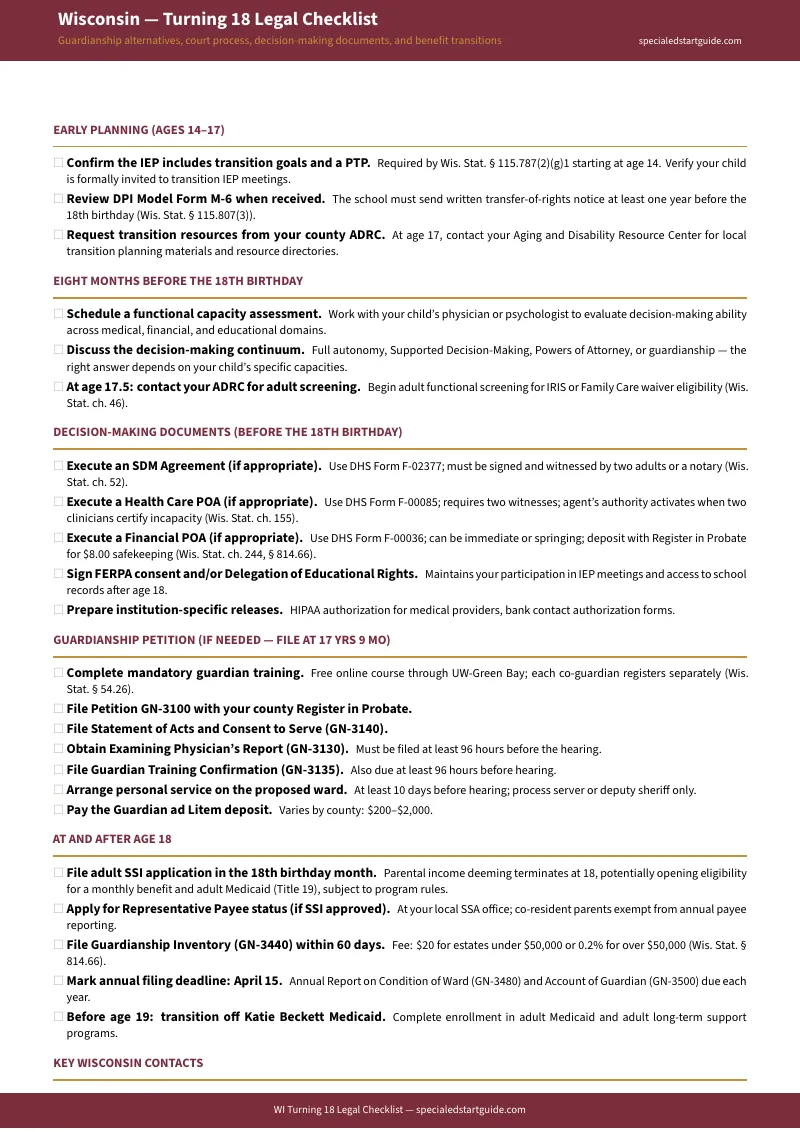
Download the free Wisconsin Turning-18 Legal Checklist — 24 items covering the full legal authority spectrum from supported decision-making through court-ordered guardianship, with key deadlines and the critical first steps every Wisconsin family should take.
When you're ready for the capability evaluation worksheets, the complete SDM workbook, the court process blueprint, and the benefits coordination framework, the full guide picks up where the checklist stops.
Get the Wisconsin Guardianship & Alternatives Guide — instant download, start the capability evaluation tonight.
Frequently Asked Questions
What if the rules change after I buy?
We update the guide when the rules change. Email us any time, even years later, and we'll send you the current edition free.