Your Child's IEP Says "Transition." Now What?
You just sat through an IEP meeting where someone used the word "transition" — and suddenly the conversation shifted from classroom goals to post-secondary outcomes, career clusters, and diploma decisions. Your child might be 14 years old. In West Virginia, that's when it starts.
The problem is that no one hands you a roadmap. The school gives you a form (Part VI: Transition Planning) and checks compliance boxes for state auditors. The Division of Rehabilitation Services has brochures about Pre-ETS. Acentra Health runs the I/DD Waiver application. The Social Security Administration handles SSI. None of these agencies talk to each other, and none of them will tell you how decisions in one system affect eligibility in another.
That coordination gap is exactly what this guide fills.
The Multi-Agency Transition System — In One Place
The West Virginia IEP Transition to Adulthood Guide is built around the specific sequence of decisions, deadlines, and agency handoffs that West Virginia families face between the first transition IEP at age 14 and the final Summary of Performance meeting before school exit. It connects the dots that no single state agency is designed — or authorized — to connect for you.
This is not a generic transition resource adapted from federal guidelines. Every form name, deadline, agency contact number, and legal citation in this guide is drawn from West Virginia Board of Education Policy 2419, the Division of Rehabilitation Services' student programs, and the Bureau for Medical Services' current waiver regulations.
What's Inside
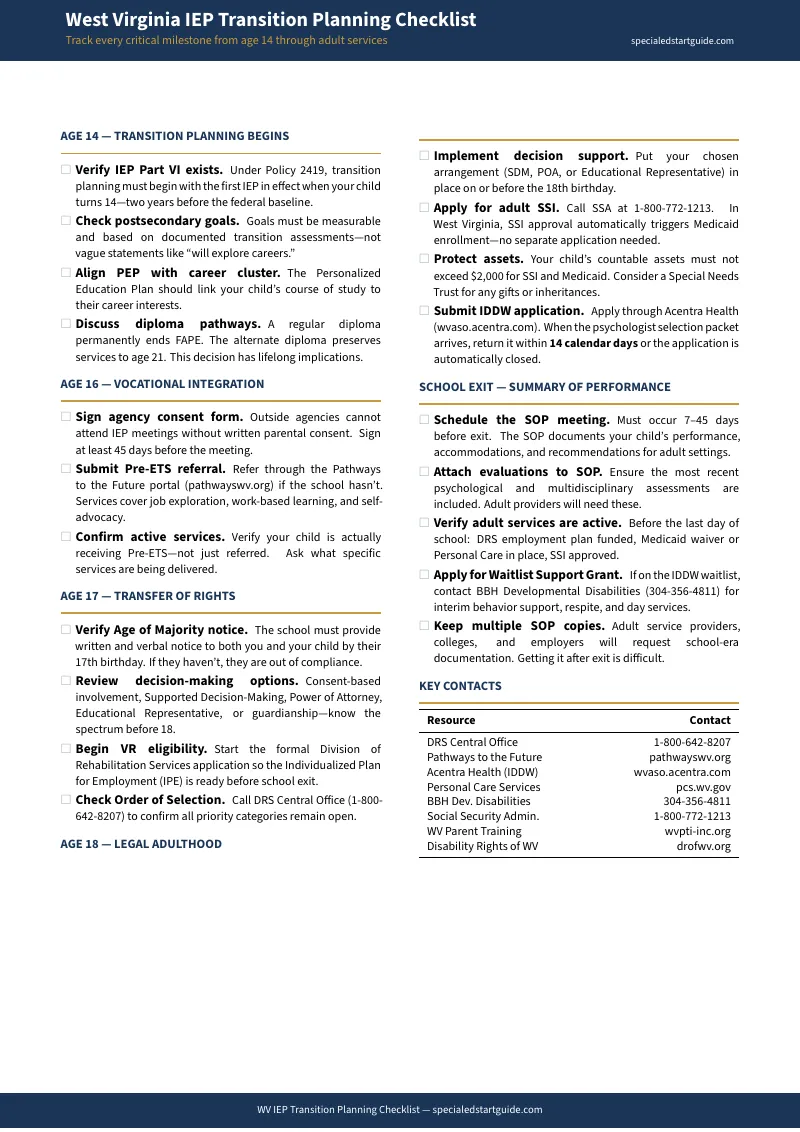
- Age-by-age transition timeline — from the Policy 2419 mandate at age 14 through FAPE eligibility end at 21, with what the school must do and what you should do at each milestone
- IEP transition goal audit — how to identify weak, checkbox-style goals that satisfy Indicator 13 paperwork but won't prepare your child for adult life, and what to request instead
- Pre-ETS and VR coordination — how to get a Division of Rehabilitation Services counselor invited to the IEP meeting, what the five mandatory Pre-ETS service areas cover, and how the Individualized Plan for Employment connects to the IEP
- Transfer of rights at 18 — what the age-17 notification letter means, how Supported Decision-Making works as an alternative to full guardianship, and how to set up school consent forms so you can stay at the table
- Diploma pathway defense — why accepting a regular high school diploma immediately and permanently terminates FAPE, how the alternate diploma preserves services to age 21, and your child's legal right to walk in the graduation ceremony under WV Code § 18-20-1(c) while continuing to receive support
- Adult services handoff — the I/DD Waiver application process through Acentra Health, the 14-day psychologist selection deadline that closes your application if missed, and how to apply for the Waitlist Support Grant for interim services while on the managed enrollment waitlist
- Special needs trusts and SSI — the $2,000 asset limit, how ABLE accounts protect savings, and how to structure finances so a gift or inheritance doesn't disqualify your child from Medicaid
- Dispute resolution options — facilitated IEP meetings, mediation, state complaints, and due process complaints, with guidance on when each option fits and how to request them
- Printable planning worksheets — transition record tracker, IEP meeting preparation form, agency notification tracker, asset and liability summary, beneficiary communication log, and dispute resolution roadmap
Who This Guide Is For
- Parents at the age-14 IEP who just learned that diploma decisions and career cluster choices are being made right now, years before high school graduation
- Families approaching the 18th birthday who received the transfer-of-rights notice and need to understand guardianship alternatives before their child's next birthday
- Parents of young adults (18–21) coordinating the handoff from school services to DRS vocational support, the I/DD Waiver, and SSI — while managing a service cliff that no one fully explained
- Rural West Virginia families navigating limited local resources, long drive times to agency offices, and waitlists that stretch for years
- Advocates and transition specialists who want a parent-friendly reference grounded in current Policy 2419 requirements
Why Free Resources Don't Cover This
West Virginia has strong free resources. The West Virginia Parent Training and Information Center (WVPTI) runs workshops. Disability Rights of West Virginia publishes a Parent's Advocacy Guide. The Department of Education posts Policy 2419 in full.
The problem isn't that information doesn't exist. The problem is that it's siloed. WVDE publishes school rules. DRS publishes vocational program details. Acentra Health publishes waiver instructions. None of them can — or will — explain how an IEP decision at age 14 affects waiver eligibility at age 18, or why accepting a diploma in May means losing services that were supposed to continue until 21.
State agencies are required to document their own compliance processes. They are not required to write cross-agency coordination guides. That structural gap means you either figure out how the systems connect on your own, hire an attorney at $250–$450 per hour, or use a guide written from an independent perspective that maps the full picture.
Satisfaction Guarantee
If the guide doesn't help you feel more prepared for your next IEP meeting, email [email protected] and we'll refund your purchase — no questions asked.
Get Started
Download the free West Virginia Transition Planning Checklist to see the milestone-by-milestone timeline. When you're ready for the full guide — with detailed chapters, agency-specific instructions, and printable worksheets — get the complete toolkit for less than the cost of 15 minutes with a special education attorney.