Your child turns 18 in a few months. Their school says "get guardianship." Their doctor says "get guardianship." And the internet gives you a 200-page legal code no one can read.
Here's what none of them mention: Washington law changed. On January 1, 2022, the state replaced its entire guardianship statute with the Uniform Guardianship, Conservatorship, and Other Protective Arrangements Act (UGCOPAA). Courts now must consider less restrictive alternatives — supported decision-making, powers of attorney, protective arrangements — before appointing a guardian. And in 2025, the Legislature extended special education services through the school year your child turns 22.
The problem isn't that guardianship exists. The problem is that it's presented as the only option, when for many families it's the most expensive, most invasive, and most permanent one on the table.
The Authority Mapping System
This guide works differently from a generic legal form packet or a single-path guardianship walkthrough. It maps every decision your family actually makes — medical, educational, financial, housing, daily life — to the least restrictive legal tool that covers it. Some families discover they need nothing more than two signed documents. Others need a limited guardianship for finances but a simple DPOA for healthcare. The guide helps you find the combination that fits your child, not the combination that's easiest for the court.
What's Inside
- Supported Decision-Making (SDM) agreements — Washington's statutory framework under RCW 11.130.740, execution requirements, and practical scripts for getting hospitals, banks, and schools to accept the document without pushback
- Durable Power of Attorney suite — financial and healthcare DPOAs under RCW 11.125, including the "plain-language assessment" approach for young adults who can choose a trusted helper but may not grasp legal terminology
- Educational Representative pathway — how to bypass the automatic transfer of educational rights at 18 under WAC 392-172A-05135 without a court order, using two professional certifications and a school-designated representative
- Age-22 FAPE entitlement — the 2025 statutory expansion that extended special education services, plus how to claim compensatory education if your student was aged out prematurely after November 2020
- SSA Representative Payee process — why a Washington guardianship order does not give you authority over federal SSI benefits, and exactly how to apply through the Social Security Administration's separate system
- Consumer Direct Washington (CDWA) caregiver pathway — step-by-step instructions for becoming your child's paid personal care provider through DDA adult services once they turn 18
- Other Protective Arrangements (OPAs) — the judicial shortcut under RCW 11.130.580 for one-time court orders (a single medical consent, a trust creation) without the ongoing obligations of a guardianship
- Limited and full guardianship process — the complete UGCOPAA petition walkthrough, filing fees ($240, with fee waiver instructions for assets under $3,000), Court Visitor preparation, the mandatory 90-day care plan, and lay guardian training requirements
- Domain-by-domain assessment worksheet — a printable seven-domain evaluation tool that maps your child's support needs to the least restrictive legal tool for each life area, producing documentation you can bring to an attorney or file with the court
- 8-month action plan — a fill-in coordinated timeline that synchronizes school, medical, benefits, and legal milestones so nothing falls through the cracks
- 7 standalone printable worksheets — domain assessment, action plan, decision-making options comparison chart, UGCOPAA court process filing checklist, Court Visitor preparation guide, Educational Representative quick reference, and SDM agreement preparation checklist
Who This Is For
- Parents whose child's 18th birthday is 6–12 months away and who need a structured plan for the legal transition
- Families told by a school, doctor, or social worker that guardianship is "required" — and who want to know what Washington law actually says
- Parents who want to protect their young adult from exploitation without stripping their right to vote, marry, or make their own choices
- Families already in the UGCOPAA process who need help preparing for the Court Visitor interview, filing annual reports, or petitioning to modify or terminate an existing guardianship
Why Not Free Resources?
Washington has excellent free guardianship resources — the courts.wa.gov Guardian Portal, Disability Rights Washington, Informing Families, and the Northwest Justice Project all publish useful information. Here's what they don't do:
- The state portal gives you mandatory court forms and lay guardian training videos, but offers zero guidance on avoiding court entirely. If your child could be served by an SDM agreement and a healthcare DPOA, the portal will never tell you that.
- Disability Rights Washington focuses on civil rights and ending guardianships — but doesn't walk you through the "how-to" of healthcare systems, benefit applications, and school procedures when guardianship isn't the answer.
- Informing Families publishes excellent transition bulletins, but they're scattered across dozens of separate PDFs with no single integrated action plan.
- The Arc of Washington offers local support and packets, but many still reference the repealed Chapter 11.88 terminology rather than the current UGCOPAA framework.
This guide integrates what all those sources cover into one step-by-step system — updated for the 2022 UGCOPAA overhaul and the 2025 age-22 FAPE expansion — and adds the decision worksheets, preparation checklists, and practical scripts that none of them provide.
Satisfaction Guarantee
If the guide doesn't help you build a clearer plan for your child's legal transition, email us at any time for a full refund. No questions, no forms, no hassle.
Start With the Free Checklist — Or Get the Full Toolkit
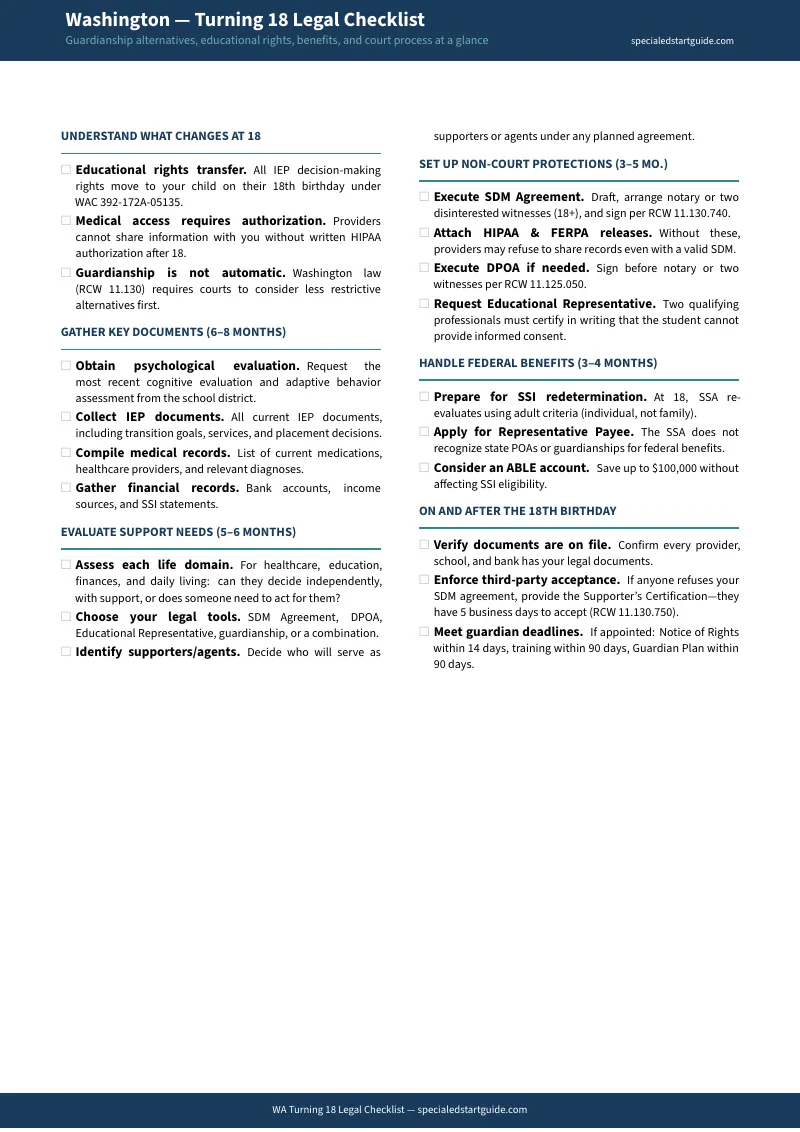
Not sure where you stand? Download the free Washington — Turning 18 Legal Checklist for a one-page overview of key deadlines and action items across educational, medical, and benefits systems. When you're ready for the complete legal pathways, assessment worksheets, and court-process walkthrough, the full guide picks up exactly where the checklist leaves off.