Your child's 18th birthday isn't just a milestone — it's a legal cliff
On that day, Virginia law presumes your child is a fully competent adult. Every right you've held — medical consent, educational decisions, financial management — transfers to a young adult who may not be ready to exercise them alone. Doctors can refuse to share information with you. Banks can lock you out. The school district can exclude you from IEP meetings.
You've been told "just get guardianship." But guardianship strips civil rights by court order. It costs thousands in legal fees. And Virginia law now requires circuit courts to consider less-restrictive alternatives before granting it. The question isn't whether to protect your child. It's whether court is even the right tool — or whether a combination of supported decision-making, powers of attorney, and administrative designations gives you the same access without removing your child's legal personhood.
The Virginia Decision-Making Authority Toolkit is a structured system that walks you through every option on the spectrum — from fully independent to fully supervised — so you can match the right legal framework to your child's actual capacity across every decision-making domain.
What makes this different from free guides and scattered state resources
DBHDS has the Supported Decision-Making Agreement template. The disAbility Law Center has advance directive toolkits. PEATC has transfer-of-rights fact sheets. Each covers one piece of a complex puzzle. None walks you through the full decision-making continuum — from supported decision-making through powers of attorney, the Educational Representative certification, limited guardianship, and full guardianship — in a single, sequenced system with the worksheets and preparation tools that connect each option to the next.
That's the gap. Not information — organization. Not what the options are — but which one fits your child, how to execute it correctly, and what happens if the first option isn't enough.
What's inside
- Decision-making continuum framework — domain-by-domain assessment worksheets for medical, financial, educational, and residential decisions, so you can document exactly where your child needs support and where they're fully capable. This assessment is what Virginia courts require before granting guardianship — completing it at home saves hours of attorney billable time.
- Complete 2021 SDM walkthrough — plain-language instructions for executing the official DBHDS Supported Decision-Making Agreement template, plus all three Discovery Tools (When Do I Want Support?, What Kind of Support Do I Want?, and Relationship Map). Includes guidance on pairing the SDMA with binding administrative tools when third parties push back, because an SDMA alone is not legally binding on third parties in Virginia.
- Educational Representative certification guide — the no-court alternative under regulation 8VAC20-81-180(D) that lets you remain involved in IEP decisions without a judge. Covers the strict 60-day evaluation window, List One professionals (MD, NP, or countersigned PA) and List Two professionals (clinical psychologist, clinical social worker, qualified adult GAL, licensed counselor), and step-by-step instructions for the VDOE certification form.
- Advance Medical Directive and POA toolkit — how to execute an AMD under the Virginia Health Care Decisions Act (two adult witnesses, no court filing required), designate a healthcare agent, and register it with ConnectVirginia for immediate hospital access. Plus the Durable Financial Power of Attorney with capacity standards that prevent institutional rejection.
- Circuit court guardianship preparation workbook — for families where court intervention is genuinely necessary. Filing the petition, the sealed medical evaluation report under § 64.2-2005, the Guardian ad Litem's investigation, the 120-day hearing timeline, filing fees, and the difference between guardianship of the person and conservatorship of the estate.
- Post-appointment compliance calendar — the DARS mandatory training within four months, the initial DSS status report within six months, annual reporting with the $5 filing fee, conservator inventory and accounting requirements, and the 2024 update allowing individuals under guardianship to request modification through an informal letter to the court.
- SSA Representative Payee process guide — how to manage SSI or SSDI benefits without court-ordered conservatorship, because the SSA does not recognize state-level guardianship orders for managing federal benefits. A free alternative that many families pursue unnecessarily through court.
Who this is for
Virginia parents whose child's 18th birthday is approaching — whether you're eight months out and feeling urgent, or planning years ahead from the age-14 transition planning window.
- Your child can make many decisions independently but struggles with financial management or complex medical choices — you need a legal framework that protects without overriding their autonomy
- You've been told "just get guardianship" but suspect a less-restrictive alternative would better serve your child's dignity and developing independence
- The VDOE Educational Representative certification sounds right, but the List One/List Two professional requirements and 60-day timing window are confusing
- You want an Advance Medical Directive so doctors will talk to you in an emergency, but your child's capacity to execute one is uncertain
- You've priced guardianship attorneys at $1,500 to $10,000 and want to know whether court is even necessary before spending billable hours
- Your child receives SSI and you need to understand Representative Payee designation vs. conservatorship — and why the SSA handles benefits separately from state courts
Why free resources aren't enough
DBHDS provides the official SDMA template — but an SDMA is one tool on a spectrum, and it's not binding on banks, schools, or hospitals acting alone. The disAbility Law Center has advance directive toolkits — but they're advocacy-focused, not structured for family self-help planning. PEATC explains the transfer of rights — but doesn't connect it to the broader guardianship decision. Private attorneys offer consultations — at $200 to $500 per hour before you've done the capacity assessment that determines whether you need a lawyer at all.
Each source covers its own lane. None walks you through the entire decision-making authority continuum in sequence, with the worksheets that connect each option to the next and the preparation tools that let you walk into a legal consultation — if you need one — with an organized case file instead of a stack of questions.
The guarantee
If the guide doesn't give you a clear path forward for your child's 18th birthday transition, you get a full refund, with no time limit. No questions, no forms.
Two ways to start
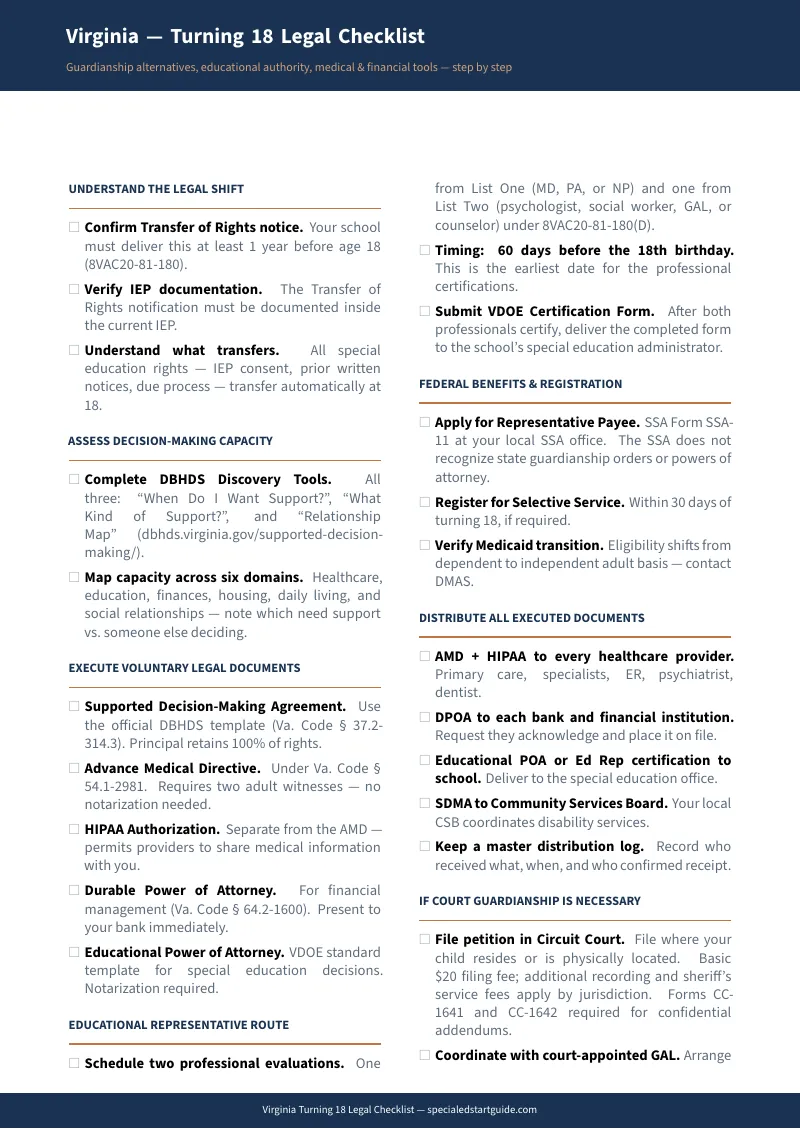
Free: Download the Virginia — Turning 18 Legal Checklist — a 26-item chronological guide covering the legal authority spectrum from supported decision-making through full guardianship, with key deadlines and first steps.
Full toolkit: Get the complete Virginia Adult Guardianship & Alternatives Guide — the decision-making continuum framework, all the worksheets, the SDMA walkthrough, the Educational Representative certification guide, the AMD and POA toolkit, the circuit court preparation workbook, and the post-appointment compliance calendar. For less than a single hour of attorney consultation time, you get a structured system that covers the full spectrum.