Your child turns 18 in Virginia. Four agencies start four separate clocks. Nobody hands you the order of operations.
The SSA sends a redetermination letter that re-evaluates your child under adult disability standards — standards that deny roughly one in three applicants who qualified as children. Virginia is not an auto-enrollment state for Medicaid. Although the General Assembly has directed DMAS to implement a Section 1634 agreement that would automate SSI-to-Medicaid enrollment, the system changes have been delayed in the state budget until fiscal year 2028. In 2026, you must file a separate Medicaid application through CommonHelp, Cover Virginia, or your local DSS — and most families discover this only after a gap in coverage has already opened. Meanwhile, Virginia's developmental disability system operates three separate HCBS waivers through a local Community Services Board pipeline with a statewide waiting list exceeding 15,000 people, and slot allocation is driven by functional urgency scores — not by how long you have been waiting. And your child's legal decision-making rights transfer on their 18th birthday whether you have evaluated supported decision-making, power of attorney, or guardianship or not.
The free resources are real. The Arc of Virginia publishes waiver fact sheets. Moms in Motion provides parent-to-parent CSB navigation guidance. DBHDS maintains waiver information pages. DARS handles vocational rehabilitation and the Auxiliary Grant. But each resource covers its own program in isolation. None of them gives you the full sequence — what to file first, which applications depend on which approvals, what to submit proactively before a coverage gap opens, and what forms you need for each step.
That sequencing gap is where families get hurt. Not from bad advice — from incomplete advice delivered one agency at a time.
The Transition Sequencing System — Every Agency, Every Form, Every Deadline in Order
The Virginia SSI at 18 & Adult Disability Benefits Guide is a 19-chapter process manual that organizes four agency systems into a single chronological workflow. It does not replace the individual agency resources — it connects them into the sequence that prevents gaps.
Where free resources explain what each program does, this guide maps which steps to take when, which applications depend on which outcomes, and what to file before a deadline you didn't know existed closes.
What's Inside
- The SSI age-18 redetermination walkthrough — the adult disability standard that replaces childhood criteria, what functional evidence you need to compile from school IEP records, psychological evaluations, and medical files, the 60-day reconsideration deadline that most families learn about after it passes, and the full four-level appeal process with the critical 10-day aid-paid-pending window that preserves both cash benefits and Medicaid while your case is reviewed
- Virginia's separate Medicaid application — why SSI approval does not automatically grant Medicaid (the Section 1634 agreement is delayed until FY 2028), exactly how to file through CommonHelp or your local DSS, and how to avoid the coverage gap that catches most Virginia families off guard
- The three DD waivers decoded — Building Independence for adults needing light, non-24/7 supports; Family and Individual Supports for individuals living with family who need moderate community services; Community Living for individuals requiring 24/7 residential support — including the legislative addition of new waiver slots being phased in quarterly for FY 2027–2028
- The CSB screening pipeline — step by step — how your local Community Services Board conducts the VIDES assessment, the adult requirement of substantial limitations in at least three of eight life-activity categories, how the Critical Needs Summary determines your priority level, how Waiver Slot Assignment Committees allocate Priority One slots, and what bridge supports are available through the IFSP while you wait
- DAC benefits on a parent's work record — eligibility when a parent retires, becomes disabled, or passes away, the before-age-22 onset requirement, how DAC interacts with SSI, and why the Social Security Fairness Act's 2025 repeal of WEP and GPO means Virginia public employees (teachers, state workers, first responders) and their dependents now receive full, unreduced benefits
- Section 1634(c) Medicaid protection — the federal provision that requires Virginia's DMAS to disregard DAC income increases and maintain Medicaid waiver eligibility when your child transitions from SSI to DAC
- SSI income rules and work incentives — the Student Earned Income Exclusion, the standard earned income formula, Section 1619(b) Medicaid continuation, and Virginia's Medicaid Works Buy-In for working individuals with disabilities
- In-kind support and the PMV rule — the September 2024 change that permanently removed food from ISM calculations, why shelter still triggers the Presumed Maximum Value reduction, and how to establish a fair-share room and board agreement that legally eliminates the shelter penalty
- ABLEnow accounts and special needs trusts — Virginia's ABLE program, the $100,000 SSI resource disregard, the ABLE-to-Work additional contribution, Virginia's elimination of state Medicaid payback claims, and how trusts complement ABLE for amounts exceeding the contribution limits
- The Auxiliary Grant program — Virginia's state-and-locally funded supplement for room and board at licensed assisted living facilities and adult foster care homes, the 2026 rates by region, the Personal Needs Allowance, and pending legislative proposals to raise the statewide rate
- The Long-Term Care Medicaid income standard — the 300% FBR limit, why Virginia's medically needy spend-down means no Miller Trust is needed, and the patient pay obligation
- Decision-making authority — the full spectrum — supported decision-making, representative payee designation, power of attorney, conservatorship, and guardianship — how each option works in Virginia, which ones preserve the most autonomy, and how to choose the least restrictive option that fits your young adult's needs
- Employment transition through DARS — vocational rehabilitation referral, Pre-Employment Transition Services while still in school, the Individual Plan for Employment after exit, and the Employment Services Organization network
- The multi-year timeline from age 17 to 19+ — every application, referral, and deadline mapped across all agencies in chronological order, so you can see what to file this month and what to prepare for next year
- Key numbers and contacts reference sheet — every agency phone number, online portal, and form reference in one section — SSA, DMAS, DBHDS, DARS, your local CSB, DSS, and ABLEnow
Printable worksheets included with the download (fill these in and carry them to appointments):
- pre-application-dossier-checklist.pdf — Document Organization Checklist
- ssi-redetermination-checklist.pdf — SSI Age-18 Redetermination Checklist
- medicaid-filing-checklist.pdf — Virginia Separate Medicaid Filing Checklist
- vides-preparation-worksheet.pdf — VIDES Preparation Worksheet
- room-and-board-agreement.pdf — Room and Board Agreement Worksheet
- ablenow-account-tracker.pdf — ABLEnow Account Tracker
- transition-timeline-worksheet.pdf — Multi-Year Transition Timeline
- decision-making-comparison.pdf — Decision-Making Options Worksheet
- agency-contacts-card.pdf — Key Numbers and Contacts Reference Sheet
- agency-communication-log.pdf — Agency Communication Log
Who This Guide Is For
Virginia parents and guardians of young adults with intellectual or developmental disabilities who are approaching, currently navigating, or recently past the age-18 transition — and who need the full sequence of steps across SSA, DMAS, DBHDS, DARS, and ABLEnow in one place.
- You received the SSA's age-18 redetermination letter and are not sure what "adult disability standards" means for your child's current SSI eligibility
- You were told to "contact your local CSB" but nobody explained the multi-step pipeline — VIDES screening, Critical Needs Summary, priority assignment, Waiver Slot Assignment Committee review — or how long each phase takes
- The IEP transition plan mentioned "adult services" but nobody explained that SSA, DMAS, DBHDS, DARS, and your local DSS each require separate applications that the school does not file for you
- You assumed SSI approval would automatically open Medicaid in Virginia — and only just learned that the Section 1634 agreement is delayed until FY 2028
- You want to save money for your child's future but worry that any savings above $2,000 will disqualify them from SSI and Medicaid
- You are trying to decide between supported decision-making, power of attorney, and guardianship — and you do not know which option preserves the most autonomy while still protecting their interests
- Your young adult wants to work and you are afraid that earned income will cost them their cash benefits and healthcare
- A parent in the household is a retired Virginia teacher or state employee and you want to understand DAC benefits and how the WEP/GPO repeal affects those calculations
Why Not Just Use Free Resources?
The Arc of Virginia, Moms in Motion, and the DBHDS waiver portal are strong sources for individual program information. We link to them throughout the guide — they are the right place for the latest forms and eligibility details. But they are organized by topic, not by timeline. When you are coordinating SSI, the separate Medicaid filing, CSB waiver screening, ABLEnow accounts, DARS vocational rehabilitation, and legal decision-making simultaneously, the challenge is not finding information about each program. It is knowing which steps depend on which outcomes, what to file proactively before a coverage window closes, and what sequence prevents the gaps that take months to repair.
A special needs planning attorney can provide all of this — for a flat fee that typically starts around $1,500 and can reach $5,000 or more for trust and guardianship planning. This guide costs and covers the preparation and sequencing work that reduces the hours you spend with an attorney if you hire one, or replaces the attorney entirely for families whose needs are administrative rather than legal.
Satisfaction Guarantee
Money-back guarantee, no time limit. If the guide does not change how you prepare for your child's transition, you get a full refund — no questions, no forms, no justification required.
Get Started Now
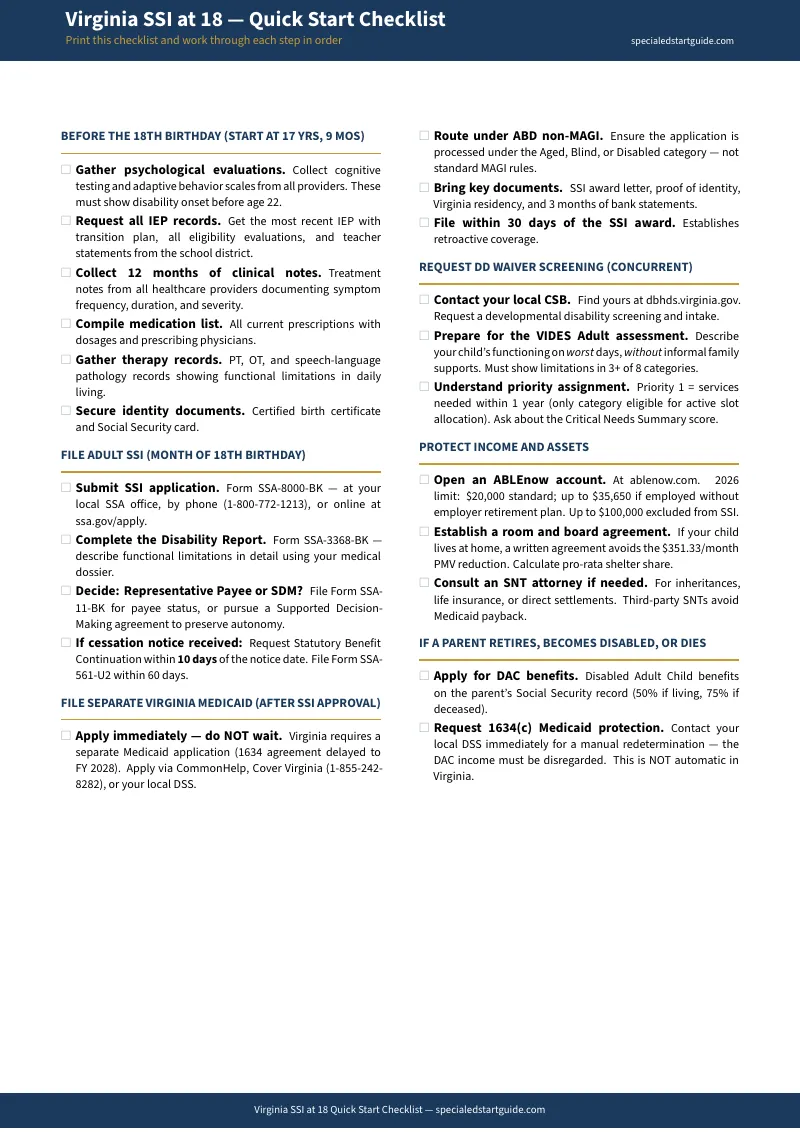
Download the free Virginia SSI at 18 Checklist — a one-page printable covering every critical action from the 17th birthday through age 19. If the checklist changes how you think about the transition, the full guide covers how to execute every step.
Get the Full Virginia SSI at 18 & Adult Disability Benefits Guide →