Your child is about to turn 18. Vermont just cut you out of every decision.
On your child's eighteenth birthday, Vermont law transfers every piece of legal authority you hold — medical, financial, educational — to your adult child. No exceptions for disability. No grace period. The hospital can refuse to tell you about their diagnosis. The bank can lock you out of their account. The school district must direct all IEP correspondence to your adult child and require their signature on every document.
You probably first heard about this at a transition IEP meeting, and it may have felt like the ground shifting under you. You have spent years coordinating therapies, fighting for services, managing medications — and in the space of a single birthday, the law presumes your child can handle all of it alone.
The real question is not whether this transfer will happen. It will, automatically. The question is what you put in place before it does.
The Dignity-First Decision System
This guide is built around a single principle that Vermont law requires and most free resources ignore: use the least restrictive tool that accomplishes your protective goal. That is not a suggestion — it is a statutory mandate under 14 V.S.A. § 3069.
Most families approaching the turning-18 transition get funneled toward one of two extremes: advocacy organizations that promote only non-court alternatives, or attorneys who present full guardianship as the default. Neither approach starts where you actually are — assessing your child's specific capacities across every life domain and matching each one to the right legal instrument.
The Dignity-First Decision System walks you through that assessment domain by domain — healthcare, finances, education, daily living, residential choices — and maps each one to the Vermont-specific document that fits. Not the most restrictive option. Not the simplest option. The right option for your child's actual needs.
What's Inside
- Supported Decision-Making Agreement walkthrough — Vermont has no formal SDM statute, which means the quality of your agreement matters more here than in states with codified frameworks. The guide walks you through the Green Mountain Self-Advocates template provision by provision, including the optional financial monitor clause that lets a third party review your actions quarterly.
- Educational Power of Attorney and FERPA Release — stay in your child's IEP meetings and access their educational records without filing anything in court. Covers the Vermont Family Network template and how to present it to a school district that has never seen one.
- Vermont Health Care Advance Directive walkthrough — your child needs only a basic understanding of appointing a healthcare agent under 18 V.S.A. § 9701, a lower capacity threshold than guardianship requires. Step-by-step registration with the Vermont Advance Directive Registry (VADR) included.
- Durable Financial Power of Attorney — delegate financial authority under 14 V.S.A. Chapter 127 without any court involvement. The guide covers notarization requirements, witness rules, and how to set up bank accounts with protective features like joint signature rules and automatic bill pay.
- Line-by-line court filing walkthrough — if guardianship is the right call, you get annotated instructions for every required form: the Petition (Form 700-00072PAG), the Statement of Assets (Form 700-00072), and the List of Interested Persons (Form 700-00002AG). No legal jargon left unexplained.
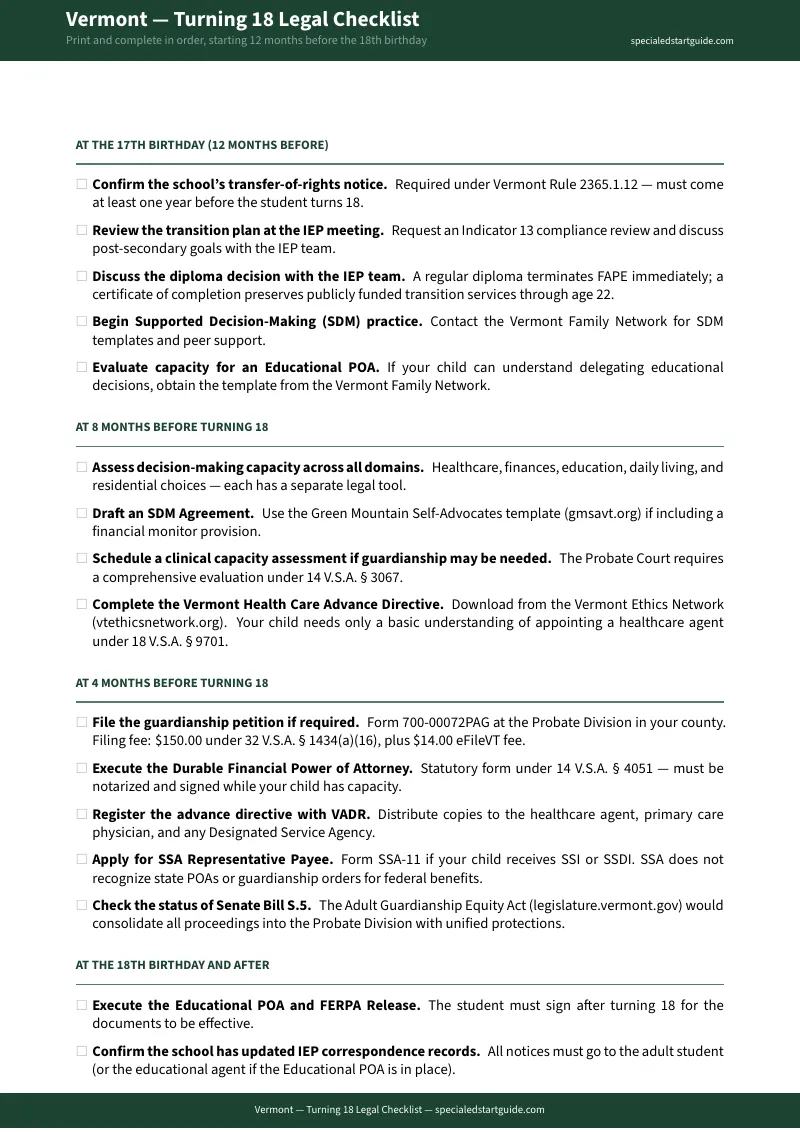
- Month-by-month preparation timeline — starting at the 17th birthday and running through the 18th, so you know exactly what to file and when. Petitions can be filed up to four months before the 18th birthday — the printable Transition Timeline Planner shows you how to use that window.
- Ongoing reporting walkthrough and preparation checklist — the guide explains every category the annual report (Form 700-00093A) and the simplified financial summary (Form 700-00400 for SSI-only estates) require, and the printable Annual Report Preparation Checklist keeps you ahead of the 30-day filing deadline under 14 V.S.A. § 3076(a).
- Six print-and-fill worksheets — the Guardianship Decision Worksheet (structured assessment of each of the six statutory powers, so you request only what your child's situation requires), the Transition Timeline Planner, the Document Execution Tracker, the Agency Communication Log, the Annual Report Preparation Checklist, and the Financial Inventory Worksheet. Print them, fill them in with a pen, and bring them to every attorney meeting, IEP meeting, and court filing.
Who This Guide Is For
This guide is for Vermont parents whose child with a disability is approaching their 18th birthday. It covers the full spectrum — from families whose child can make most decisions independently with structured support, to families whose child has significant cognitive or medical needs that require court-ordered protection.
- If your child has mild cognitive delays or high-functioning autism — the SDM and POA chapters will likely give you everything you need without ever setting foot in a courtroom.
- If your child has moderate intellectual or developmental disabilities — you will probably use a combination of instruments: an advance directive for medical decisions, a financial POA for banking, and potentially a limited guardianship for specific areas where no other tool is workable.
- If your child has severe disabilities or is medically fragile — the court filing chapters walk you through the full guardianship process step by step, including how to work with the court-appointed advocate attorney and what to expect at the hearing.
Why Free Resources Leave You Stuck
Vermont has excellent free resources — the Vermont Family Network, Disability Rights Vermont, the Ethics Network, the Judiciary's self-help forms. The problem is not quality. The problem is that each organization covers one piece of the puzzle, and none of them can tell you how the pieces connect.
The Vermont Family Network publishes strong SDM toolkits but cannot walk you through court filings — that would cross into unauthorized practice of law. The Probate Court website has all the forms but zero guidance on which combination to file or how to present a limited guardianship petition that the judge will actually accept. The Ethics Network handles advance directives beautifully but stops at the medical domain. The Social Security Administration covers representative payee appointments but has no idea how Vermont's probate system works.
You end up with tabs open across six different websites, trying to figure out whether the SDM agreement covers the bank account or whether you also need a financial POA, and whether the advance directive makes a medical guardianship unnecessary, and whether the representative payee application conflicts with the financial guardianship petition.
This guide connects every piece in chronological order. One document. One timeline. Every Vermont-specific form number, deadline, and procedural requirement in the sequence you actually need them.
Satisfaction Guarantee
If the guide does not give you a clear path forward for your family's situation, email [email protected] and we will make it right.
Get Started Today
Download the free Vermont — Turning 18 Legal Checklist for a quick-start planning timeline with key deadlines and resource contacts. When you are ready for the full step-by-step process, the complete guide gives you every form walkthrough, worksheet, and planning tool you need to protect your child's future — on your terms, at their pace.