Your teenager is turning 18. Tennessee just made them a legal stranger.
One letter from SSA can wipe out the SSI check your family depends on. One missed form at school can end special education services years early. One wrong diploma choice can shut the door to ECF CHOICES, vocational rehabilitation, and extended IEP eligibility — permanently.
And here is what nobody warns you about: when your child turns 18, Tennessee law treats them as an independent adult. You lose immediate legal access to their medical records, their school files, and their financial accounts. Their SSI gets reviewed against a stricter adult disability standard. Their TennCare Medicaid is suddenly contingent on new eligibility categories you have never heard of. And if you do not file the right paperwork before the birthday, you may spend months — and thousands of dollars — catching up in probate court.
The information exists. It is scattered across four state departments, the Social Security Administration, and a patchwork of nonprofit handbooks that each cover one piece of a thirteen-piece puzzle. You could spend weeks searching TDOE for diploma rules, TennCare for waiver limits, the Department of Disability and Aging for ECF CHOICES groups, and local courts for conservatorship alternatives — and still miss the connections between them.
The Agency Sequencer: Every Department, One Coordinated Timeline
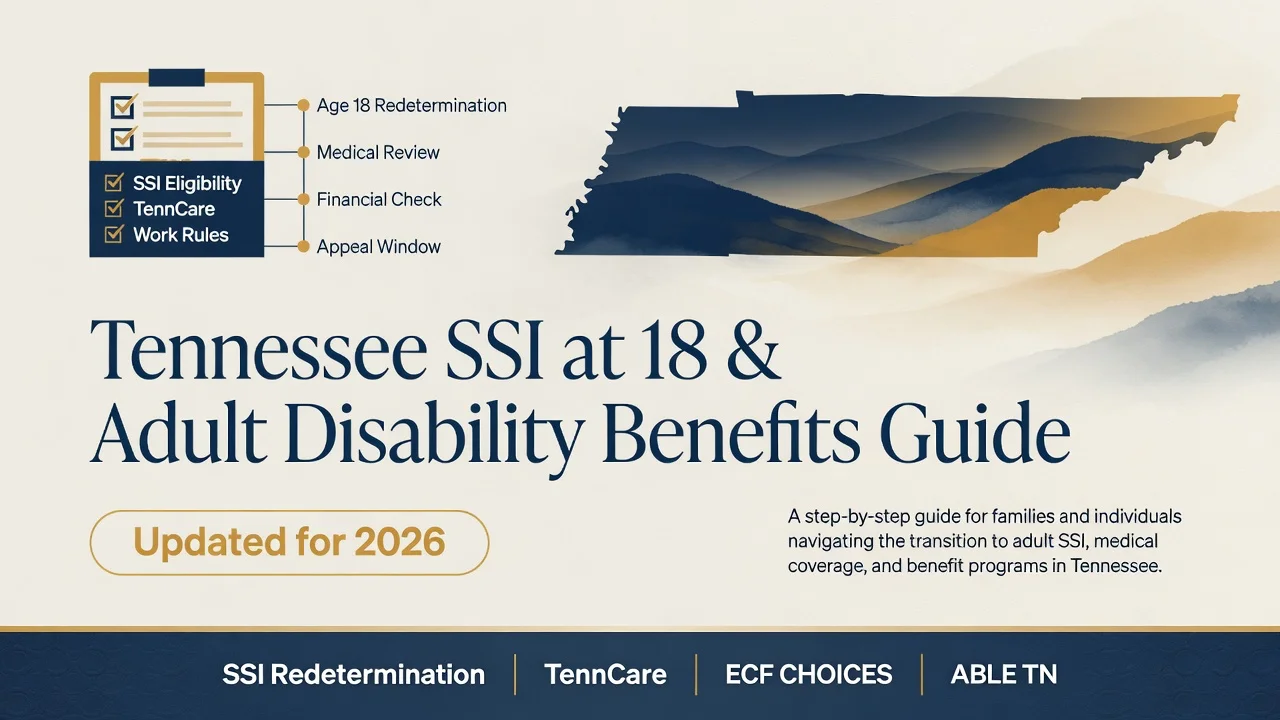
The Tennessee SSI at 18 & Adult Disability Benefits Guide is a 47-page sequenced workflow that coordinates every agency involved in your child's transition. It does not replace any single agency's handbook. It puts them in order — so the SSI redetermination packet is ready before the letter arrives, the legal decision-making framework is established before the 18th birthday, and the ECF CHOICES referral is filed before the school services end.
Thirteen chapters. Three worked examples with verified arithmetic. Every 2026 threshold and deadline current as of publication.
What's Inside
- SSI Age-18 Redetermination Walkthrough — the adult disability standard is different from the childhood functional standard your child qualified under. The guide explains exactly what Tennessee Disability Determination Services evaluates, which school records to gather, how to document daily limitations under the adult framework, and the critical difference between the 10-day continued-payment window and the 60-day appeal deadline.
- In-Kind Support and Maintenance Math — if your adult child lives at home and you pay for food and shelter, SSA may reduce their SSI by up to one-third. The guide walks through two worked examples showing how the Presumed Maximum Value rule calculates the reduction, when the Value of One-Third Reduction applies instead, and the specific documentation that prevents an overpayment notice.
- Legal Decision-Making Framework — Tennessee uses "conservatorship" (not guardianship) for adults, and state law requires courts to consider the least restrictive alternative before granting one. The guide maps every option: supported decision-making agreements under T.C.A. § 34-1-101, durable financial power of attorney, healthcare surrogate designation, SSA representative payee (Form SSA-11), and limited conservatorship — with the 90-day medical evaluation requirement and typical court costs so you know when a $3,000–$10,000 legal filing is genuinely necessary versus when a free voluntary arrangement covers your family's needs.
- TennCare Medicaid Protection Sequences — losing SSI does not automatically mean losing TennCare. The guide details the ex parte review requirement (TennCare must check every other Medicaid category before termination), the Medically Needy spend-down pathway, the Working Disabled Demonstration Group for employed adults, and how to respond to TennCare Connect pre-termination letters so coverage is never interrupted.
- Disabled Adult Child (DAC) Benefits — when a qualifying parent retires, becomes disabled, or passes away, your adult child may be eligible for Title II benefits tied to that parent's work record. The guide covers DAC eligibility rules (unmarried, disability onset before 22), explains why DAC is now unreduced following the January 2025 repeal of WEP and GPO, and details Section 1634(c) — the federal provision that protects TennCare Medicaid eligibility even when the DAC payment exceeds SSI limits.
- ECF CHOICES Navigator — Tennessee's primary home- and community-based services program has five benefit groups with annual expenditure caps ranging from $18,000 to $513,625. The guide explains each group's eligibility criteria, the self-referral process, the statewide referral list and reserve-capacity priority slots (including the aging-caregiver priority for families with a custodial parent 75 or older), the Family Caregiver Stipend in Group 4, and how to establish a Qualified Income Trust (Miller Trust) if your child's income exceeds the $2,982 monthly cap.
- Diploma Pathway Decision Tree — the diploma your child earns determines whether IDEA services continue or end. A Regular High School Diploma terminates special education immediately. The Alternate Academic Diploma, Occupational Diploma, and Special Education Diploma each preserve eligibility through the school year the student turns 22. The guide compares all four pathways and their downstream effects on VR enrollment, Section 301 benefit continuation, and ECF CHOICES transition timing.
- VR and Pre-ETS Enrollment Timeline — Tennessee recommends applying for adult Vocational Rehabilitation services 18 to 24 months before high school exit. The guide covers the Pre-ETS enrollment process (available at 14, no eligibility determination required), the formal VR intake timeline (up to 60 days for eligibility), and how the Individualized Plan for Employment connects to SSA's Section 301 benefit continuation program.
- ABLE TN Account Strategy — the first $100,000 in an ABLE TN account is excluded from the SSI resource limit entirely. The guide covers the 2026 annual contribution limit ($20,000), the ABLE to Work provision for employed beneficiaries, and Tennessee Public Chapter 44 — the state law prohibiting TennCare from recovering ABLE account funds after the beneficiary's death, making ABLE TN more protective than a first-party special needs trust for Medicaid recapture purposes.
- SSI Work Incentives Sequencing — the Student Earned Income Exclusion, Plan to Achieve Self-Support, Impairment-Related Work Expenses, and Section 1619(b) each protect a different piece of your child's benefits when they start working. The guide explains how earned income reduces SSI gradually (versus the all-or-nothing SGA cliff under SSDI), provides the 2026 thresholds, and sequences the protections so your child's first paycheck does not trigger a benefits review.
- Three Worked Planning Examples — each example uses verified 2026 arithmetic to walk through a realistic family scenario: the ISM room-and-board reduction, the DAC benefit calculation after a parent's retirement, and an ABLE TN contribution strategy that maximizes savings without crossing the SSI suspension threshold.
- Ten Fillable Worksheets — print-and-write tools named in the guide: Transition Timeline Planner, SSI Document Organizer, Redetermination Evidence Tracker, Room and Board Calculator, Decision-Making Framework Worksheet, ECF CHOICES Application Tracker, VR and Pre-ETS Tracker, ABLE TN Contribution Tracker, Agency Communication Log, and Representative Payee Ledger.
Who This Is For
- Parents whose teenager with a disability is approaching 18 and who need to coordinate SSI, TennCare, school transition, and legal decision-making before the birthday
- Families who just received the SSI age-18 redetermination letter and need to prepare their response under the adult disability standard
- Parents navigating ECF CHOICES enrollment — understanding the benefit groups, the referral list, and how to position for reserve-capacity priority
- Families weighing conservatorship against less-restrictive alternatives and unsure which legal framework fits their situation
- Siblings or extended family members stepping into a coordination role as the primary caregiver ages
Why Not Just Use Free Resources?
Tennessee's state websites contain excellent information. The problem is fragmentation. The Department of Education covers diploma rules and IEP transition goals. The Department of Human Services handles Vocational Rehabilitation. TennCare publishes ECF CHOICES eligibility manuals. The courts have their own conservatorship filing requirements. The SSA runs a separate process entirely. Each agency's materials are accurate for their piece — and none of them show you how the pieces connect.
The Tennessee Center for Decision-Making Support publishes strong conservatorship guides but does not cover SSI redetermination or ECF CHOICES enrollment timelines. TN-STEP offers excellent IEP workshops but limited guidance on Medicaid waivers. Disability Rights Tennessee focuses on legal protections and advocacy, not day-to-day administrative organizing. A private special needs attorney provides customized legal support — at $3,000 to $10,000 for a conservatorship filing alone.
This guide does not replace any of those resources. It integrates them. It puts the four-department, thirteen-step process into a single sequenced plan so you know what to file, where to file it, and what must be complete before the next step unlocks.
What You Get
- The Full Guide — 47-page PDF covering all thirteen chapters, three worked examples, and every 2026 threshold and deadline
- Ten Fillable Worksheets — separate 1–2 page printables for the timeline, SSI evidence file, ISM math, legal framework, ECF CHOICES, VR, ABLE TN, agency calls, and payee accounting
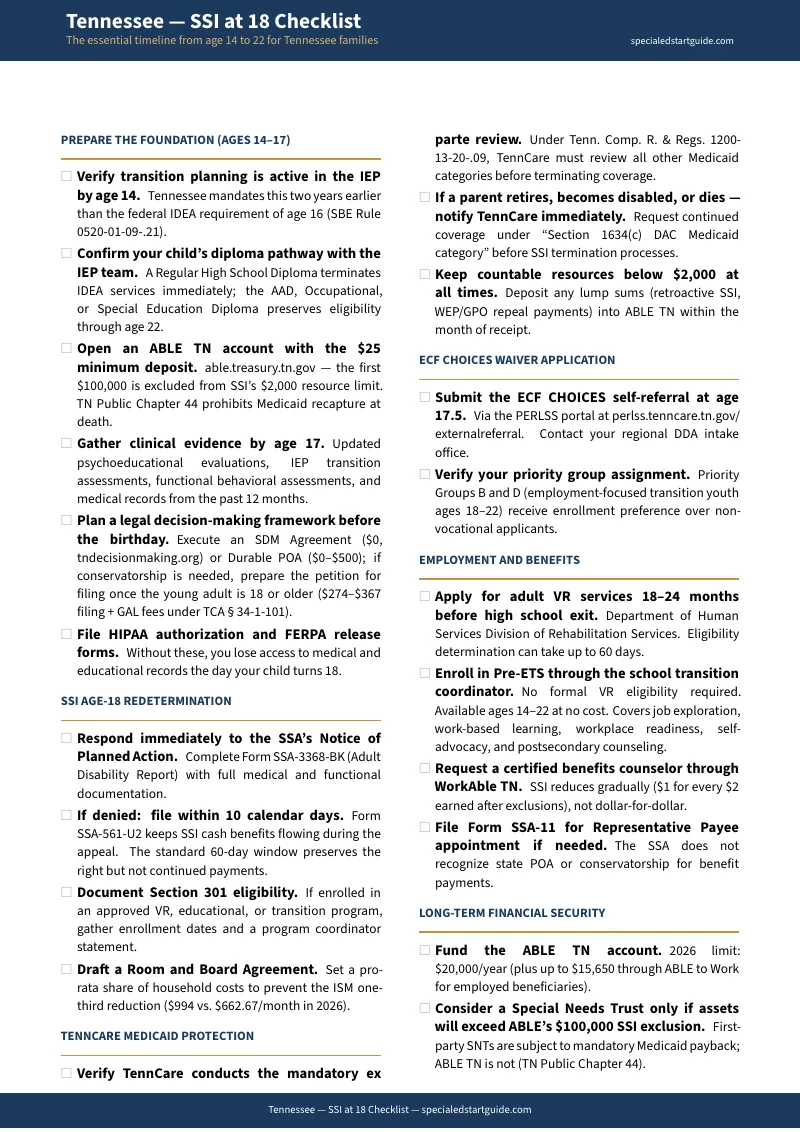
- The Free Checklist — a two-page, 22-item transition timeline you can print and pin to the refrigerator
100% satisfaction guarantee. If the guide does not help you organize your family's transition plan, email us for a full refund. No forms, no questions.
Start With the Free Checklist
Download the Tennessee — SSI at 18 Checklist to see the timeline at a glance. When you are ready to work through each step in detail, the full guide picks up exactly where the checklist leaves off.
Frequently Asked Questions
What if the rules change after I buy?
We update the guide when the rules change. Email us any time, even years later, and we'll send you the current edition free.