
Your child turns 18. Every legal right you've held for two decades disappears — unless you build the right legal framework first.
You signed the IEP. You sat in every meeting. You managed the doctors, the therapists, the school evaluations. And then someone at the school district casually mentioned that on your child's 18th birthday, all of that authority — medical consent, HIPAA access, bank accounts, treatment decisions — transfers to a young adult who may not be able to manage it alone.
So you started searching. The Arc of Pennsylvania publishes dense policy papers. PEAL Center runs webinars spread across different sessions. Achieva has community resources — but nothing chronological. Your county MH/ID office told you to "call back when you're ready to apply." A special needs attorney quoted $4,750 for an uncontested guardianship petition. And you still don't know whether court is even the right path.
Here's what nobody explained clearly: Act 61 of 2023 changed everything. Pennsylvania's Orphans' Court is now prohibited from granting a guardianship based on incapacity alone. The judge must find — on the record — that every less restrictive alternative has been considered and is insufficient. If you walk into court without documenting that analysis, your petition fails. And if your child can function with the right supports in place, the court may not grant guardianship at all.
That's not a problem. That's an opportunity. It means you might not need to spend thousands on a court proceeding. But you need to know which tools replace it — and how to implement them in Pennsylvania, where the rules are different from every other state.
The Act 61 Decision Framework: Navigate the Full Spectrum from SDM to Guardianship
This guide is built around the decision framework that Act 61 forces every Pennsylvania family to complete. Not a list of options. A structured, sequential process that walks you from capacity evaluation through legal instrument selection, document preparation, and — only if necessary — the Orphans' Court petition. Every chapter maps to a specific decision point on the continuum from supported decision-making to plenary guardianship.
What's Inside
- Decision-Making Capacity Assessment Worksheet — assess medical consent, financial management, educational choices, and daily-living decisions, producing the documented analysis Act 61 requires before any court filing
- Eight-Month Transition Timeline Planner — month-by-month tasks from eight months before the 18th birthday through the first year of adult services
- Supported Decision-Making walkthrough — construct an SDM arrangement using the In re Peery precedent and Act 61's statutory recognition, with instructions for presenting it to hospitals, banks, and school administrators who may be unfamiliar with SDM
- Power of Attorney and HIPAA execution guide — Durable Financial POA under 20 Pa. C.S. § 5601, Health Care Power of Attorney, and HIPAA Authorization with Pennsylvania-specific execution requirements and capacity thresholds
- Act 169 health care representative guide — Pennsylvania's built-in statutory safety net that makes a parent the default medical decision-maker without any paperwork, plus when and how to formalize it with a Health Care Power of Attorney
- Guardianship Petition Preparation Checklist — county-specific filing procedures, the petition requirements under 20 Pa. C.S. § 5511, the Expert Report (Form G-06), personal service rules (20 days), court-appointed counsel under Act 61, and a realistic cost breakdown (filing fees $35 in Beaver County to $164.75 in Allegheny County, medical evaluations $500–$1,500, uncontested attorney fees typically $3,000–$5,000)
- SSI Asset Tracking Ledger — monthly bank, ABLE, and countable-resource log so the $2,000 SSI limit is never breached at month-end, plus the Age-18 Redetermination documentation the guide walks through
- ODP Waiver Comparison Worksheet — the three waiver tracks (P/FDS capped at $47,000, Community Living at $97,000, Consolidated uncapped), county Administrative Entity intake, PUNS priority categories, and why registering at your county MH/ID office by age 17 is critical when 11,462 individuals are already waiting statewide
- Agency Communication Log and Annual Guardian Report Reminder Calendar — every call with MH/ID, SSA, and the CAO, plus GTS filing deadlines (Inventory at 90 days; Forms G-02/G-03 within 30 days of each anniversary)
Who It's For
Pennsylvania parents whose child's 18th birthday is approaching — whether that's eight months away or three years out. Parents who were told "just get guardianship" and suspect that's not the whole story. Parents who know Act 61 changed the rules but can't find a clear explanation of what that means for their family. Parents who have priced attorneys at $4,750+ and want to determine whether court is even necessary before spending billable hours on a consultation.
This guide doesn't replace an attorney. If court-ordered guardianship is the right path, Pennsylvania law requires legal representation and the Orphans' Court must appoint independent counsel for your child. What this guide does is help you complete the less-restrictive-alternative analysis that Act 61 mandates, organize every document the process requires, and walk into any legal consultation fully prepared — saving hours of billable time.
Why Free Resources Don't Solve This
The Arc of PA, PEAL Center, and Achieva are trusted organizations doing critical advocacy work. Their individual resources are excellent — on the topics they cover. But each organization publishes separately, in different formats, without a shared timeline. You'll find a detailed SDM policy brief from one, a guardianship rights fact sheet from another, and a PUNS registration guide from a third. None of them integrates the full transition pathway — from the capacity evaluation through the legal instrument selection, SSI redetermination, ABLE account setup, and ODP waiver coordination — into a single sequential framework with fillable worksheets.
State agencies are worse. The COMPASS portal handles Medicaid financial eligibility but doesn't process ODP waivers — you need the county MH/ID Administrative Entity for that, and many families waste months applying through the wrong system. The UJS publishes guardianship forms without step-by-step instructions. The SSA requires a completely separate Representative Payee application that has nothing to do with your Orphans' Court order.
The guide puts every piece in chronological sequence: evaluate, decide, document, implement. One framework. One timeline. Every worksheet designed to take to an attorney meeting, county intake appointment, SSA interview, or notary session.
What You Get
Instant PDF download. The 45-page main guide covers the full legal authority spectrum with Act 61 compliance at every step. Plus seven standalone printable worksheets: Decision-Making Capacity Assessment Worksheet, Eight-Month Transition Timeline Planner, Agency Communication Log, ODP Waiver Comparison Worksheet, SSI Asset Tracking Ledger, Guardianship Petition Preparation Checklist, and Annual Guardian Report Reminder Calendar.
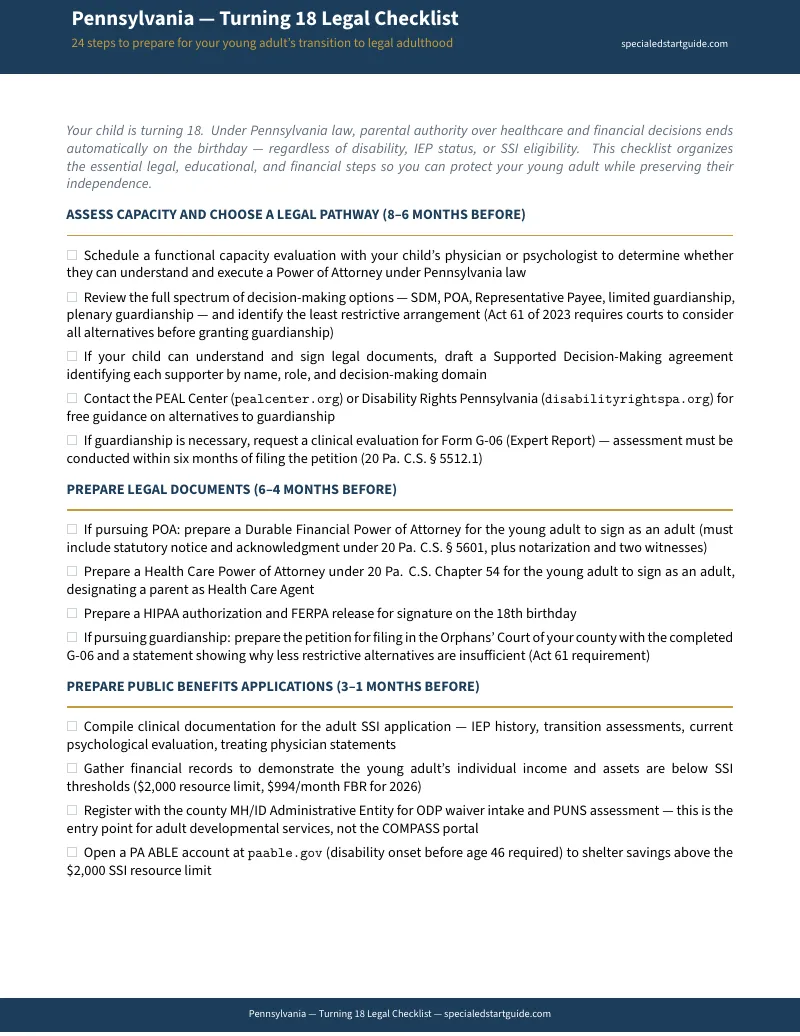
Free tier: Download the Pennsylvania Turning-18 Legal Checklist — a chronological overview of the legal authority spectrum from supported decision-making through full guardianship, key deadlines, and the critical first steps every Pennsylvania family should take.
Get the Pennsylvania Guardianship & Alternatives Guide — instant download, start the capability evaluation tonight.
Money-back guarantee, no time limit — if the guide doesn't give you a clear path forward for your child's 18th birthday transition, you get a full refund.
Frequently Asked Questions
What if the rules change after I buy?
We update the guide when the rules change. Email us any time, even years later, and we'll send you the current edition free.