Five Agencies. Zero Coordination. One Guide That Connects Them All.
Your child's IEP team just started talking about "transition" — and the meeting felt like walking into a conversation halfway through. Postsecondary goals, career pathways, transfer of rights, vocational rehabilitation referrals. Everyone at the table seems to know what these words mean except you.
Here's what nobody in that room will tell you: the school only controls one piece. The actual transition from special education to adulthood in Oklahoma runs through five separate state and federal agencies, and not one of them is responsible for coordinating with the others. The school handles the IEP. The Department of Rehabilitation Services handles job training. Developmental Disabilities Services handles waiver funding. The Oklahoma Health Care Authority handles Medicaid. And Social Security handles benefit redetermination at 18.
If you miss a single filing window — like the separate SoonerCare application that Oklahoma requires because SSI approval doesn't automatically trigger Medicaid enrollment — your child can end up with no medical coverage, no waiver services, and no clear path to get them back.
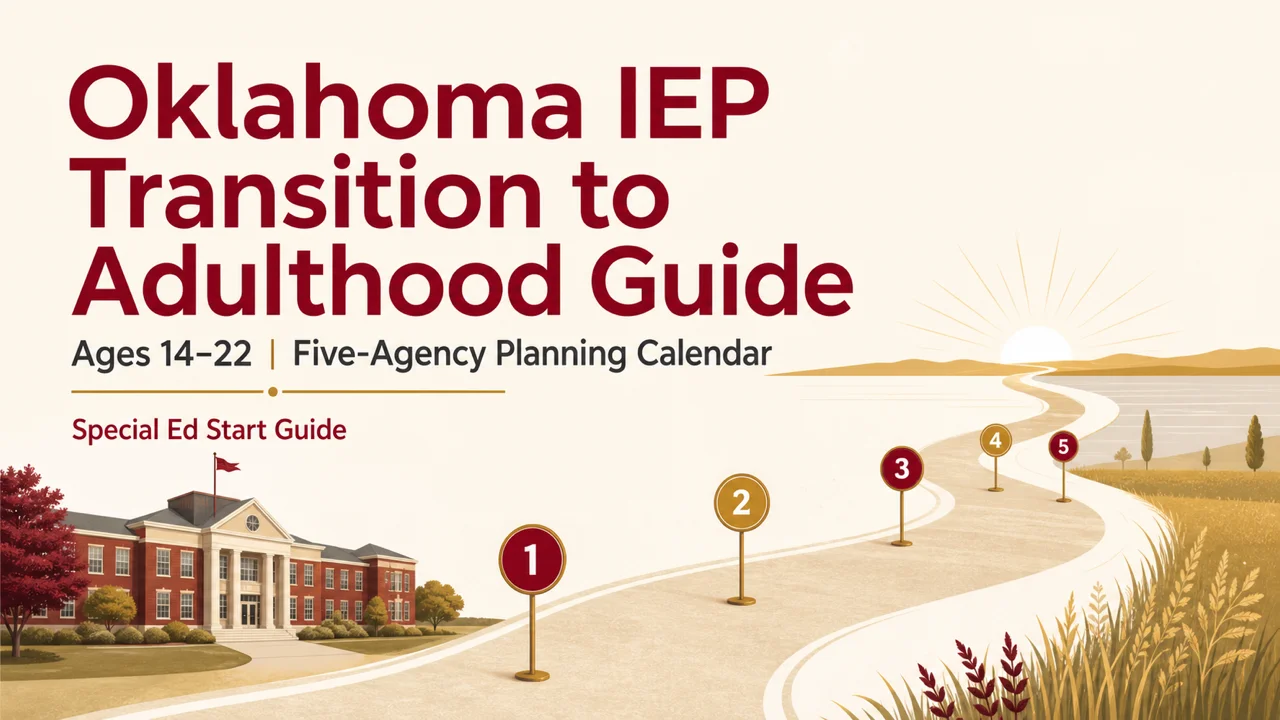
The Five-Agency Transition Map
This guide is built around one idea: every agency handoff your family will encounter between age 14 and age 22, mapped in the exact order you'll face them, with the Oklahoma-specific forms, deadlines, and filing instructions for each one.
It's not a list of tips or a general overview of transition law. It's the operational sequence — what to file, with whom, and when — so you can work through the process systematically instead of discovering each agency's requirements after you've already missed their preferred timeline.
What's Inside
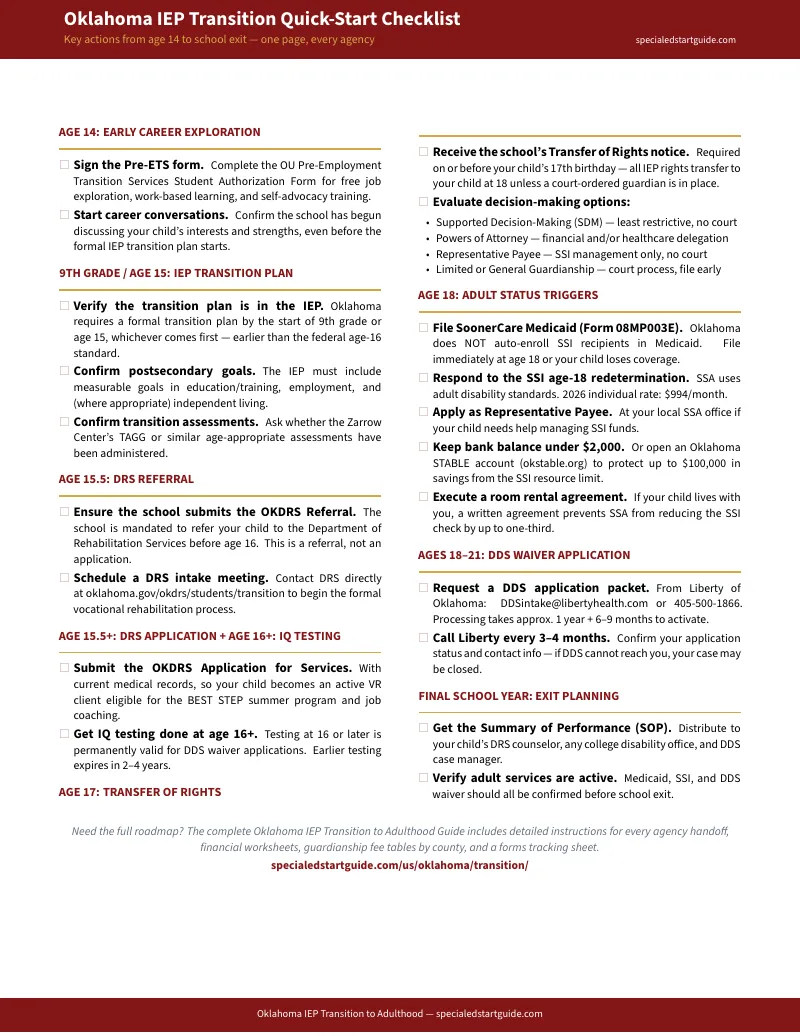
- The master transition calendar (ages 14–22) — every milestone tied to a specific age, a responsible agency, and the exact action you need to take. Pre-ETS enrollment at 14, DRS vocational rehabilitation referral at 15.5, IQ testing timing for permanent DDS validity, transfer of rights notification at 17, SSI redetermination and separate Medicaid filing at 18, DDS waiver application, and the school exit checklist.
- Graduation pathway comparison — the Standard Diploma terminates your child's right to services immediately. The Alternate Diploma (created by HB 1041) preserves school services until age 22. The Certificate of Completion also preserves services. The guide breaks down the legal consequences of each pathway with a comparison table so you can make this decision with full information at the IEP meeting.
- Decision-making alternatives at 18 — the full spectrum from Supported Decision-Making (no court, no lawyer) through Powers of Attorney and Representative Payee to Limited and General Guardianship, with Oklahoma probate filing fees, typical attorney costs, and ongoing court obligations for each option.
- DDS waiver navigation — how to apply after Oklahoma cleared its historic 5,000-person waitlist, what clinical documentation DDS requires (and why testing timing matters), the current approximate processing timeline, and why you must file a separate SoonerCare Medicaid application before any waiver services can be authorized.
- SSI financial planning — the 2026 federal benefit rate, the resource limit, how the room rental agreement prevents a one-third SSI reduction, the ABLE/STABLE account rules (including the January 2026 age-46 eligibility expansion and the $20,000 annual contribution limit), and how Disabled Adult Child benefits work when a parent retires or passes away.
- The entitlement-to-eligibility shift explained — why everything changes when school ends, how each adult program's eligibility rules differ from the IEP's guarantee, and what that means for your family's planning timeline.
- IEP transition plan compliance — what Oklahoma law requires in the transition plan (it starts earlier than the federal default), how to verify your school is meeting the standard, and how to use the Zarrow Center's TAGG assessment scores in your child's postsecondary goal-setting.
Who This Guide Is For
This guide is for Oklahoma families navigating the transition from school-based special education services to the adult system — whether you're at the beginning of transition planning or trying to catch up before your child exits school.
- Parents whose child's IEP team just introduced transition and you need to understand what you're being asked to decide
- Families who received the Transfer of Rights notice and need to evaluate guardianship alternatives before 18
- Parents of graduating students trying to line up DDS waivers, SSI, and Medicaid before school services end
- Grandparents, foster parents, or guardians managing the transition for a young person with disabilities
Why Not Piece It Together Yourself?
You could read every page on oklahoma.gov/education, oklahoma.gov/okdrs, oklahoma.gov/okdhs, and ssa.gov separately. Families who do that typically discover three problems:
- No one site shows the full sequence. OSDE explains the school's role. DRS explains vocational rehab. DDS explains waivers. But none of them map when you should be talking to the other agencies, and the sequencing matters — some applications must be filed before others or you lose months.
- Critical requirements are buried. The fact that Oklahoma doesn't auto-enroll SSI recipients in Medicaid isn't prominently stated on any one agency's website. The IQ testing timing that makes DDS documentation permanently valid instead of expiring is buried in regulatory text. The room rental agreement that protects the full SSI rate isn't mentioned by your school's transition coordinator.
- Timing mistakes are expensive. Filing the DDS application too late means your child exits school before waiver services are active. Missing the Medicaid application at 18 creates a coverage gap. Starting guardianship proceedings after the 18th birthday means your child signs their own IEP without representation.
This guide puts the entire sequence in one place, in the order you need it, with the forms and timelines already identified.
The Free Checklist vs. the Full Guide
The free checklist gives you the milestones — what to do and when. It's a one-page reference you can bring to your next IEP meeting.
The full guide gives you the how. Each milestone in the checklist is backed by a detailed chapter explaining the Oklahoma-specific rules, the forms, the agency contacts, the common mistakes, and the decisions you'll need to make at each stage. It includes 10 standalone printable worksheets and reference cards — a graduation pathway comparison, decision-making worksheet, DDS waiver application checklist, SSI and STABLE quick reference, forms tracker, agency contacts sheet, and more — designed so you can print exactly what you need for each meeting.
100% Satisfaction Guarantee
If the guide doesn't give you a clearer path through Oklahoma's transition process, email [email protected] for a full refund. No time limit, no questions.
This is an educational resource, not legal advice. For individualized questions about guardianship, trusts, or benefit eligibility, consult a qualified Oklahoma attorney or benefits counselor.