Your child turns 18 in New Jersey. Three state departments, one federal agency, and a DDD waiver system split across two programs — and nobody hands you the order of operations.
The SSA sends a redetermination letter that re-evaluates your child using adult disability standards. Your County Board of Social Services expects you to know that SSI approval triggers automatic NJ FamilyCare Medicaid in a Section 1634 state — and that an SSI denial ends the automatic pathway unless you proactively file for ABD Medicaid Only or NJ WorkAbility protections that most county caseworkers never volunteer. The Division of Developmental Disabilities operates two distinct waiver programs: the Supports Program, which has no waiting list for eligible adults at 21, and the Community Care Program, which runs a priority waiting list for residential services governed by Division Circular 8. And your child's legal decision-making rights transfer on their 18th birthday whether you have filed for guardianship, executed a power of attorney, or put a supported decision-making agreement in place or not.
The free resources are real. The Arc of New Jersey's Planning for Adult Life project publishes thorough webinars and slide decks. The Boggs Center's Pre-IEP Family Workbook series is strong on self-advocacy. DDD explains each program on its website. But each resource covers its own program in isolation. None of them gives you the full sequence — what to file first, which applications depend on which approvals, what to submit proactively before a coverage gap opens, and what forms you need at each step across the SSA, DDD, your County Board of Social Services, and DVRS.
That sequencing gap is where families get hurt. Not from bad advice — from incomplete advice delivered one agency at a time.
The Transition Sequencing System — Every Agency, Every Form, Every Deadline in Order
The New Jersey SSI at 18 & Adult Disability Benefits Guide is a 13-chapter process manual that organizes four agency systems into a single chronological workflow. It does not replace the individual agency resources — it connects them into the sequence that prevents gaps.
Where free resources explain what each program does, this guide maps which steps to take when, which applications depend on which outcomes, and what to file before a deadline you didn't know existed closes.
What's Inside
- The SSI age-18 redetermination walkthrough — the adult standard that replaces childhood criteria, what Forms SSA-3368-BK and SSA-827 require, how the cessation of parent-to-child income deeming opens new eligibility for families who were previously excluded, and the full four-level appeal process including the critical 10-day continued-payment rule and the 60-day reconsideration deadline that most families learn about after it passes
- New Jersey SSI cash benefits decoded — the 2026 payment structure including the state supplement many online sources incorrectly claim does not exist (total: $1,025.25/month for independent living), the room-and-board agreement that prevents the one-third reduction ($318.27/month difference), the Student Earned Income Exclusion ($2,410/month for students under 22), and SNAP integration
- DAC benefits on a parent's work record — eligibility when a parent retires, becomes disabled, or passes away, the before-age-22 onset requirement, how DAC interacts with SSI (and when it replaces SSI entirely), and why the Social Security Fairness Act's 2025 repeal of WEP and GPO means previously reduced benefits for children of New Jersey's public employees are now fully restored
- Four Medicaid pathways mapped — Section 1634 automatic enrollment through SSI, ABD Medicaid Only through the County Board of Social Services, NJ WorkAbility for employed adults, and Section 1619(b) Medicaid continuation for workers earning above the SSI cash limit — plus DAC-related Medicaid protections and the steps to invoke them before coverage lapses
- DDD waiver programs and the NJCAT assessment — eligibility criteria, the NJCAT that determines tier budgets, the Supports Program (no waiting list at 21), the Community Care Program (priority waiting list under Division Circular 8), how to select a Support Coordination Agency, and the priority categories that allow early placement when both parents are over age 55 or a caregiver is incapacitated
- NJ ABLE accounts — the $100,000 SSI resource disregard, the $20,000 annual contribution limit plus the $15,650 ABLE-to-Work provision, the expanded age-of-onset (now 46 as of January 2026), and how exceeding $100,000 suspends SSI cash but preserves Medicaid
- Legal decision-making options — supported decision-making (recognized by DDD despite no formal NJ statute, reinforced by the ABA's 2026 Resolution 100), powers of attorney, healthcare proxies, and guardianship through Superior Court, Probate Part — including the six-month pre-filing window under P.L. 2025, c. 129
- The diploma decision — why accepting a high school diploma before age 21 terminates FAPE entitlement, the pending alternate diploma legislation (S4500) that would let students graduate while preserving transition services, and 18–21 transition programs
- Special needs trusts and the contribution-to-care formula — third-party vs. first-party SNTs, and the Treasury Formula-DDD(A) that governs how much DDD charges for residential services
- The transition timeline from age 14 through 21 — every application, referral, and deadline across SSA, DDD, DVRS, your County Board of Social Services, and the school district in chronological order, mapping the PerformCare (CSOC) termination at 21 against DDD adult service activation
- Key contacts and resources — every form number, agency website, and phone number in one reference section
Who This Guide Is For
New Jersey parents and guardians of young adults with intellectual or developmental disabilities who are approaching, currently navigating, or recently past the age-18 transition — and who need the full sequence of steps across SSA, DDD, DVRS, and the County Board of Social Services in one place.
- You received the SSA's age-18 redetermination letter and are not sure what "adult disability standards" means for your child's current SSI eligibility
- Your child's IEP transition plan mentions "adult services" but nobody has explained that the school does not actually enroll your child in any of them — DDD, DVRS, and your County Board of Social Services each require their own separate applications
- You contacted DDD about waivers and were told you need an NJCAT assessment, but nobody explained how the tier budget works, what the Supports Program covers versus the Community Care Program, or how to get on the CCP priority waiting list
- Your young adult's income from DAC benefits pushed them above the SSI cash limit and you are scrambling to figure out whether Section 1634 Medicaid protection applies, whether you need to file with your County Board of Social Services, or both
- You want to save money for your child's future but are afraid that any savings above $2,000 will disqualify them from SSI and Medicaid
- Your young adult wants to work and you need to understand exactly how earned income affects cash benefits and healthcare coverage — SEIE, the $1-for-$2 formula, Section 1619(b), and NJ WorkAbility
- You are trying to decide between supported decision-making, power of attorney, and guardianship — and you want to understand the new six-month pre-filing window before weighing your options
- A parent in the household is a retired or retiring public employee and you want to know whether your adult disabled child qualifies for DAC benefits now that WEP and GPO have been repealed
Why Free Resources Alone Leave Gaps
The free resources from The Arc of New Jersey, the Boggs Center, DDD, and DB101 NJ are genuinely valuable — this guide references many of them. The problem is structural, not qualitative.
Each organization publishes information about its own programs. The Arc's Planning for Adult Life project organizes materials as separate webinars and slide decks by topic. The Boggs Center's materials focus on self-advocacy and IEP participation. DDD structures its information by program rather than by family timeline. DB101 NJ explains benefit rules but cannot tell you which applications to file in which order.
None of them can tell you: "File the SSI application before you open the ABLE account because the SSI approval is what triggers automatic NJ FamilyCare Medicaid, and you need Medicaid in place before DDD can activate waiver services at 21 because HCBS waivers require active Medicaid as a prerequisite."
That sequencing — which steps gate which other steps, which deadlines are absolute, and which applications can run in parallel — is what this guide provides. One document, one timeline, one reference point instead of four agency websites and a dozen separate webinar recordings.
Satisfaction Guarantee
If the guide does not change how you prepare for your child's transition — if the timelines, form references, and agency sequences do not save you confusion, missed deadlines, or hours of scattered research — email [email protected] at any time for a full refund.
Get Started
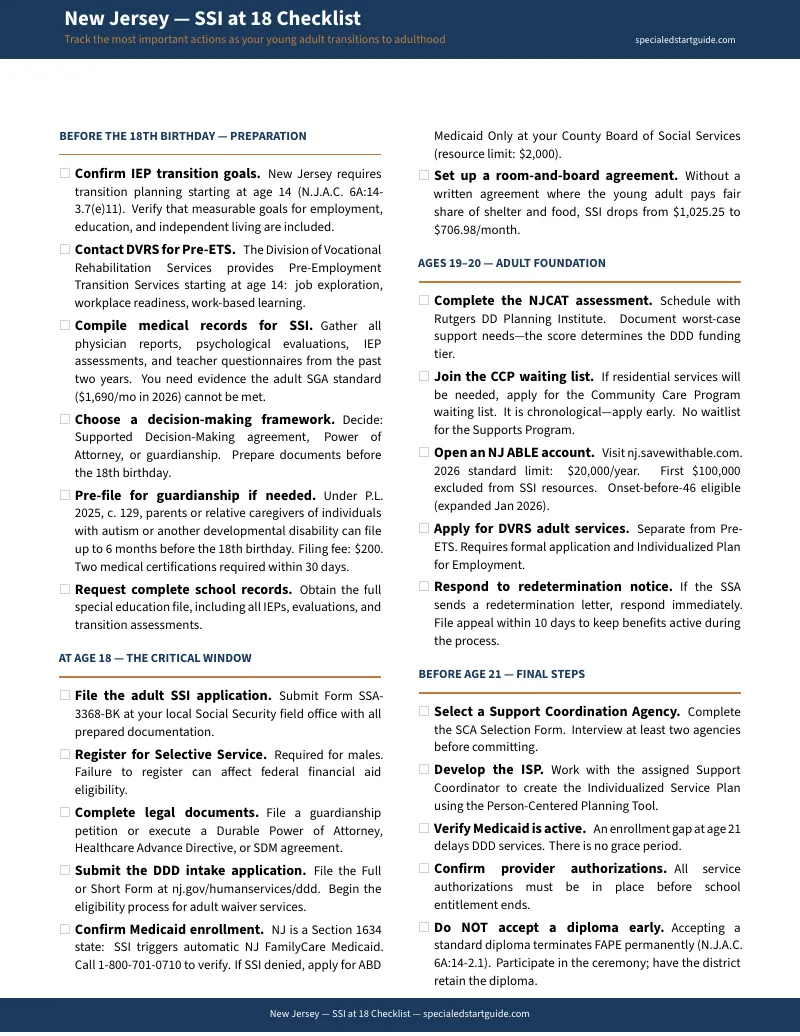
The free New Jersey — SSI at 18 Checklist gives you the one-page overview — every critical action from the 17th birthday through age 19 on a single printable page. Download it now, or get the full New Jersey SSI at 18 & Adult Disability Benefits Guide for the complete 13-chapter walkthrough with every form, every portal, and every deadline across all four agencies.
The transition timeline does not pause while you research. The SSI redetermination appeal window closes in 60 days. The 10-day continued-payment rule waits for no one. Guardianship pre-filing can begin six months before the 18th birthday. And the DDD intake process at 18 determines whether services are ready to activate on the day PerformCare terminates at 21.
Get the New Jersey SSI at 18 & Adult Disability Benefits Guide →
Frequently Asked Questions
What if the rules change after I buy?
We update the guide when the rules change. Email us any time, even years later, and we'll send you the current edition free.