Five Agencies. Three Levels of Government. Zero Coordination Between Them.
Your child's IEP team says "transition." You nod, take the handout, and go home to Google what that actually means for a family in New Hampshire.
Here's what you find: the school handles the IEP transition plan. VR New Hampshire handles Pre-ETS and vocational services. The Bureau of Developmental Services runs through ten separate Area Agencies. Medicaid has its own application under NH's 209(b) rules. The Probate Court handles guardianship. Social Security runs the SSI redetermination at 18. And none of these agencies talk to each other about your child.
Each one has its own eligibility criteria, its own forms, its own timeline. Each one assumes you already know how the other four work. And the free resources — as helpful as PIC NH, DRCNH, and the state websites are — live in separate silos, giving you one piece of the puzzle at a time without ever showing you how the pieces fit together.
That's the coordination gap. It's where families lose months, miss deadlines, and discover — too late — that the service they assumed was automatic requires an application that should have been filed a year ago.
The Transition Coordination System
The New Hampshire IEP Transition to Adulthood Guide is a 47-page chronological roadmap that connects every agency, deadline, and decision point into a single planning sequence. It doesn't replace the school's transition coordinator or any state agency — it shows you how to coordinate them all yourself, on one timeline, without anything falling through the cracks.
It starts at the age-14 Course of Study (New Hampshire's state-mandated trigger, two years earlier than the federal baseline) and runs through the age-22 exit under SB 394-FN. Every chapter follows the order you'll encounter these systems, with the specific New Hampshire statutes, forms, contacts, and deadlines you need at each stage.
What's Inside
- The Age-14 Course of Study Workbook — NH starts transition planning two years before the federal requirement. The guide walks you through verifying compliance with Ed 1109.03, documenting the Course of Study projection, and using the Transition Timeline Tracker to catch when annual updates diverge from the original plan.
- Measurable Postsecondary Goal Templates — the difference between IEP goals that check a compliance box ("student will explore career options") and goals that actually drive services. Side-by-side examples across education, training, employment, and independent living domains, keyed to Indicator 13 standards.
- The Diploma Decision Matrix — an objective comparison of the regular high school diploma, the Alternate Diploma under Ed 306.27(q), and the certificate of completion. Shows exactly how each credential affects FAPE eligibility, access to transition services through age 22 under SB 394-FN, and postsecondary options.
- Supported Decision-Making Implementation Guide — RSA 464-D (effective January 2022) gives families a legal alternative to court-ordered guardianship. The guide includes a walkthrough of the SDM agreement structure, supporter role definitions, and communication scripts for presenting the agreement to schools, banks, and medical providers. It also covers what RSA 186-C:3-c requires the IEP team to do when guardianship comes up at a meeting.
- VR and Pre-ETS Coordination Roadmap — how to initiate a referral to VR New Hampshire for Pre-Employment Transition Services (available as early as age 14), what the five core Pre-ETS services cover, when to pursue a formal Individualized Plan for Employment (IPE), and how to align VR services with your child's IEP transition goals without duplication or gaps.
- The Area Agency Intake Guide — the Bureau of Developmental Services operates through ten regional Area Agencies, each a private nonprofit with its own capacity constraints. The guide explains clinical eligibility criteria, the assessment process, how to register on the planning list, and what to expect from NH's Direct Support Professional workforce shortage.
- Medicaid and Benefits Toolkit — NH is a 209(b) Medicaid state, meaning eligibility rules are more restrictive than federal SSI standards. The guide covers the adult Medicaid application, the SSI childhood-to-adult redetermination at age 18, Disabled Adult Child benefits, 2026 ABLE account rules (including the expanded age-46 onset and $20,000 standard limit), and how Special Needs Trusts interact with benefit eligibility.
- Dispute Resolution Playbook — how to document school refusals using Written Prior Notice, prepare for facilitated IEP meetings, access state mediation through the NHED Bureau of Special Education, and when to contact DRCNH or PIC NH for formal advocacy support. Includes non-adversarial meeting scripts.
Who This Is For
- Parents whose child is approaching the age-14 IEP trigger — your school district just mentioned "transition" for the first time, and you need to understand what New Hampshire requires before the next IEP meeting
- Families facing the diploma decision — your child is 15-17, the team is discussing graduation pathways, and you need to understand exactly how each credential affects eligibility for continued services
- Parents coordinating the age-18 handoff — transfer of rights, SDM vs. guardianship, SSI redetermination, Medicaid application, Area Agency intake, and VR services are all converging, and you need one timeline to manage them all
- Families with students ages 18-22 still receiving services — you're in the final stretch and need to ensure the adult system handoff happens before school services end
Why Not Free Resources Alone?
PIC NH publishes the Transition Tool Kit. DRCNH has excellent guides on SDM and dispute resolution. VR New Hampshire has referral forms and Pre-ETS fact sheets. The state DHHS site has BDS waiver rules. These are valuable resources — and every one of them covers its own silo.
The problem isn't that information doesn't exist. The problem is that no one has connected it into a single chronological sequence with cross-agency coordination built in. That's what this guide does: it takes the content from across six separate agencies and organizes it into the order you'll actually encounter it, with worksheets that track dependencies between systems so nothing slips between the cracks.
A private special education advocate in New Hampshire charges $100 to $175 per hour. A special education attorney charges $250 to $400+ per hour with an upfront retainer. This guide costs a fraction of one consultation and gives you the project management framework to use professional time more effectively when you do need it.
What You Get
Your download includes the full 47-page guide, a transition planning checklist, and six standalone printable worksheets — a transition timeline tracker, IEP meeting prep sheet, graduation pathway comparison, decision-making framework selector, agency communication log, and financial benefits organizer. Eight PDFs total, designed for offline use — print them, take them to IEP meetings, mark them up. No subscription, no login, no student data collected.
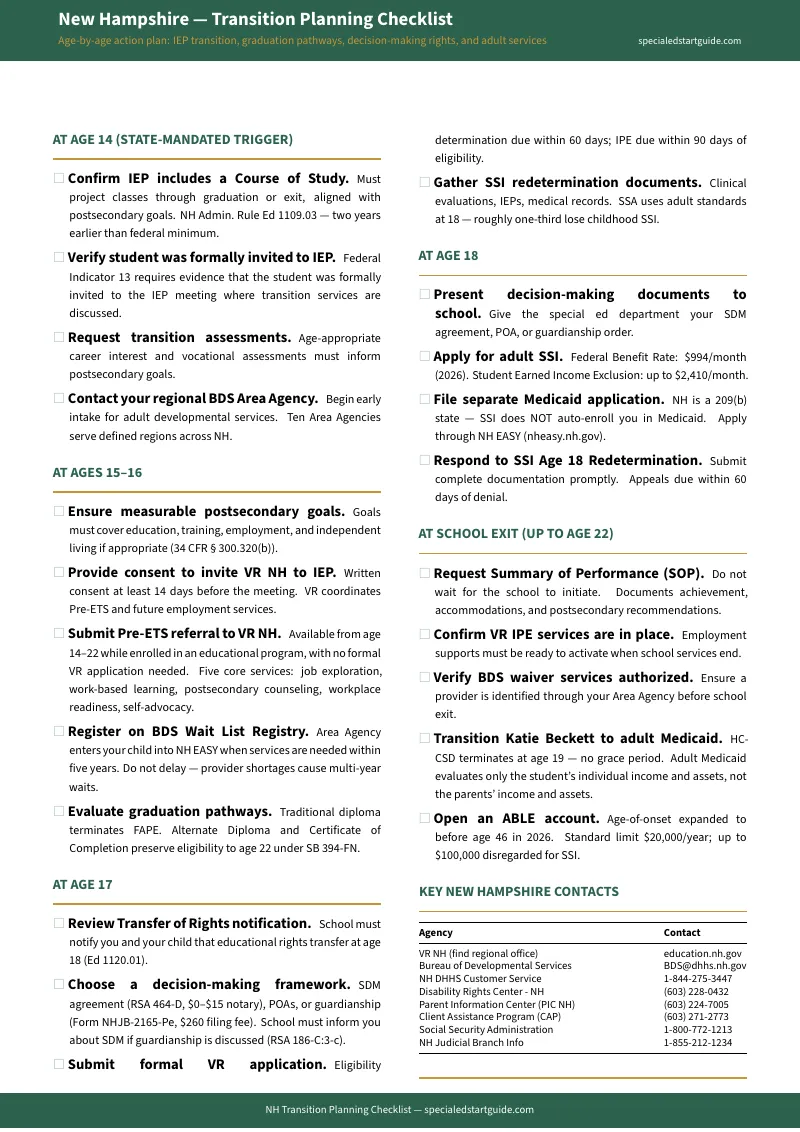
The free checklist gives you the bird's-eye timeline — every milestone from age 14 to 22 on one page. The full guide shows you how to execute each milestone, with the worksheets, scripts, and agency contacts to do it.
Both are yours to keep permanently. Download once, use forever.
Satisfaction Guarantee
If the guide doesn't save you time and reduce the confusion of coordinating New Hampshire's transition systems, email [email protected] for a full refund. No forms, no questions.
Frequently Asked Questions
What if the rules change after I buy?
We update the guide when the rules change. Email us any time, even years later, and we'll send you the current edition free.