
They Said "You Need Guardianship." Montana Law Says: Not So Fast.
Somewhere between the IEP meeting and the phone call with an attorney, you realized the truth: nobody is giving you the full picture. The school transition coordinator told you that you'll lose all educational rights on your child's 18th birthday. The estate planning attorney quoted you $3,310 to $7,770 and implied court was inevitable. The free online resources covered guardianship or supported decision-making — but never explained how to choose between them, or why Montana's version of SDM has a critical gap that can leave families stranded at the bank.
Montana's Senate Bill 31 (2021) requires every district court to consider supported decision-making before granting guardianship. That's a meaningful legal reform. But Montana never passed a standalone SDM enforcement act — which means a private supported decision-making agreement, by itself, cannot legally compel a bank to honor it, a hospital to accept it, or an insurer to recognize it. Families who rely on SDM alone can face sudden, devastating administrative rejections at the worst possible moment.
The Montana Guardianship & Alternatives Guide is the Supported Adulthood Planner — a structured decision system that walks you through every legal option from least restrictive to most restrictive, shows you exactly how to pair Montana's SDM framework with enforceable legal instruments, and helps you determine whether court-ordered guardianship is genuinely necessary for your family — before you spend thousands on an attorney to find out.
What's Inside the Guide
The Capacity Assessment Worksheet
Before you can choose the right legal framework, you need an objective assessment of your child's decision-making capabilities — not a gut feeling, not a doctor's one-paragraph letter. This print-and-fill worksheet guides you through six domains: daily living, healthcare, finances, education, employment, and social relationships. Each domain maps directly to the legal tools available in Montana. The result isn't a diagnosis — it's a structured analysis that tells you whether an SDM agreement resolves the need, whether you need to layer in powers of attorney, or whether the evidence points toward court.
The SDM Pairing Strategy and SDM Agreement Planner
This is the section that makes the guide structurally different from free resources. Montana defines supported decision-making and requires courts to consider it, but the state has no standalone enforcement act. That means a private SDM agreement — on its own — carries legal meaning but cannot compel third-party compliance. The pairing strategy shows you exactly how to combine a written SDM agreement with a durable financial power of attorney (MCA § 72-31-353), a healthcare power of attorney (Title 50, Chapter 9), a HIPAA release, and FERPA educational consent into a single cohesive packet that institutions are legally obligated to honor. The SDM agreement documents the relationship and capacity; the legal instruments provide the enforcement teeth. The included SDM Agreement Planner walks you through drafting your own agreement and pairing each life area with its binding instrument.
The Durable Power of Attorney Toolkit
Montana's Uniform Power of Attorney Act includes a feature many families don't know about: under MCA § 72-31-304, every power of attorney is durable by default. You don't need special durability language — the law protects you automatically. The toolkit covers the statutory form, notarization requirements (required — no witnesses needed), "hot powers" that require express grants under MCA § 72-31-336 (gifts, trust creation, beneficiary changes), and how to structure the agent's authority so banks and financial institutions accept it without delay.
The Healthcare Directive and HIPAA Toolkit
A healthcare power of attorney in Montana springs into effect only when the principal is clinically determined to lack capacity — it doesn't override your child's day-to-day medical decisions. The toolkit covers the DPHHS standard forms, the execution standards (notary or two independent adult witnesses), and a standalone HIPAA authorization that gives you immediate access to medical records and clinical discussions without waiting for an incapacity determination. Two separate tools, two separate purposes — the guide explains when each one activates and why you need both.
The Educational Rights Toolkit
When your child turns 18, FERPA transfers all educational privacy rights to them. But a student can voluntarily sign a FERPA release granting parents access to records and IEP meetings. The toolkit covers district-specific release forms, educational representative options for students who cannot provide informed consent, and the landmark Disability Rights Montana settlement extending FAPE eligibility to age 22 — which means you may have more time than the 18th-birthday deadline suggests.
The District Court Process Walkthrough and Court Filing Cost Calculator
If guardianship is necessary, your filing goes to the district court in the county where your child resides. Montana doesn't have a separate probate court system — the same district court judges who handle civil and criminal cases hear guardianship petitions. The walkthrough maps the full process: filing a verified petition under MCA § 72-5-311, the Court Visitor's mandatory home interview and report ($610 minimum), appointment of independent counsel for the respondent, the formal capacity hearing, and issuance of Letters of Guardianship. The Court Filing Cost Calculator lets you estimate the real total in your county — filing fee, process server, evaluations, and attorney fees on both sides — before you decide court is worth it. For rural families, it also covers the logistics of working with courts that may be 100+ miles from your home.
The SSI Redetermination Document Checklist
On your child's 18th birthday, parental income deeming stops — which means some children who were financially ineligible during childhood qualify for SSI for the first time. But existing recipients face a complete reassessment using the stricter adult disability standard. The checklist prepares you for the DDS interview: which clinical records and school evaluations to compile, how the Substantial Gainful Activity threshold works, when Section 301 educational continuation applies, and what to do if benefits are denied (Form SSA-561 within 60 days).
The ABLE Account Financial Planner
Montana ABLE accounts let you save up to $100,000 without jeopardizing SSI eligibility. The 2026 standard annual contribution limit is $20,000. The ABLE-to-Work provision allows an additional $15,650 from wages. Montana offers a state tax deduction of up to $3,000 ($6,000 for married filing jointly). And if the balance exceeds $100,000, SSI cash benefits suspend — but Medicaid coverage stays active. The planner tracks resources against the $2,000 SSI limit, calculates contribution caps, and maps the interactions between ABLE balances, SSI payments, and Medicaid eligibility.
The Representative Payee and Benefits Guide
The SSA does not recognize state guardianship as automatic payee authority. Whether or not you pursue guardianship, managing your child's SSI benefits requires a separate Representative Payee application directly with the SSA. The guide walks you through the Form SSA-11-BK application, the interview process, ongoing financial reporting, and the interaction between Representative Payee status, guardianship, and ABLE account management. For families where a parent receives a Montana TRS or PERS pension, it also explains how the 2025 Social Security Fairness Act eliminated the WEP and GPO offsets that previously reduced Childhood Disability Benefits.
The Print-and-Fill Planning Tools
Every decision in the guide has a matching tool you print and write on: the Support Instrument Decision Tree (one page from "can your child sign documents?" to the right legal tool), the Annual Reporting Calendar (every guardian and conservator deadline computed from your appointment date), and the Agency Communication Log (every SSA, DDP, VRBS, school, and court contact in one place). Bring them to attorney consultations, IEP meetings, SSA interviews, and the notary appointment.
Who This Guide Is For
This is for Montana parents facing the 18th birthday transition — whether you're eight months out and scrambling, or years ahead and planning strategically.
- You received the Transfer of Rights notice and realized you have months to figure out whether your child needs guardianship, supported decision-making, or something in between — and nobody gave you a framework for deciding
- Your child can make many decisions independently but struggles in specific domains, and "just get guardianship" feels like it would strip rights your child doesn't need to lose
- You live in rural Montana and the nearest legal aid office or specialized attorney is hours away — you need a structured, self-guided planning framework
- Your child receives SSI and you need to prepare for the Age-18 Redetermination — one wrong step and a third of recipients lose benefits
- You've been told to open an ABLE account but the contribution rules, SSI exemptions, and Medicaid interactions make it feel like a trap you'll accidentally trigger
- You've priced guardianship attorneys at $3,310 to $7,770+ and want to know whether court is even necessary before writing that retainer check
Why Not Just Use Free Resources?
The free resources are excellent — and they're fragmented, incomplete, and not sequenced for decision-making.
Disability Rights Montana is the leading advocate for supported decision-making in Montana — they helped drive Senate Bill 31. Their materials explain what SDM is and why it matters. But they don't walk you through the capacity evaluation that determines whether SDM alone is sufficient for your child's specific profile, or help you coordinate the SDM agreement with powers of attorney, HIPAA releases, and Representative Payee designations when SDM alone isn't enough.
The University of Montana Rural Institute has research-backed transition resources covering alternatives to guardianship. But the information is spread across separate web pages and PDFs with no chronological planning sequence — you're assembling a puzzle without the picture on the box.
Montana Legal Services Association provides free interactive form generators and legal assistance — but income eligibility limits exclude most middle-class families, and the self-help centers are legally prohibited from helping you select the correct forms or advising on which legal framework fits your situation.
Court websites list filing fees and office hours. They don't explain why a family that files for full guardianship when a Representative Payee designation and powers of attorney would have sufficed has spent thousands of dollars unnecessarily.
This guide takes everything these organizations publish — the statutory forms, the legal frameworks, the transition timelines — and organizes it into a structured decision sequence that starts with "what can my child do independently?" and ends with "here's the legal framework that fits, here's how to execute it, and here's how to protect benefits in the process."
Satisfaction Guarantee
Money-back guarantee, no time limit. If the guide doesn't give you a clear path forward for your child's 18th birthday transition, you get a full refund. No questions, no forms, no waiting.
The Free Checklist Gets You Started. The Full Guide Gets You Through.
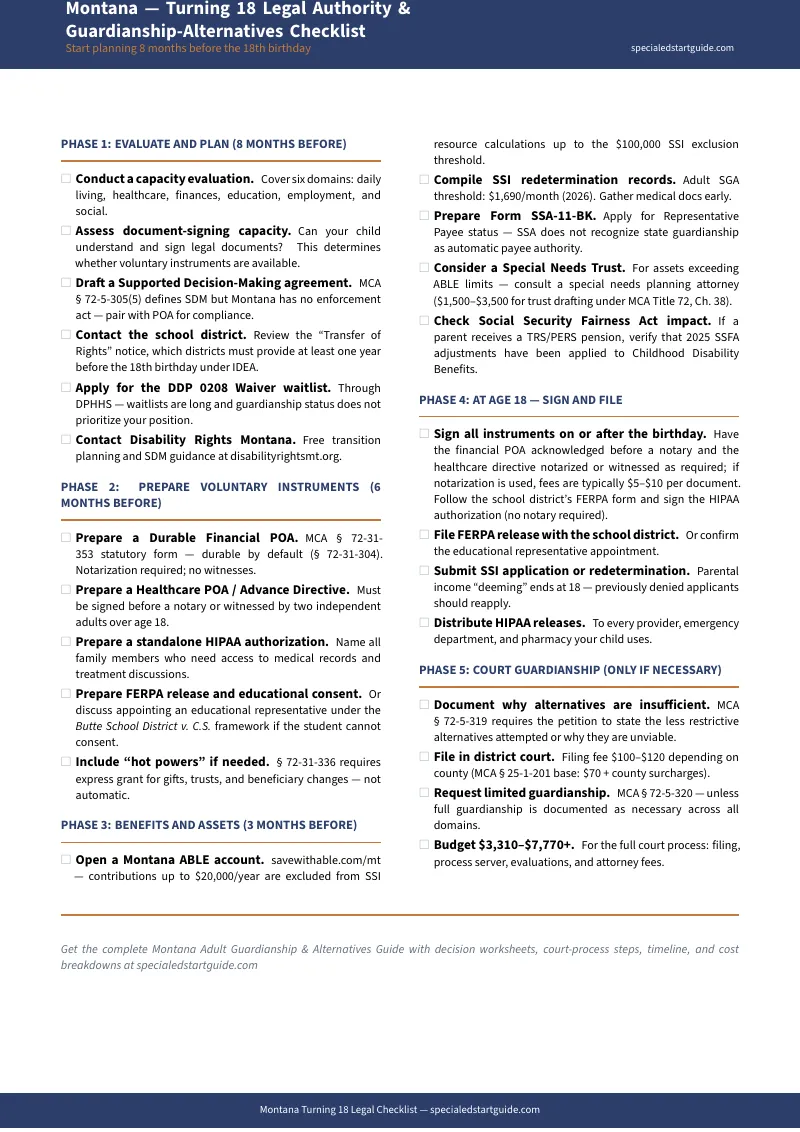
Download the free Montana Turning-18 Legal Checklist — 24 items covering the legal authority spectrum from supported decision-making through full guardianship, with key deadlines and the critical first steps every Montana family should take.
When you're ready for the Capacity Assessment Worksheet, the complete SDM pairing strategy and SDM Agreement Planner, the court process walkthrough and cost calculator, and the SSI/ABLE financial planning tools, the full guide picks up where the checklist stops.
Get the Montana Guardianship & Alternatives Guide — instant download, start the capacity evaluation tonight.