Your child turns 18. Michigan says they are an adult. You know they still need you.
One day your signature authorizes their surgery, manages their bank account, and advocates for them in every IEP meeting. The next day — their 18th birthday — Michigan law transfers all of that authority to them. No transition period. No grace for families whose child has a developmental disability. Just a hard legal cliff that leaves you standing outside every door you used to walk through.
Most parents learn about this cliff from a school district notice that arrives sometime around their child's 17th birthday. By then, they are already behind. The hospitals want a patient advocate designation. The bank wants a power of attorney. Social Security wants a representative payee application. The school wants a FERPA release. And each of these instruments has its own execution rules, witness requirements, and statutory deadlines that no single free resource in Michigan explains in one place.
The Transition Authority Blueprint
This guide gives you what the free brochures and scattered workshop PDFs do not — a single, linear workflow that takes you from "my child is turning 18" to "every legal instrument is executed and filed." It maps the full decision-support spectrum from the least restrictive option to the most restrictive, with the Michigan-specific statutory requirements for each one, so you choose the path that matches your child's actual capacity — not the path a well-meaning but overworked school counselor defaulted to.
You do not have to choose between stripping your child of their civil rights and hoping for the best. Michigan law already provides powerful tools — durable powers of attorney under the 2024 Uniform Power of Attorney Act, patient advocate designations under EPIC, FERPA educational releases, representative payee applications — that let your child keep their rights while legally authorizing you to act on their behalf. The guide shows you exactly how to execute each one, with the witness rules, notarization options, and activation requirements spelled out in plain language.
What's Inside
- The Decision-Support Spectrum (decision-worksheet.pdf) — a side-by-side comparison of every option from supported decision-making to full guardianship, plus a fillable domain worksheet so you can match healthcare, money, school, and daily living to the least-restrictive Michigan tool
- 2024 Power of Attorney Execution Guide (poa-execution-checklist.pdf) — Michigan repealed its old POA statute and enacted the Uniform Power of Attorney Act. Most online templates and law firm blog posts have not caught up. The printable walks you through the new execution requirements — two independent witnesses OR notarization, mandatory disclosure statements, and the Kimble Center plain-language forms that institutions are legally required to accept
- Patient Advocate Designation Kit (pad-witness-verification.pdf) — the witness exclusion rules for medical proxies in Michigan are strict (no family, no heirs, no care providers, no facility employees). The kit is a verbal verification script so you can confirm your witnesses qualify before you sign DCH-3916
- SSI Age-18 Redetermination Evidence Kit (ssi-redetermination-kit.pdf) — one-third of youth lose SSI at 18 because the adult disability standard is different from the childhood standard. The kit gives you the evidence matrix, the school-to-SSA evaluation request fields, and the Section 301 protection tracker so your child keeps their benefits and Medicaid coverage during the transition
- County Probate Filing Packet (county-probate-filing-packet.pdf) — if guardianship is the right path, the packet tracks the SCAO forms, the DD vs. LII track determination, the $175 LII filing fee (or $0 on the DD track), the MC 20 waiver, Wayne County extras (WCPC 99 and MC 505), and a line for your county clerk's MiFILE rules
- FERPA Educational Release Templates (ferpa-release-planner.pdf) — your child can stay in Michigan special education programs through their 26th birthday under MARSE. The planner keeps you in the IEP room and connected to school records the entire time
- MiABLE Account and Special Needs Trust Planner (miable-snt-planner.pdf) — save up to $100,000 without affecting SSI eligibility. Track the 2026 contribution limits, the age-46 onset expansion, and how to split money between ABLE and first-party or third-party special needs trusts
- Emergency Guardianship Workflow (emergency-guardianship-workflow.pdf) — for families in crisis: the temporary petition facts, the 24-hour personal service rule, the 28-day EPIC follow-up hearing (14 days on the DD temporary track), and the bridge to a permanent petition
- Timeline Planner and Annual Reporting Calendar (timeline-planner.pdf, annual-reporting-calendar.pdf) — month-by-month actions from eight months before the 18th birthday, then the 56-day annual report and conservator inventory deadlines if a court order is entered
Who This Is For
This guide is built for Michigan families whose child with a developmental or cognitive disability is approaching — or has just passed — their 18th birthday. Whether your child has an IEP, receives SSI, or you simply know they will need ongoing support with medical, financial, or educational decisions, this is the operational roadmap between the free advocacy PDFs that tell you what to think and the attorney retainers that charge thousands of dollars to tell you what to do.
Why Not Just Use the Free Resources?
Michigan has genuinely good free resources — Disability Rights Michigan publishes advocacy guides, Michigan Alliance for Families runs parent workshops, and the State Court Administrative Office provides blank court forms. The problem is not quality. The problem is fragmentation. The DRM brochures explain the philosophy of alternatives but do not give you step-by-step filing instructions. The MAF workshops are scattered across dozens of separate PDFs with no single chronological workflow. The SCAO forms are dense legal documents with no guidance on which boxes to check to request a limited guardianship instead of a full one.
This guide takes all of that scattered expertise and organizes it into one linear process — from the transfer-of-rights notice your school district sends before your child turns 17, through the execution of powers of attorney and medical proxies, through the SSI redetermination evidence gathering, through the probate court filing if that is the path you choose. Every step references the current Michigan statute, the correct SCAO form number, and the county-specific filing quirk you need to know about.
Satisfaction Guarantee
If the guide does not give you a clear, actionable plan for your child's turning-18 transition, email us for a full refund. No forms, no justification required.
Get Started Today
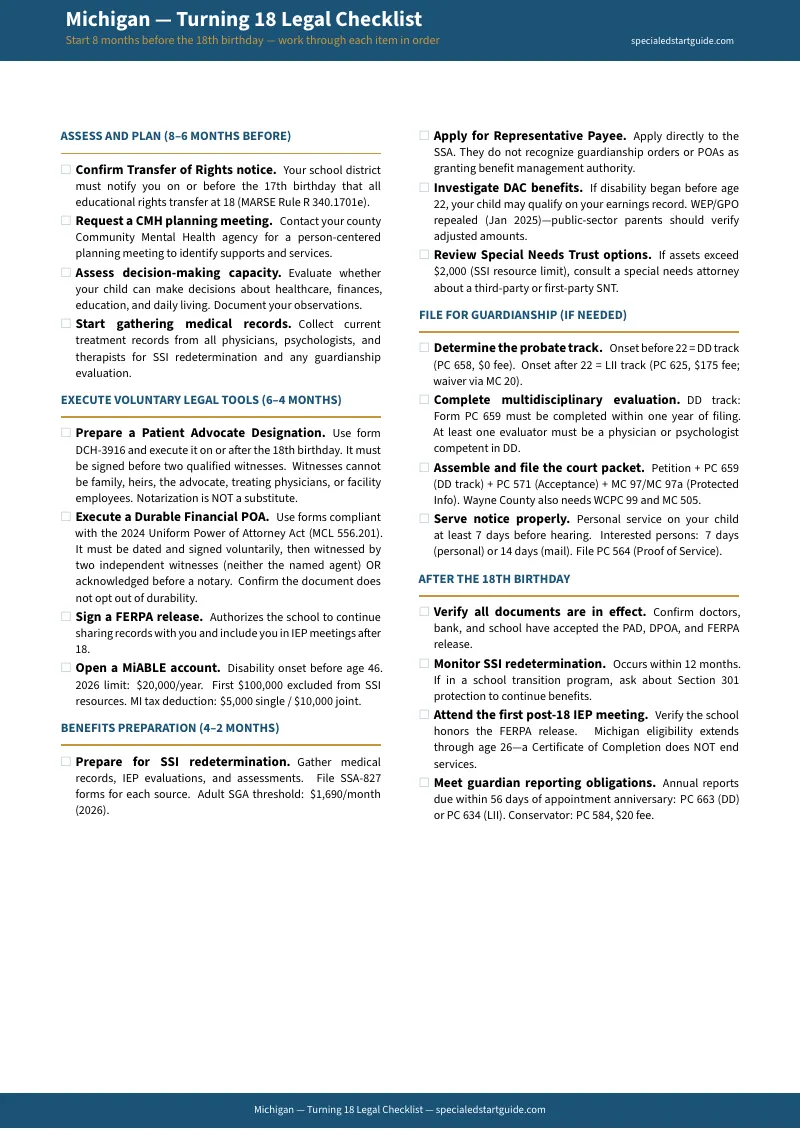
Download the free checklist to see the 20 critical action items. When you are ready for the full workflow — the legal context, the execution templates, the evidence kits, and the county-specific filing guides — the complete Michigan Adult Guardianship & Alternatives Guide is waiting for you at .