Your child's IEP team just said "transition." Here's what they didn't tell you about the next eight years.
Massachusetts starts transition planning at age 14 — two full years before the federal requirement. That early start exists because the system your teenager is about to enter is one of the most fragmented in the country. Between now and their 22nd birthday, you'll coordinate with your school district, MassAbility, the Department of Developmental Services, MassHealth, the Social Security Administration, and possibly the Bureau of Special Education Appeals. Each agency runs its own intake process, its own eligibility criteria, its own deadlines. None of them share a calendar with you or each other.
The free brochures from FCSN and Mass.gov explain the rules clearly. What they can't do is manage the overlapping deadlines that determine whether your child enters adulthood with services in place — or falls through the gap between the entitlement-based system they're leaving and the eligibility-based system they're entering.
That gap has a name: the Turning-22 Cliff. When special education entitlement ends on your child's 22nd birthday, there's no extension and no grace period. The families who land safely on the other side are the ones who started filing — not just planning, but filing — years before the cliff arrived.
The Transition Filing System: every agency, every deadline, every form — organized by the year your child needs it
This isn't a transition planner that summarizes the law and wishes you luck. The Massachusetts IEP Transition to Adulthood Guide is a filing-deadline management system that converts eight years of regulatory milestones across six agencies into a chronological task list. You open the chapter that matches your child's age, and it tells you exactly what to file, which agency handles it, and what happens if you miss the window.
Most transition guides tell you to "apply for vocational support." This one tells you to submit an application through the MassAbility Connect portal, explains that your child does not need to be an open Career Services client to access Pre-ETS, and walks you through the difference between a direct self-referral and the Chapter 688 referral your school district files on your behalf.
What's inside the guide
- The complete Massachusetts transition timeline (ages 14–22) — every regulatory milestone organized chronologically with the lead agency, statutory deadline, and specific action items, so you never have to guess what's due when
- MassAbility Pre-ETS navigation — how to connect with your high school's contracted provider, the five core Pre-ETS services available starting at age 14, and clarification that students don't need to be open Career Services clients to participate
- DDS adult eligibility roadmap — the three-step process from initial conversations at 14 through application at 17.5 to determination before 18, including documentation requirements and the revised regulations that eliminated the rigid IQ-based eligibility threshold for autism services
- Transfer of rights decision framework — the mandatory one-year advance notification your district must deliver before your child turns 18, plus guidance on choosing between guardianship, durable power of attorney, and Supported Decision-Making agreements using Center for Public Representation templates
- The diploma-vs-certificate analysis — why accepting a standard diploma immediately terminates special education eligibility, while a certificate of completion preserves access to school-based transition services and community training through age 22
- Chapter 688 referral tracking — what the electronic referral through the EOHHS Virtual Gateway actually triggers, why it's not an active service application, who files it, and how to confirm the transitional agency opens your child's case file
- SSI and benefits coordination at age 18 — the Age-18 Redetermination process, how parental income deeming ends, the Federal Benefit Rate formula, unearned income exclusion calculations, and why keeping SSI active — even at a minimal payment — preserves automatic MassHealth eligibility
- ABLE account setup — how to open a MEFA Attainable Savings Plan, the baseline annual contribution limit, and the additional earned-income contribution for working beneficiaries
- Disabled Adult Child (DAC) benefits — eligibility rules based on onset before age 22, payment thresholds, and the Section 1634 protection that preserves MassHealth coverage when DAC benefits reduce SSI
- Dispute resolution tools — how to use the Bureau of Special Education Appeals for mediation, advisory opinions, or due process, and the Problem Resolution System for compliance complaints
- College transition chapter — why IEPs don't transfer to postsecondary settings, how to register with college disability offices for Section 504/ADA accommodations, and the MA Inclusive Concurrent Enrollment Initiative
- Social Security Fairness Act impact — how the January 2025 repeal of WEP and GPO affects Massachusetts public-employee families and their children's DAC benefits
- Seven fillable worksheets — Transition Timeline Tracker, Agency Communication Log, ITP Meeting Preparation Worksheet, Benefit and Account Tracker, Graduation Decision Worksheet, Agency Preference Worksheet, and SDM vs. Guardianship Comparison Worksheet, each designed to print and write on
Who this guide is for
This guide is for Massachusetts parents whose child has an IEP and is approaching — or already in — the transition years. You might recognize your situation:
- Your child's IEP team introduced transition planning and you don't know how to write measurable postsecondary goals that satisfy the revised DESE form
- You've been told to apply for DDS adult eligibility "soon" but nobody gave you a specific age or explained the consequences of applying late
- The school mentioned MassAbility and Pre-ETS, but you don't know whether your child qualifies, who the provider is, or how to start
- Your child is approaching 18 and you need to choose between guardianship, power of attorney, and Supported Decision-Making — with SDM legislation still pending
- Someone mentioned Chapter 688 but didn't explain that it's a referral your school district files, not something you apply for, and that it doesn't guarantee services
- Your child could graduate with a standard diploma this year and nobody told you it terminates their right to school-based transition services immediately
- You've been managing the IEP for years but you've never coordinated with four state agencies at once, and the deadlines don't align
Why free transition resources aren't enough
The Federation for Children with Special Needs (FCSN) runs workshops. Exceptional Lives publishes accessible guides. Mass.gov hosts the Chapter 688 brochure and MassAbility service descriptions. All of these are helpful — and none of them manage the multi-agency calendar that actually determines whether your child's adult services are in place when school ends.
A brochure tells you that DDS adult eligibility should be established before age 18. It doesn't tell you that applying at 17.5 instead of 18 is critical because the determination process itself takes months, and a gap means your child turns 18 as their own legal decision-maker with no adult services agency aware they exist.
This guide fills the gap between "here's how the system works" and "here's exactly what you need to file this year."
What about hiring a special education advocate?
You may eventually need one — particularly for BSEA disputes or if your school district resists filing the Chapter 688 referral. Massachusetts advocates and special needs attorneys charge $150 to $420 per hour. If you walk into that first consultation with an unorganized collection of IEP documents, transition assessments, and agency correspondence, you'll spend the first several billable hours paying them to understand your situation.
This guide helps you organize the administrative timeline before you hire anyone — so your consultation starts with strategy instead of triage.
Included at no extra cost: the transition planning checklist
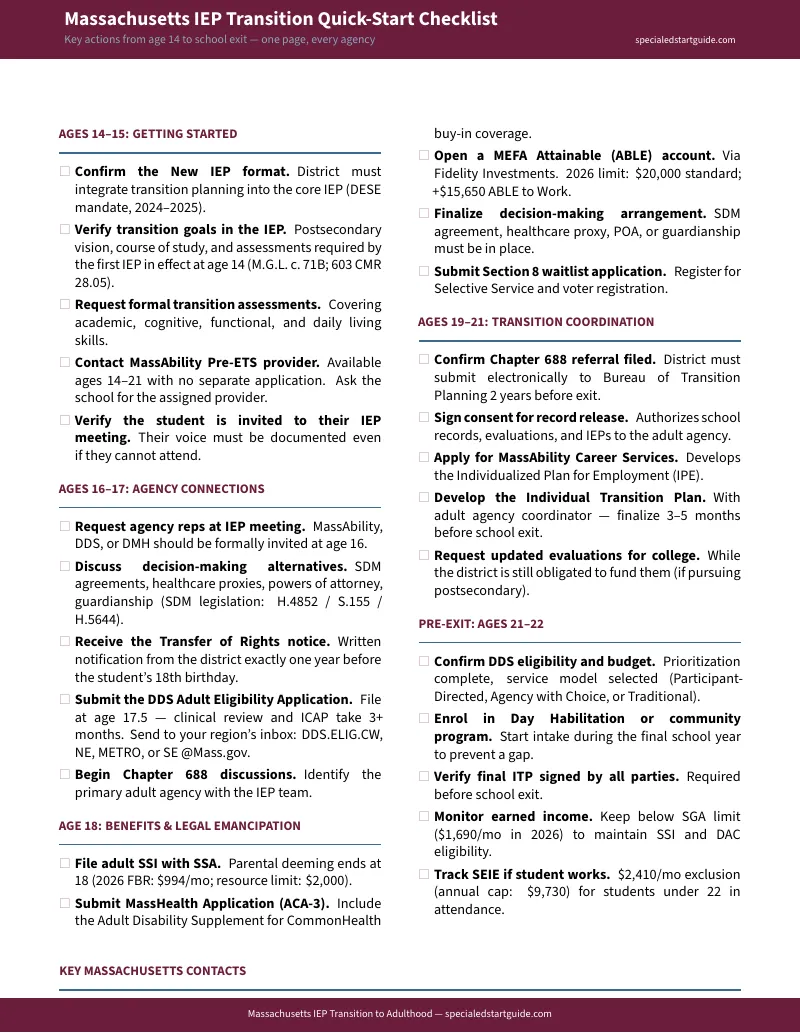
Every purchase includes the Massachusetts Transition Planning Checklist — a printable two-page summary of every critical filing deadline organized by age. Post it on the refrigerator. Bring it to every IEP meeting. Use it to verify that your school district is meeting its own statutory obligations.
The checklist is also available as a free standalone download — no purchase required — so you can start tracking deadlines today.
Your guarantee
If the guide doesn't help you navigate the Massachusetts transition process, email us at any time for a full refund. No forms, no justification required.
Stop guessing which deadline comes next
The transition to adulthood isn't one decision — it's hundreds of filings, applications, and agency intakes spread across eight years. The families who get through it with services intact are the ones who track every deadline from the first transition IEP at 14 through the last Chapter 688 intake at 22.
Get the Massachusetts Transition Guide — instant download. Start organizing the timeline tonight.
Already have the checklist? Upgrade to the full guide for the complete filing system, agency-by-agency roadmaps, and benefits coordination worksheets.