Your child turns 18 in Maryland. Five agencies start five separate clocks. Nobody hands you the order of operations.
The SSA sends a redetermination letter that applies adult disability standards to a case approved under childhood criteria. Maryland is a Section 1634 state, so SSI approval automatically enrolls Medicaid — but an SSI denial does not, and you must file a separate ABD application through myDHR before coverage lapses. At 18, Medicaid also shifts from family-income MAGI rules to the restrictive ABD category, where the $2,500 asset limit starts counting. The DDA determines your child eligible for services, then places them on a needs-based waiting list where "eligible" does not mean "funded." DORS offers two employment support tracks, but only if you know to apply before age 21. And your child's legal decision-making framework must be resolved — whether that means supported decision-making, power of attorney, or guardianship — because Maryland's transfer-of-rights exception does not protect financial or medical decisions the way most parents assume.
The free resources are real and valuable. Disability Rights Maryland publishes comprehensive rights handbooks. Parents' Place of Maryland hosts transition workshops and peer consultations. The DDA regional offices maintain eligibility guidance. Each organization covers its own domain thoroughly. But each resource covers its own program in isolation. None of them gives you the full sequence — which applications gate which other applications, which deadlines are absolute, which filings can run in parallel, and what happens to Medicaid if the SSI redetermination is denied before you have filed the ABD conversion.
That sequencing gap is where families get hurt. Not from bad advice — from incomplete advice delivered one agency at a time.
The Transition Sequencing System — Every Agency, Every Form, Every Deadline in Order
The Maryland SSI at 18 & Adult Disability Benefits Guide is a 15-chapter process manual that organizes five agency systems into a single chronological workflow. It does not replace the individual agency resources — it connects them into the sequence that prevents gaps, missed deadlines, and coverage disruptions.
Where free resources explain what each program does, this guide maps which steps to take when, which applications depend on which outcomes, and what to file before a deadline you didn't know existed closes.
What's Inside
- The SSI age-18 redetermination walkthrough — the adult standard that replaces childhood criteria, what Forms SSA-3368, SSA-3369, and SSA-3373 require, how to prepare medical evidence before the SSA contacts you, the 2026 Federal Benefit Rate of $994/month, the pro-rata rent strategy that prevents a one-third SSI reduction, the 60-day reconsideration deadline, and the full four-level appeal process with the critical 10-day benefit continuation window
- DAC benefits on a parent's work record — eligibility when a parent retires or passes away, the before-age-22 onset requirement, how DAC interacts with SSI, and why the Social Security Fairness Act's January 2025 repeal of WEP and GPO means previously reduced benefits are fully restored (any Maryland guide still warning about WEP/GPO reductions is outdated)
- Maryland Medicaid at 18 decoded — how SSI approval automatically enrolls Medicaid under Maryland's Section 1634 agreement (and why an SSI denial requires a separate myDHR ABD filing), the shift from MAGI to ABD, the 2026 asset limits ($2,500 ABD individual, $2,000 SSI), the $350/month Medically Needy Income Level, Maryland's spend-down mechanism, the Employed Individuals with Disabilities (EID) program, and why no Miller Trust is required because Maryland is a spend-down state
- Legal decision-making options compared — Maryland's protective transfer-of-rights exception under Educ. Art. § 8-412.1 and COMAR 13A.05.01.11B (educational rights stay with parents unless formally transferred — unlike nearly every other state), the 2022 Supported Decision-Making Act, durable power of attorney, representative payee designation, and court guardianship, with a comparison framework for choosing the least restrictive option
- The DDA and the Community Pathways Waiver — the October 2025 consolidation that merged Family Supports and Community Supports into the unified Community Pathways Waiver, the four waiting list priority categories under COMAR 10.22.12.07 (Crisis Resolution, Crisis Prevention, Current Request, Future Needs Registry), how to document changed circumstances for a priority reassessment, and the DDA regional office directory covering all four Maryland regions
- ABLE accounts and special needs trusts — the 2026 annual contribution limit of $20,000 ($35,650 with ABLE-to-Work), the $100,000 SSI resource disregard, the expanded eligibility threshold (disability onset before age 46, up from 26), the Maryland state tax deduction, and when a special needs trust is the better vehicle
- DORS employment services — Pre-Employment Transition Services and Student Employment Services available through age 21, the Individual Plan for Employment, how to coordinate with IEP transition goals, and the work incentives (Student Earned Income Exclusion, Section 1619(b)) that protect benefits while your adult child earns income
- The Governor's Transitioning Youth Initiative (GTYI) — how to access dedicated day and employment funding at school exit through the DDA
- The multi-agency action plan from age 14 through school exit — every application, referral, and deadline mapped chronologically across SSA, Medicaid, DDA, DORS, and the school system
- Forms, portals, and agency contacts — every form number, every online portal, every DDA regional office phone number and address, every relevant agency contact in one reference section
Printable worksheets included with the download (fill these in and carry them to appointments):
- agency-communication-log.pdf — landscape log for every SSA, Medicaid, DDA, DORS, and school contact
- pro-rata-rent-agreement.pdf — fill-in living arrangement plus payment log to prevent the SSI one-third reduction
- ssi-redetermination-checklist.pdf — evidence dossier, Forms SSA-3368 / 3369 / 3373, and the 10-day / 60-day appeal fields
- decision-making-comparison.pdf — SDM vs. DPOA vs. Representative Payee vs. guardianship before age 18
- sdm-agreement-worksheet.pdf — draft Supported Decision-Making agreement with witness lines
- dda-waiting-list-tracker.pdf — eligibility filing, COMAR 10.22.12.07 priority category, and escalation packet
- able-account-tracker.pdf — Maryland ABLE contribution and qualifying-expense log
- transition-action-plan.pdf — master dated tracker from age 14 through school exit
- medicaid-abd-worksheet.pdf — 1634 auto-enroll vs. myDHR ABD path, spend-down log, EID, fair-hearing deadlines
- annual-maintenance-calendar.pdf — LISS window, 183-day waiver use, SSA-623, PCP 20-day deadline, trigger events
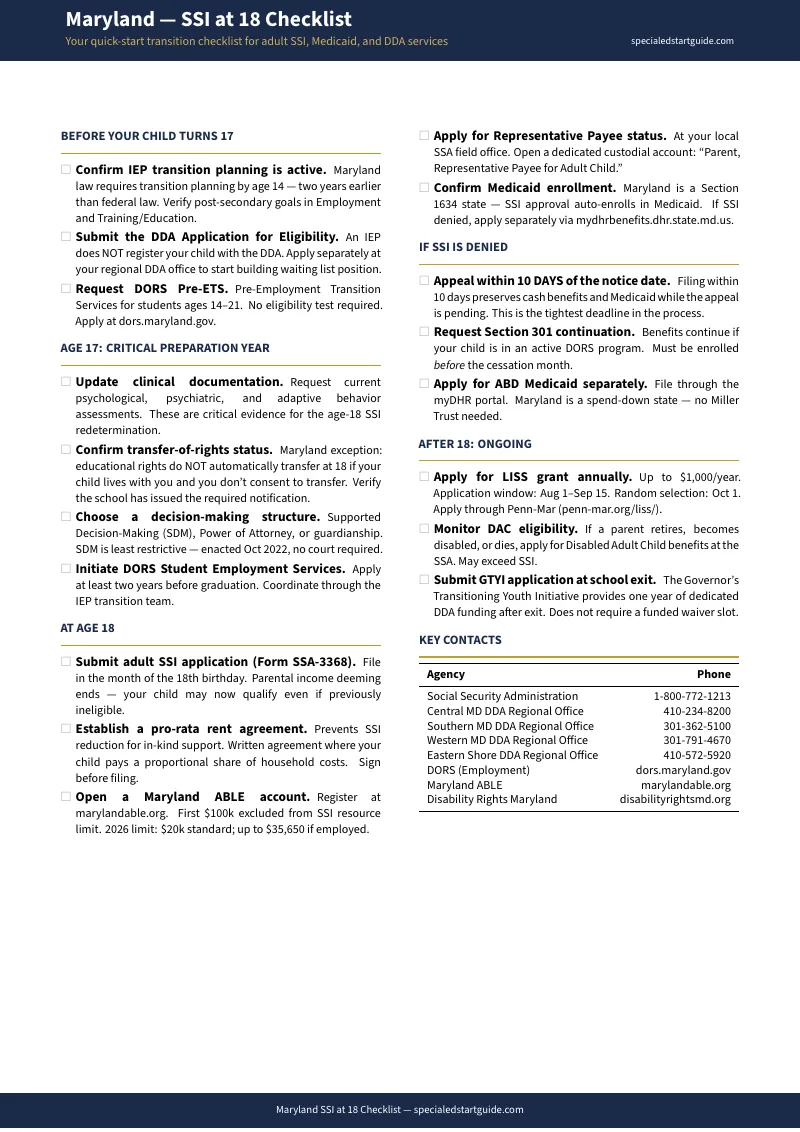
The free Maryland — SSI at 18 Checklist is included with every purchase — a one-page printable checklist covering the most critical actions from age 14 through school exit.
Who This Guide Is For
Maryland parents and guardians of young adults with intellectual or developmental disabilities who are approaching, currently navigating, or recently past the age-18 transition — and who need the full sequence of steps across SSA, Medicaid, DDA, DORS, and the school system in one place.
- You received the SSA's age-18 redetermination letter and are not sure what "adult disability standards" means for your child's current SSI eligibility
- Your child is about to turn 18 and you know Medicaid eligibility rules change but do not know the difference between MAGI and ABD, what the $2,500 asset limit means, or how Maryland's spend-down system works
- The IEP transition plan mentioned "adult services" but nobody explained that the DDA, DORS, and Medicaid each require separate applications that the school does not file for you
- You applied to the DDA, received an eligibility determination, and assumed services would follow — only to discover a needs-based waiting list with no guarantee of funded services this year
- You want to save money for your child's future but are afraid that any savings above $2,000 will disqualify them from SSI and Medicaid
- Your young adult wants to work and you need the actual thresholds — not reassurances — for how earned income affects cash benefits and healthcare coverage
- You are weighing guardianship against supported decision-making and need to understand what Maryland's 2022 SDM statute actually allows versus what court guardianship restricts
Why Free Resources Alone Leave Gaps
The free resources from Disability Rights Maryland, Parents' Place of Maryland, the DDA, and DORS are genuinely valuable — this guide references many of them. The problem is structural, not qualitative.
Each agency publishes information about its own programs. DRM's rights handbooks explain legal protections. PPMD's transition factsheets cover program-by-program awareness. The DDA publishes eligibility criteria and regional office contacts. But none of them can tell you: "File the SSI adult application before the Medicaid ABD conversion because the SSI denial triggers a different Medicaid pathway, and you need to have the DDA application submitted before age 21 to preserve GTYI eligibility, and the ABLE account should be open before any back-pay arrives because retroactive SSI deposits above $2,000 can immediately disqualify your child from the benefits they just won."
That sequencing — which steps gate which other steps, which deadlines are absolute, and which applications can run in parallel — is what this guide provides. One document, one timeline, one reference point instead of five agency websites and three phone calls per office.
Satisfaction Guarantee
If the guide does not change how you prepare for your child's transition — if the timelines, form references, and agency sequences do not save you confusion, missed deadlines, or hours of scattered research — email [email protected] at any time for a full refund.
Get Started
The free Maryland — SSI at 18 Checklist gives you the one-page overview — every critical action from age 14 through school exit on a single printable page. Download it now, or get the full Maryland SSI at 18 & Adult Disability Benefits Guide for the complete walkthrough with every form, every portal, and every deadline across all five agencies.
The transition timeline does not pause while you research. The SSI redetermination appeal window closes in 60 days. The DDA waiting list does not get shorter while you wait. DORS Pre-ETS expires at age 21. And every month without a pro-rata rent agreement in place is a month the SSA may reduce your child's benefits by one-third.
Get the Maryland SSI at 18 & Adult Disability Benefits Guide →