The ARC meeting said "transition" — and now your child's future runs through four agencies that don't coordinate with each other
Your child's school district handles the IEP through the Admissions and Release Committee. The Office of Vocational Rehabilitation handles job training and Pre-ETS. The Department for Behavioral Health, Developmental, and Intellectual Disabilities manages the Medicaid waivers. The Social Security Administration controls the SSI benefits. Each system has its own eligibility rules, its own application process, and its own timeline. None of them will tell you what to do with the other three — and if you miss a step, the consequences don't surface until your child ages out of school services and the safety net disappears.
Kentucky adds complications that generic transition resources miss entirely. The state triggers transition planning at age 14 under 707 KAR 1:320 — two years before the federal default. OVR's Order of Selection has closed all traditional rehabilitation categories to new applicants, but Pre-ETS remains fully open through a separate pathway most families don't know about. And Kentucky has no formal supported decision-making statute, which means the standard approach to guardianship alternatives doesn't apply here the way it does in most states.
The Four-Agency Coordination System
The Kentucky IEP Transition to Adulthood Guide is built around the central challenge Kentucky families face: coordinating four independent systems on a timeline that starts in middle school and runs through the school year your child turns 21. The guide maps every milestone across the school district, OVR, DBHDID, and SSA into a single chronological workflow — so you can see which application to file, which consent form to submit, and which meeting to prepare for at each stage.
This isn't a generic IEP binder with federal-only requirements. Kentucky's age-14 trigger, its ARC process, its Order of Selection workaround through Pre-ETS, its SCL and Michelle P. waiver waitlist structure, its STABLE account program, and the landmark Suzanne Heck case that established supported decision-making as a court-recognized alternative to guardianship — all of these are built into the system. Every step references the specific Kentucky regulation, statute, or agency process it corresponds to.
What's Inside
The full guide includes a 49-page walkthrough, a printable transition checklist, and eight standalone worksheets — tools you can print and bring to ARC meetings, OVR intake appointments, and waiver application sessions.
- 707 KAR Transition Roadmap — every action item from the age-14 ARC transition trigger through age 21, mapped to the specific Kentucky administrative regulation that requires it, so you know whether your district is meeting its obligations at each milestone
- Diploma Pathway Decision Matrix — a clear breakdown of how a regular high school diploma terminates FAPE eligibility, how the Alternate High School Diploma (formalized by HB 562) preserves services through age 21, and the academic, career, and service-access implications of each track
- OVR Pre-ETS Application Walkthrough — step-by-step instructions for the Pre-ETS referral form, including how to access all five core services as a "potentially eligible" student without going through the Order of Selection waitlist that has closed traditional rehabilitation categories
- Medicaid Waiver Navigation Guide — SCL and Michelle P. waiver eligibility criteria, the Kynect portal application process, ICF/IID level of care documentation requirements, and an explanation of waitlist categories (Emergency, Urgent, Future Planning) so you can position your child before school services end
- SSI, DAC, and STABLE Account Coordination — the adult SSI application timeline, the age-18 redetermination shift from childhood to adult medical criteria, the elimination of parental income deeming, Disabled Adult Child benefit calculations, the impact of the Social Security Fairness Act (GPO and WEP repealed January 2025), and STABLE account setup including the 2026 contribution limits
- Guardianship Alternatives Toolkit — because Kentucky lacks a formal SDM statute, the guide builds on the Suzanne Heck case to show how to structure a supported decision-making agreement that Kentucky courts and institutions will recognize, alongside powers of attorney, healthcare surrogate designations, and limited guardianship options
- Community Work Transition Project (CWTP) Guide — how Kentucky's school-to-work partnership between KDE and OVR provides customized employment training, and how to coordinate CWTP services with Pre-ETS and SCL-funded supported employment after graduation
- Dispute Resolution Roadmap — Kentucky's state complaint procedures, mediation, and due process hearing options, with guidance on connecting with KY-SPIN and the Department of Public Advocacy's Protection and Advocacy Division for additional support
Who This Guide Is For
- Parents whose child just hit the age-14 transition trigger and want to start the ARC transition process right
- Families in rural Kentucky where transition coordinators are stretched across entire districts and you're effectively coordinating agencies on your own
- Parents of young adults aged 18–21 who need to navigate the shift from school services to Medicaid waivers, OVR, and SSI before school-age eligibility expires
- Families approaching age 18 who need to decide between guardianship, SDM, and powers of attorney — in a state where the standard SDM playbook requires a different approach
- Anyone trying to coordinate between the school district, OVR, DBHDID, and SSA without paying an advocate or attorney
Why Free Resources Aren't Enough
Kentucky has useful free resources — the KDE's transition guidance documents, KY-SPIN's parent training workshops, and the Human Development Institute's "Journey to Adulthood" guide. The problem isn't quality. It's that they're siloed by agency and designed for compliance, not coordination.
The KDE's transition documents don't explain how to file an OVR Pre-ETS referral. OVR materials don't address Medicaid waiver timelines. KY-SPIN provides peer support and workshops but doesn't offer step-by-step application walkthroughs for the Kynect waiver portal. And the HDI's "Journey to Adulthood" guide — written for use "ANYONE, ANYWHERE, ANYTIME" — doesn't account for Kentucky's specific Order of Selection closure, its lack of an SDM statute, or its unique waiver waitlist categories.
Generic transition templates on Teachers Pay Teachers or Etsy are worse. They rely on federal IDEA baselines — age 16 transition start, standard diploma assumptions — and miss Kentucky's regulations entirely.
The guide bridges those gaps. It takes what each agency publishes separately and organizes it into a single workflow where every step follows the one before it and you can see where all four systems intersect.
Special education attorneys charge $250+ per hour. Independent advocates run $80–$150 per hour. This guide delivers the same level of planning detail, available the moment you download it.
100% Satisfaction Guarantee
If the guide doesn't help you take clear, informed action on your child's transition, email us and we'll refund your purchase. No conditions, no time limit.
Start With the Free Checklist — or Get the Full Guide
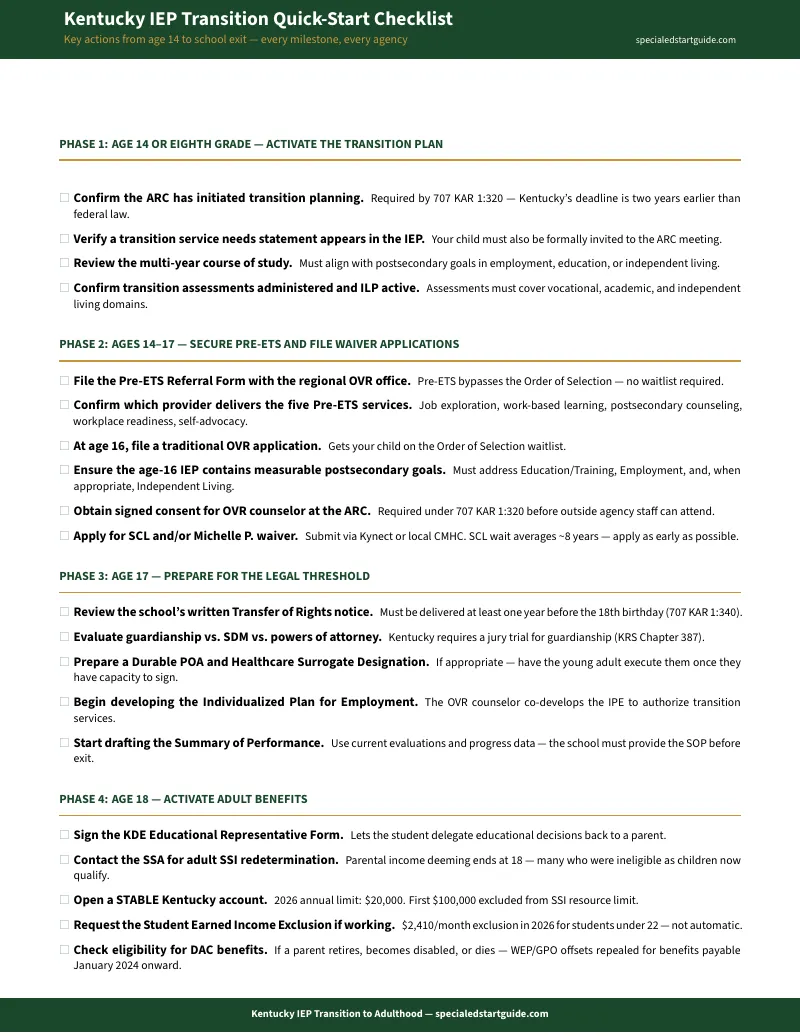
Download the free Kentucky Transition Planning Checklist to see the milestones and action items at a glance. When you're ready for the complete step-by-step system — with printable worksheets, application walkthroughs, and the full Four-Agency Coordination timeline — the full guide is waiting.
Get the Kentucky IEP Transition to Adulthood Guide →
Frequently Asked Questions
What if the rules change after I buy?
We update the guide when the rules change. Email us any time, even years later, and we'll send you the current edition free.