Indiana's transition system spans five agencies, eight years, and zero coordination between them. This guide is the coordination layer that doesn't exist.
Your child's school just handed you a Transition IEP generated from a dropdown menu — "measurable postsecondary goals" copied from a compliance template, "age-appropriate transition assessments" checked off without explanation, and a course-of-study section that looks identical to every other student's in the district. You walked out of the Case Conference with a thick document and no clearer idea what to actually do next than when you walked in.
Here's why that keeps happening. Indiana's transition system is split across agencies that can't advise you on each other's programs. The school explains the IEP. Vocational Rehabilitation Services explains Pre-ETS. The Bureau of Disabilities Services explains the waiver. Indiana Family to Family offers emotional support. And none of them are permitted to tell you how to sequence these programs together, time a BDS Gateway application so you don't lose your waitlist position, or help you decide between Supported Decision-Making and the Educational Representative process at age 18. Those decisions fall in the gaps between the agencies — the exact gaps where families lose months, miss application windows, and watch services disappear.
The Indiana IEP Transition to Adulthood Guide is a Transition Integration System — a single, chronological framework that connects every agency, every filing deadline, and every decision point from the first TIEP at age 14 through the school-year exit at 22. It doesn't duplicate the free brochures. It sequences them into a timeline that shows exactly when to act, which agency to contact, and what happens if you don't.
What's Inside
- Complete transition timeline from 14 to 22 — every milestone in the order you'll actually face them, with the lead agency, the regulatory citation, and your specific action items laid out so you stop discovering deadlines after they've passed
- TIEP audit framework — how to evaluate whether your child's Transition IEP actually meets Article 7 requirements under 511 IAC 7-43-4, rewrite generic dropdown goals into measurable postsecondary targets backed by real transition assessments, and document what the school needs to fix before the next Case Conference
- Graduation pathway decision guide — the legal difference between a regular high school diploma (which terminates FAPE the day it's issued), the Indiana Alternate Diploma (which preserves eligibility through 22 for students with significant cognitive disabilities), and a Certificate of Completion (which preserves eligibility through 22 for all qualifying students) — because the school will ask you to choose, and most families don't realize this decision is irreversible
- Transfer of rights at 18 — all three options mapped — a side-by-side comparison of Supported Decision-Making agreements, the Educational Representative appointment under 511 IAC 7-43-6 (free, school-based, requires no court involvement), and full legal guardianship (expensive, restrictive, and difficult to reverse), so you can protect your child's future without defaulting to the most expensive option
- Pre-ETS and VR coordination guide — the five core Pre-Employment Transition Services available starting at 14 with no VR application required, the critical handoff to formal Vocational Rehabilitation services during the exit year, the 60-day eligibility determination timeline, and how to ensure your child has an Individualized Plan for Employment before school services end
- BDS waiver application system — step-by-step instructions for the BDS Gateway application, monitoring your position on the HCBS Waitlist Portal, surviving the 30-day response window and 21-day medical review without losing your slot to automatic rescission, and navigating the Family Supports Waiver's approximately $19,614 annual capped budget and the uncapped Community Integration and Habilitation waiver
- Waiver Reset preparedness guide — what the August 2026 case management transition means for your family, which of the five contracted statewide companies will handle your case, the July 2027 Youth Waiver launch, and how the interRAI assessment tool will replace current Algo levels by 2028
- SSI and asset protection toolkit — a worked example walking through the age-18 adult SSI redetermination, how qualifying for SSI automatically establishes Indiana Medicaid Disability coverage, ABLE account rules through INvestABLE Indiana, and the math behind keeping benefits while building savings
- Dispute resolution playbook — the state complaint process through I-CHAMP, mediation through IDOE, due process hearings at the Office of Administrative Law Proceedings, the Client Assistance Program for VR disputes, and BDS waiver appeal timelines — so you know your escalation options before you need them
- Nine fillable worksheets — Transition Timeline Planner, Diploma Pathway Decision Worksheet, CCC Meeting Preparation Checklist, Waiver Application Tracker, VR Application and IPE Tracker, Educational Representative Certification Checklist, Agency Communication Log, SSI and Benefits Tracking Worksheet, and Summary of Performance Review Checklist
- Complete resource directory — direct links to IDOE, FSSA, BDS Gateway, all five contracted case management companies, regional VR offices, Indiana postsecondary disability services programs, and every form referenced in the guide
Who It's For
This guide is built for Indiana parents at every stage of the transition process — whether your child just triggered the TIEP at 14 or you're scrambling to set up adult services before the school-year exit at 22.
- You just received a Transition IEP with boilerplate goals and you need to know what a compliant, useful TIEP actually looks like before the next Case Conference
- Your child is approaching 17 and the school mentioned "transfer of rights" — but nobody explained what you can do about it or that a free alternative to guardianship exists
- The district is encouraging your child to accept a regular diploma and you aren't sure whether the graduation ceremony is worth permanently losing transition services
- You need to coordinate VRS, BDS, the SSA, and the school simultaneously and the timelines from each agency contradict each other
- Your child already graduated or aged out and nobody set up VR or the BDS waiver — you need the self-referral process laid out step by step
- You've been quoted $75–$150/hour for an advocate and $300+/hour for a special education attorney and you want to get organized before deciding if professional help is worth the cost
Why the Free Resources Leave You Stuck
Indiana has genuinely useful free resources — IDOE publishes Article 7 guidance, the Indiana Secondary Transition Resource Center offers training modules, VRS distributes Pre-ETS brochures, BDS maintains the waiver portal, and Indiana Family to Family provides checklists and webinars. Every one of these covers its own piece of the system well.
But none of them can show you the full picture, because none of them are allowed to. No state resource tells you how to time a BDS Gateway application so it aligns with the school exit calendar. No free brochure compares Supported Decision-Making, the Educational Representative process, and guardianship side by side — school staff can't advise on legal alternatives, and court clerks can't advise on school-based alternatives. No INSTRC training module explains how to coordinate Pre-ETS and formal VR services so there's no gap when FAPE ends.
Each brochure answers one question. This guide answers the question nobody else can: in what order, and by when?
The Guarantee
Money-back guarantee, no time limit. If the guide doesn't help you navigate your child's transition, email [email protected] for a full refund — no forms, no questions.
Start Before the System Moves Without You
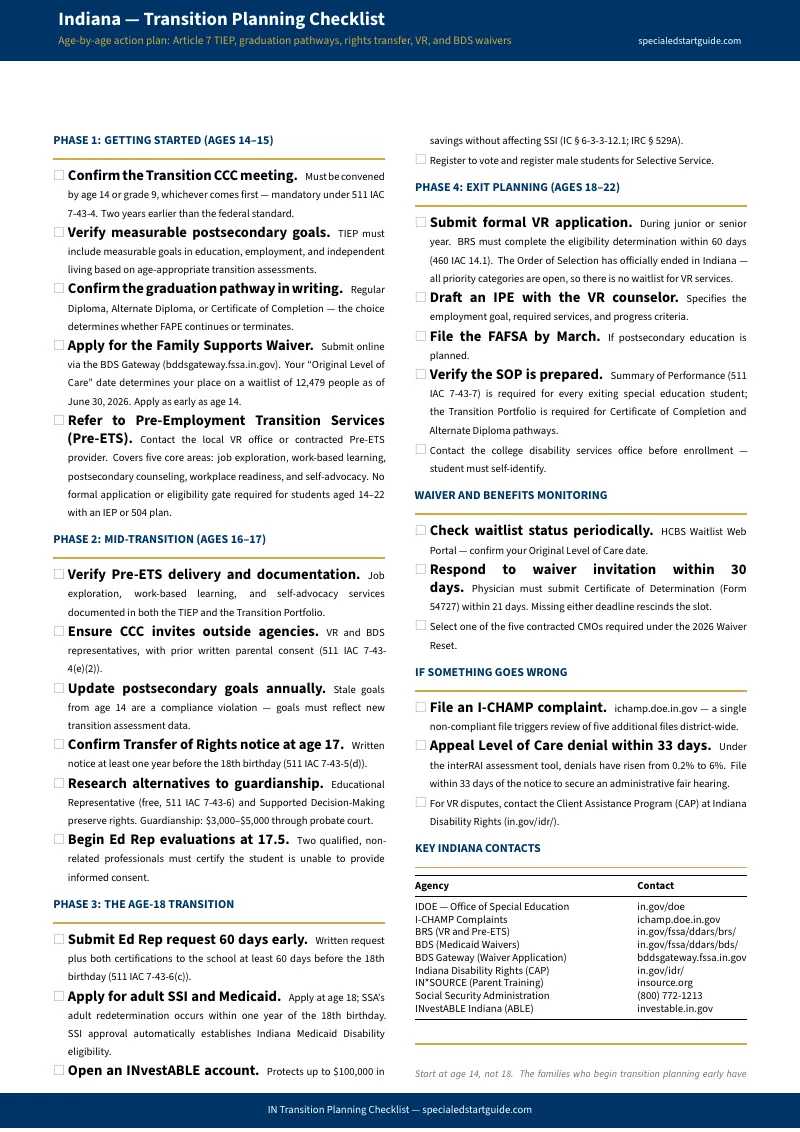
Download the free Indiana Transition Planning Checklist — a printable two-page timeline covering every milestone from age 14 through 22. Take it to the next Case Conference and see how many boxes your district hasn't checked yet.
Ready for the full system? The Indiana IEP Transition to Adulthood Guide gives you the complete timeline, the decision frameworks, the agency coordination tools, and the worksheets to manage every step — for a fraction of what one hour with a special education advocate costs.
Frequently Asked Questions
What if the rules change after I buy?
We update the guide when the rules change. Email us any time, even years later, and we'll send you the current edition free.