Your child is turning 18 and every system is resetting at the same time
The Social Security Administration is switching your child from the childhood disability standard to the adult standard — and a meaningful share of redeterminations end in cessation. Indiana's FSSA just replaced its waiver screening tool, and the denial rate jumped from 0.2% to 6.0%. The Bureau of Disabilities Services terminated dozens of case management providers overnight and restricted services to five authorized organizations. And the school district is preparing to transfer legal decision-making authority to a student who may not be able to exercise it.
No state agency in Indiana coordinates any of this. The SSA does not notify the Division of Family Resources when benefits are suspended. The school district does not alert BDS when your child exits special education. FSSA does not check whether Medicaid has lapsed before suspending waiver services. You are the systems integrator — and right now, the operation has no manual.
The Transition Sequencer: Every Agency in One Coordinated Workflow
This guide is the manual. It maps every federal and state agency your family touches — SSA, FSSA, the Division of Family Resources, the Bureau of Disabilities Services, your school district, and Vocational Rehabilitation — into a single chronological workflow where each filing builds on the last. The guide does not recite eligibility rules you can find scattered across in.gov. It shows you the dependencies between agencies, the domino effects when one filing fails, and the precise order that prevents gaps in coverage and services.
What's Inside
- SSI Age-18 Redetermination Walkthrough — how the adult disability standard differs from the childhood standard, what evidence to assemble at age 17½, how to complete the Function Report with limitation-specific examples that clear the $1,690/month Substantial Gainful Activity threshold, and the 10-day benefit-continuation window that keeps payments flowing during an appeal
- DAC and Childhood Disability Beneficiary Pathways — how to calculate derivative benefits from a parent's work record when the parent retires, becomes disabled, or passes away, plus the marriage restriction rules and how the Social Security Fairness Act repeal of WEP and GPO restored full payment amounts retroactive to January 2024
- Section 1634(c) Medicaid Protection Protocol — step-by-step instructions for preventing the Medicaid termination that Indiana's automated system triggers when DAC income reduces the SSI cash payment to zero, including what to submit to the Division of Family Resources and the exact statutory reference that overrides the termination
- Miller Trust Blueprint — how to establish a Qualified Income Trust when DAC income exceeds Indiana's $2,982 monthly waiver cap, how to open the bank account, and how to execute the monthly deposits that keep waiver services active
- BDS Waiver Application Walkthrough — how to complete the Application for Developmental Disabilities Services (State Form 55068) and the Confirmation of Diagnosis (State Form 54727), navigate the BDS Gateway portal, and claim the school-exit priority slot that bypasses the standard chronological waitlist
- InterRAI Assessment Preparation — how to document worst-day scenarios for the three-day lookback window, avoid the binary scoring traps that produce false negatives, and prepare for the clinical assessment that replaced the legacy LOCSI tool in January 2026
- 33-Day Appeal Protocol — the complete appeal timeline for waiver level-of-care denials, the 10-day rule for maintaining existing services during the hearing, how to request the full interRAI scoring record, and how to complete State Form 53932
- CMCO Transition Guide — what the August 2026 case management reorganization means for your service plan, how to choose among the five authorized statewide organizations, and how to transfer providers without gaps in support
- INvestABLE Account Strategy — the $20,000 standard contribution limit, the $15,650 ABLE-to-Work add-on for employed beneficiaries, the $100,000 SSI resource exclusion, and the 20% Indiana state tax credit worth up to $500 annually
- Working Without Losing Coverage — Indiana's MED Works buy-in for employed adults ($3,391.50 gross monthly limit in 2026), Section 301 benefit continuation for students in IEP or Vocational Rehabilitation programs, the monthly sweep strategy that keeps wages from breaching the $2,000 asset limit, and how to allocate the new 6-hour annual benefits counseling cap
- Decision-Making Authority Selector — the precise legal and administrative differences between guardianship, power of attorney, supported decision-making, and representative payee status, so you know which tool you need and which ones you can skip
Who This Guide Is For
- Parents whose teenager with a disability is approaching 18 and who need to prepare for the SSI redetermination, secure Medicaid continuity, and initiate the BDS waiver application before the birthday
- Families who already received the age-18 redetermination packet or a waiver level-of-care denial and need to respond correctly within the 10-day service-continuation window
- Parents of young adults aged 18–22 still enrolled in special education who need to claim the school-exit priority slot on the FSW waitlist before IDEA eligibility ends
- Families whose case management provider was terminated in the August 2026 CMCO reorganization and who need to transition to one of the five authorized organizations without losing services
- Parents approaching retirement who need to protect their adult child from the Medicaid Cliff when DAC benefits replace SSI
Why the Free Information Is Not Enough
The Arc of Indiana publishes excellent policy briefs, but they do not sequence your filings across agencies. Indiana Family to Family runs workshops focused on school-age IEP support, but their coverage stops where adult financial safety nets begin. The FSSA website explains how to apply for a waiver, and the SSA website explains how to apply for SSI — but neither maps the domino effect when one filing interacts with another. No government page warns you that derivative DAC income triggers an automated Medicaid termination notice, or that missing the 10-day appeal window suspends your child's daily therapy while the hearing is pending. Special needs attorneys can coordinate the whole picture, but retainer fees run $1,500 to $5,000 for guardianship and trust work alone.
This guide organizes the verified pathways across every agency into one sequenced workflow — for a fraction of one billable hour.
Satisfaction Guarantee
If the guide does not deliver the structured clarity you need to navigate this transition, email us at any time for a full refund. No forms, no justification required.
Get Started
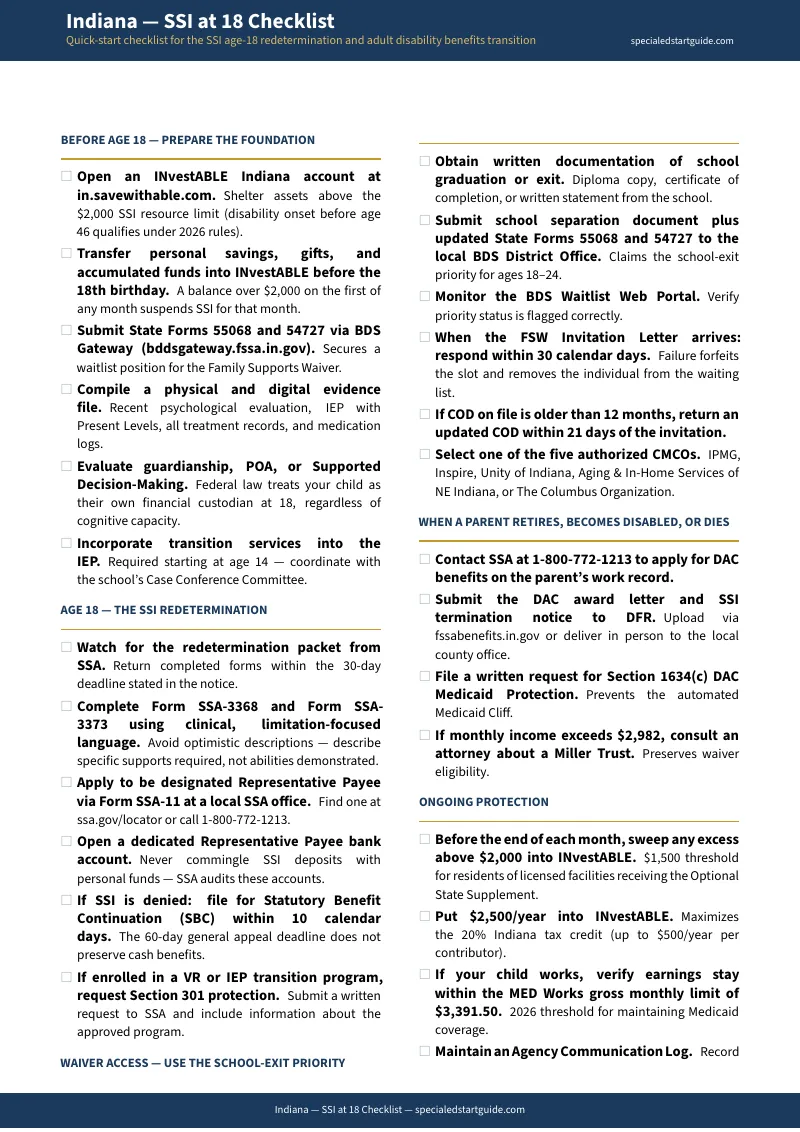
Download the free Indiana — SSI at 18 Checklist to see the milestones mapped from age 14 through 22. When you are ready for the sequenced instructions, form references, and statutory language you need to coordinate every agency — get the full toolkit for and start building your transition binder tonight. Your download includes the 54-page guide, a 2-page printable checklist with the waiver enrollment sequence and red-flag deadlines, and 11 fillable planning tools — the Transition Timeline Planner, Evidence File Checklist, SSI Redetermination Preparation Worksheet, Benefit Payment Tracking Log, Waiver Application Tracker, interRAI Assessment Prep Sheet, Evidence Request Letter Template, Medicaid Preservation Tracker, Service Plan Budget Worksheet, Agency Communication Log, and Monthly Asset Sweep Checklist.