Your child's IEP says "transition." The school handed you a pamphlet. Now what?
Hawaii starts transition planning at age 14 — two years before the federal standard — but the state scored zero points on federal transition compliance (Indicator 13). That means many families sit through IEP meetings where the transition section is vague, the goals are unmeasurable, and nobody explains what happens between now and the day your child ages out at 22.
Meanwhile, the agencies your child will eventually need — the Division of Vocational Rehabilitation, the Department of Health's Developmental Disabilities Division, college disability offices — all operate on separate timelines with separate eligibility rules. None of them sync with the school. And if you live on a neighbor island, the provider gap is even wider.
The Three-System Transition Map
The Hawaii IEP Transition to Adulthood Guide is a chronological planning system that maps HIDOE, DVR, and DOH-DDD onto a single timeline. Instead of piecing together information from three separate agency websites that do not cross-reference each other, you get one document that tracks every milestone, every deadline, and every handoff from age 14 through school exit.
This is the organizational layer that sits between you and the system — the structure that tells you what to ask for, when to ask for it, and which agency owns the answer.
What's Inside
- Age-by-age transition timeline — every milestone from the age-14 mandate through the 22nd birthday, with what the school is required to do and what you should be doing at each stage
- Measurable postsecondary goal construction — how to write IEP goals that actually pass Indicator 13 compliance standards, because generic "student will explore careers" goals do not count and the school may not tell you that
- Diploma vs. Certificate of Completion decision framework — HIDOE's 24-credit requirements, the Modern History of Hawaii credit, and why accepting a certificate does not end eligibility (your child can stay in school working on transition goals until 22)
- Transfer-of-rights toolkit — the Power of Attorney for Special Education (POA SPED), the Educational Representative pathway, and why court-ordered guardianship is usually the most expensive option, not the only option
- DVR and Pre-ETS walkthrough — how Pre-Employment Transition Services work for students aged 14 to 21 without a formal VR case, the five core service areas, and how to move from Pre-ETS to individualized DVR case management before graduation
- Medicaid I/DD waiver preparation — Hawaii's zero-waitlist waiver system, the 30-working-day eligibility review, and how to organize the documentation that demonstrates substantial functional limitations before the review window opens
- College accommodation shift — why IEPs do not transfer to higher education, how UH Mānoa's KOKUA Program and community college disability offices work, and what your child needs to self-disclose
- SSI, Medicaid, and ABLE accounts — federal benefit eligibility at 18, the Student Earned-Income Exclusion, and how ABLE accounts protect savings without jeopardizing benefits
- Island-specific service realities — where to find providers on O'ahu and how to navigate the limited options on the Big Island, Maui, and Kaua'i, including the DVR, DDD, and community rehabilitation provider landscape on each island
- Dispute resolution guide — state complaints, mediation, and due process hearings when the school's transition plan is not meeting requirements
- Printable worksheets — transition timeline planner, IEP meeting preparation worksheet, accommodation vs. modification tracker, agency communication log, decision-making framework tracker, and document execution tracker
Who This Guide Is For
- Parents of middle schoolers approaching the age-14 transition trigger who need to understand what the school should be doing now, not just "eventually"
- Families of 16- to 18-year-olds who received the transfer-of-rights notice and are weighing their options between POA SPED, Educational Representative, and guardianship
- Parents of young adults on a Certificate of Completion track who are coordinating the final years of school services and the simultaneous handoff to DVR and DOH-DDD
- Neighbor island families who cannot access the O'ahu-concentrated advocacy organizations and need a self-directed, structured planning resource
Why Not Free State Resources?
State agency websites, SPIN handouts, and HIDOE's Family Engagement Transition Toolkit all exist and all contain useful information. The problem is not that the information is missing — it is that it is scattered across three separate agencies, dozens of separate PDFs, and multiple websites that do not reference each other.
A parent trying to coordinate a transition plan has to visit HIDOE's site for the IEP timeline, then DVR's site for Pre-ETS, then DOH-DDD's site for the I/DD waiver, then SPIN's site for the transfer of rights, then Med-QUEST's site for Medicaid eligibility — and none of those resources explain when to do what or how these systems connect.
This guide takes the raw content from every relevant Hawaii agency and organizes it chronologically, so you are not reading five different websites wondering which step comes first.
Satisfaction Guarantee
If the guide does not help you organize your child's transition plan, email us and we will refund you — no questions asked. The planning structure works or you do not pay.
Get Started
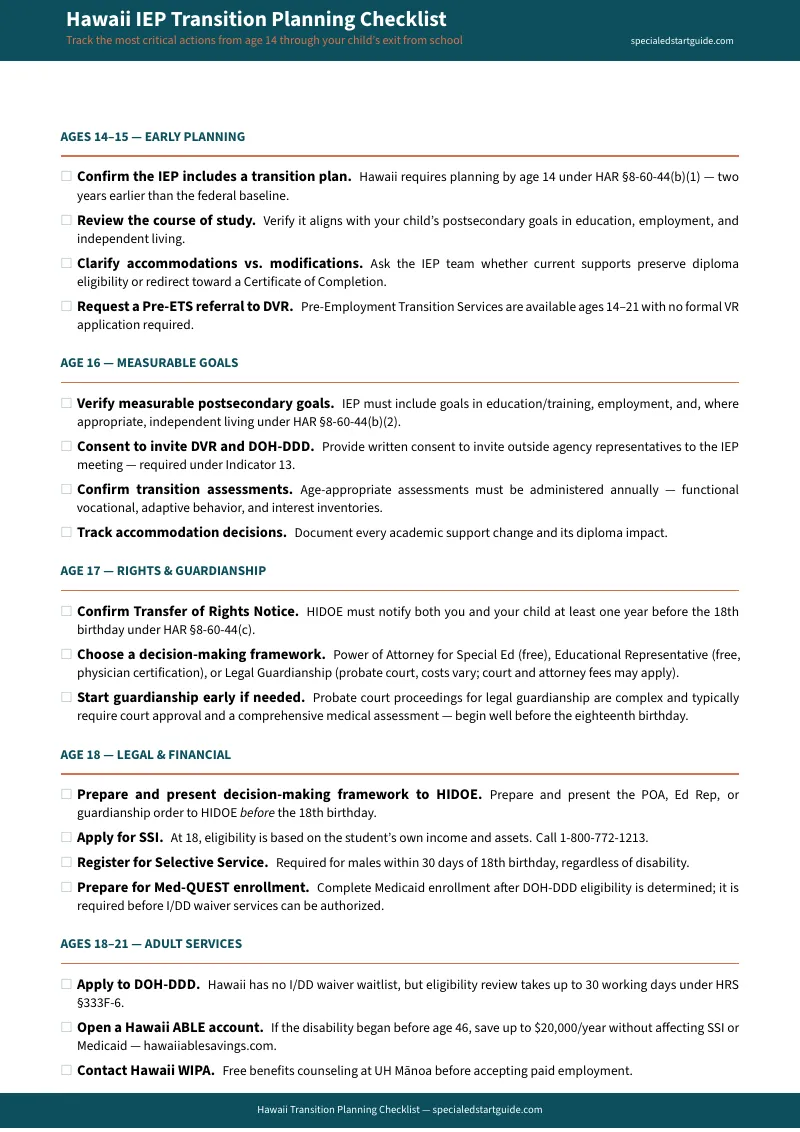
Download the free Hawaii Transition Planning Checklist to see the milestone-by-milestone overview. When you are ready for the full timeline, decision frameworks, worksheets, and island-specific contacts, the complete guide is available for .
Frequently Asked Questions
What if the rules change after I buy?
We update the guide when the rules change. Email us any time, even years later, and we'll send you the current edition free.