The birthday is eight months away. The legal rights are already slipping.
You sat in the IEP meeting and heard the transition coordinator mention "transfer of rights." You went home and discovered the truth: on your child's 18th birthday, every medical, financial, and educational decision-making right transfers to them — regardless of their disability. You started researching and found pieces scattered everywhere. SPIN Hawaii's transition newsletters. The Hawaii Disability Rights Center's advocacy materials. The First Circuit's ProSeIncap petition packet. A private attorney on Oahu quoted you $2,000 before you even know which legal framework fits your child. And if you live on a neighbor island, add inter-island travel costs to that figure.
Here's what makes this transition in Hawaii uniquely complex: in July 2025, Act 284 created the state's first formal Supported Decision-Making framework — a statutory alternative to guardianship that most school administrators, doctors, and bank managers haven't heard of yet. And Hawaii's court system adds another layer: adult guardianship of the person is heard in either Family Court or Circuit Court Probate Branch (concurrent jurisdiction), while conservatorship of the property goes exclusively through Probate Court. Most families don't know they have a choice of courts, and most free resources don't explain how to choose.
The Hawaii Transition Navigator — One Structured System Where You Need Six
This guide replaces the six-tab research session with a single chronological framework. It walks you through every legal option on the spectrum — from informal family support and hānai arrangements through full court-ordered guardianship — and helps you determine which combination actually fits your child's capabilities, not which option the last professional you talked to happened to specialize in.
The difference between this and the free resources isn't that we know more than SPIN Hawaii or the Hawaii Disability Rights Center. It's that we've organized what they teach — along with the dual-court system, the neighbor-island filing logistics, the financial transitions, and the brand-new Act 284 framework — into one decision framework you can work through at the kitchen table.
What's Inside
- Capability Evaluation Worksheets — because "does my child need guardianship?" is the wrong question. The right question is domain-specific: can they consent to medical treatment? Manage a bank account? Choose where to live? Navigate school meetings? These worksheets help you evaluate capacity across five domains so the legal framework matches reality, not anxiety.
- Complete Act 284 SDM Walkthrough — Hawaii's 2025 Supported Decision-Making Agreement statute from start to finish. Who qualifies as a "qualified adult," what "members of the supportive community" can and cannot do (they assist with decisions but never make decisions for the person), execution requirements (two disinterested adult witnesses or a Hawaii notary), the third-party good-faith reliance protections that limit liability for banks and doctors who honor the agreement, and how to present it to institutions that haven't encountered Act 284 before — including the specific statutory citations to print and share.
- Power of Attorney and Health-Care Directive Toolkit — Durable Financial POA, the Hawaii Advance Health Care Directive under HRS Chapter 327E (combining health-care agent designation and living will into one document), the strict witness requirements (one witness must be unrelated by blood, marriage, or adoption), the Educational Representative pathway under Act 182 for continued IEP involvement, the POA for Special Education, and HIPAA/FERPA releases. Each instrument includes the capacity requirement and step-by-step execution instructions.
- The Two-Court System Explained — Hawaii's Family Court and Circuit Court Probate Branch both hear adult guardianship petitions. Conservatorship goes exclusively through Probate Court. This section explains which court to choose, the "CG" combined filing strategy under Hawaii Probate Rule 100 (one petition instead of two), and when a combined filing at $320 saves money versus separate petitions at $215 and $220–$315.
- Circuit-by-Circuit Filing Guide — how to file in the First Circuit (Oahu), Second Circuit (Maui County — Hoapili Hale courthouse in Wailuku), Third Circuit (Hawai'i Island), or Fifth Circuit (Kaua'i — Līhu'e courthouse). Includes remote hearing options via Zoom for neighbor-island families, how to request the in forma pauperis fee waiver, and what to expect from the court investigator's review.
- SSI Representative Payee and Financial Planning — the free SSA designation process that doesn't require court involvement, the age-18 redetermination from childhood to adult disability standards, the 2026 Federal Benefit Rate, the $2,000 resource limit, and when a Representative Payee is sufficient versus when conservatorship is necessary. One wrong choice here means paying court costs for authority you could have gotten for free.
- ABLE Account Planner — Hawaii's ABLE savings account program, 2026 contribution limits, expanded eligibility (disability onset before age 46), the $100,000 SSI exemption, and how to protect Medicaid coverage while building savings. One miscalculation can trigger a benefit suspension — this planner prevents that.
- Transition Timeline Integration — coordinating legal authority decisions with HIDOE transition planning (the age-17 Transfer of Rights notification), FERPA and HIPAA preparation, SSI redetermination timing, and Vocational Rehabilitation Division services so no deadline catches you unprepared and no service gap opens when school-based supports end.
- Guardianship Restoration Pathway — if your child's capabilities improve, you can petition for modification or termination. SDM agreements under Act 284 are revocable or modifiable at any time without court involvement — a critical advantage over court-ordered guardianship when your young adult's skills continue to develop.
Who This Guide Is For
You're a Hawaii parent or caregiver facing one of these situations:
- Your child turns 18 within the year and you're not sure whether they need guardianship, supported decision-making under Act 284, or some combination of tools you haven't heard of yet
- You've been told "just get guardianship" but your child makes many decisions independently — you need a framework that protects without overriding their autonomy
- Your child's doctor refused to share medical information after their 18th birthday, or the school barred you from an IEP meeting, and you need immediate legal authority
- You live on Maui, the Big Island, Kauai, Molokai, or Lanai and specialized guardianship attorneys are on Oahu — you need a process guide that works from your island
- You want to coordinate the legal transition with SSI redetermination and ABLE account setup — and the financial interactions between these programs feel impossible to untangle
- Your extended family favors traditional hānai support but you need to understand how informal family arrangements interact with formal legal recognition at hospitals, schools, and banks
- You've priced guardianship attorneys and want to know whether court is even necessary before spending on a consultation — especially since the SDM agreement requires no attorney and no court involvement
Why Not Free Tools Alone?
Free resources in Hawaii are excellent — and fragmented. SPIN Hawaii's transition guides focus on educational advocacy without covering the court guardianship process. The Hawaii Disability Rights Center advocates for systemic rights but doesn't provide step-by-step filing instructions. Legal Aid Society of Hawaii offers interactive self-help forms but has strict income limits and high caseloads. The First Circuit's ProSeIncap packet gives you blank forms without explaining whether court is necessary at all. And a private attorney can advise on the legal tools but typically charges hourly to explain the financial transitions that interact with them.
This guide doesn't replace any of those resources — it connects them into one decision framework so you can evaluate your options systematically, gather every document the process requires, and walk into any professional consultation fully prepared.
Your Purchase Is Protected
Money-back guarantee, no time limit. If the guide doesn't give you a clear path forward for your child's 18th birthday transition, email us for a full refund. No forms, no hassle.
The Clock Is Already Running
Every month without a plan is a month closer to a birthday that changes everything. Hawaii's new Supported Decision-Making framework under Act 284 means a court order may not be what your family needs — but figuring that out takes structured evaluation, not a last-minute scramble.
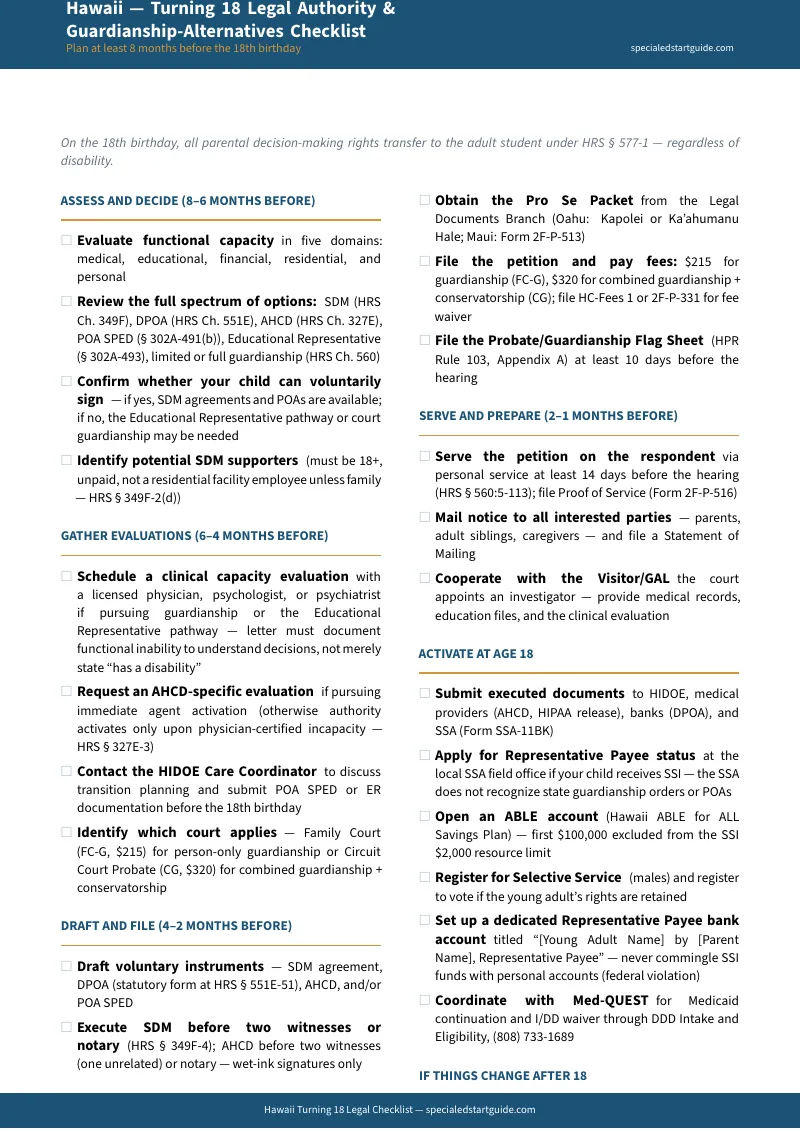
Download the free Hawaii Turning-18 Legal Checklist to see the timeline, or get the full guide to start the capability evaluation tonight.
Get the Hawaii Guardianship & Alternatives Guide — instant download, .