Your child is turning 18 and D.C. law is about to shut you out of every system at once
On your child's eighteenth birthday, the District of Columbia presumes them competent to manage their own affairs — regardless of their disability diagnosis, IEP history, or your assessment of their readiness. Under D.C. Official Code § 38-2571.04, all parental rights under IDEA Part B transfer automatically to your child. HIPAA locks you out of their medical records. Banks and government agencies treat them as the sole account holder. The school stops returning your calls about their IEP. There is no grace period, no transition window, and no one-document fix that covers everything.
The District uses entirely separate legal frameworks for education, healthcare, finances, and government benefits. A durable financial power of attorney gives you zero authority at a school IEP meeting. An educational power of attorney has no weight at a hospital. And neither guardianship nor any power of attorney is recognized by the Social Security Administration for managing SSI — the SSA requires its own Representative Payee process, handled entirely outside the court system. Most families discover this piecemeal, one locked door at a time.
The Authority Map: Every D.C. Instrument in One Decision Framework
This guide maps every legal and administrative instrument available under D.C. law into a single decision framework — so you can see which tools cover which domains, where they overlap, and where gaps remain that only a court order can fill. Instead of guessing whether one document handles everything (it does not), you build a combination tailored to your child's actual needs: the instruments that preserve their autonomy where they can exercise it, and formal authority where they cannot.
The framework covers Supported Decision-Making Agreements under D.C. Law 22-93, Educational Powers of Attorney, the OSSE Educational Representative appointment, Durable Powers of Attorney for Healthcare, the default surrogate hierarchy under the Health Care Decisions Act, Representative Payee status, limited guardianship, general guardianship, and emergency and temporary guardianship — each with the exact execution requirements, professional certifications, court forms, and timelines specific to the District.
What's Inside
- Supported Decision-Making Agreement Walkthrough — how to execute a valid SDMA under D.C. Law 22-93 using the official DDS statutory form, the witness and notary requirements that make the agreement enforceable, who is statutorily disqualified from serving as a supporter, and why Maryland-style oral arrangements and Virginia's 23-page template have no legal standing in the District
- OSSE Educational Representative Path — the administrative process under 5-A DCMR § 3036 that lets you maintain educational decision-making authority without going to court, including which licensed professionals qualify to provide the two required capacity certifications and the evaluator restrictions that disqualify school employees
- Healthcare Authority Builder — how to determine whether your child can execute a Durable Power of Attorney for Healthcare, how the default surrogate hierarchy under D.C. Code § 21-2210 works when they cannot, and how the District's unique flexible rebuttal mechanism allows a lower-ranked individual to act when they have better knowledge of the patient's wishes
- D.C. Superior Court Probate Division Process — the complete intervention proceeding mapped step by step, from the mandatory forms (Petition for a General Proceeding, Form 26, Form 27) through the court-appointed attorney, medical examiner, and visitor appointments, to the post-appointment obligations including MPD background checks within 60 days, FBI fingerprint submission within 180 days, guardianship plan within 90 days, and bi-annual reporting
- Limited vs. General Guardianship Decision Tool — how D.C. law favors limited guardianship that restricts court-ordered authority to specific decisions while preserving the young adult's autonomy in other domains, with guidance on crafting a petition that requests only the authority your child actually needs
- Emergency and Temporary Guardianship Protocols — the two distinct pathways for urgent situations: emergency guardianship lasting up to 21 days for life-threatening scenarios and temporary healthcare guardianship lasting up to 90 days when a general guardian is absent or incapacitated
- Financial Authority Selector — why a court-ordered conservatorship is unnecessary when your child's only assets are government benefits, how the Representative Payee process works outside the court system, and practical alternatives like joint bank accounts for daily financial management
- DMV Cross-Border Warning Guide — the specific statutory differences between D.C., Maryland, and Virginia that make cross-border legal materials dangerous for D.C. families, including Maryland's recognition of oral SDM arrangements, Virginia's different form requirements, and the District's unique OSSE educational transfer exceptions
- Six Printable Planning Tools — the Capacity Assessment Worksheet (domain-by-domain audit with a clinical-evaluations log), Transition Planning Tracker (eight-month milestone grid), Agency Communication Log, SDMA Preparation Checklist, Court Filing Checklist, and Post-Appointment Compliance Calendar — each designed to print and fill in by hand
Who This Guide Is For
- Parents in the District of Columbia whose child's 18th birthday is approaching and who need a clear comparison of every legal instrument available — from supported decision-making to full guardianship — before deciding which path to pursue
- Families who received the LEA Transfer of Rights notice at age 17 and need to act before educational, medical, and financial authority transfers automatically
- Parents exploring the OSSE Educational Representative path who need to understand the two-certification requirement, the evaluator restrictions, and the professional qualifications before scheduling assessments
- Families who may ultimately need to file a guardianship petition and want to understand the Probate Division process, forms, appointed professionals, costs, and ongoing obligations before committing to court
- Parents preparing for a first consultation with a D.C. special needs attorney who want to maximize the value of professional time by arriving with a clear understanding of the District's legal framework — instead of paying $400+ per hour to learn basic definitions
Why the Free Information Is Not Enough
The D.C. government provides forms and templates across three separate agency websites — dccourts.gov for probate filings, dds.dc.gov for supported decision-making forms, osse.dc.gov for educational representative procedures — but none of these agencies explains how the instruments interact or when to choose one over another. Disability Rights D.C. and Quality Trust promote self-determination and supported decision-making, but they do not assist with guardianship petitions or provide court-preparation materials. Meanwhile, DMV-area law firms publish generalized resources that routinely conflate D.C., Maryland, and Virginia requirements — and relying on the wrong state's rules can leave you with documents that have no legal standing in the District.
This guide sequences the verified D.C.-specific pathways across every domain into one decision framework — for a fraction of one billable hour with a local attorney.
Satisfaction Guarantee
If the guide does not deliver the structured clarity you need to navigate this transition, email us at any time for a full refund. No forms, no justification required.
Get Started
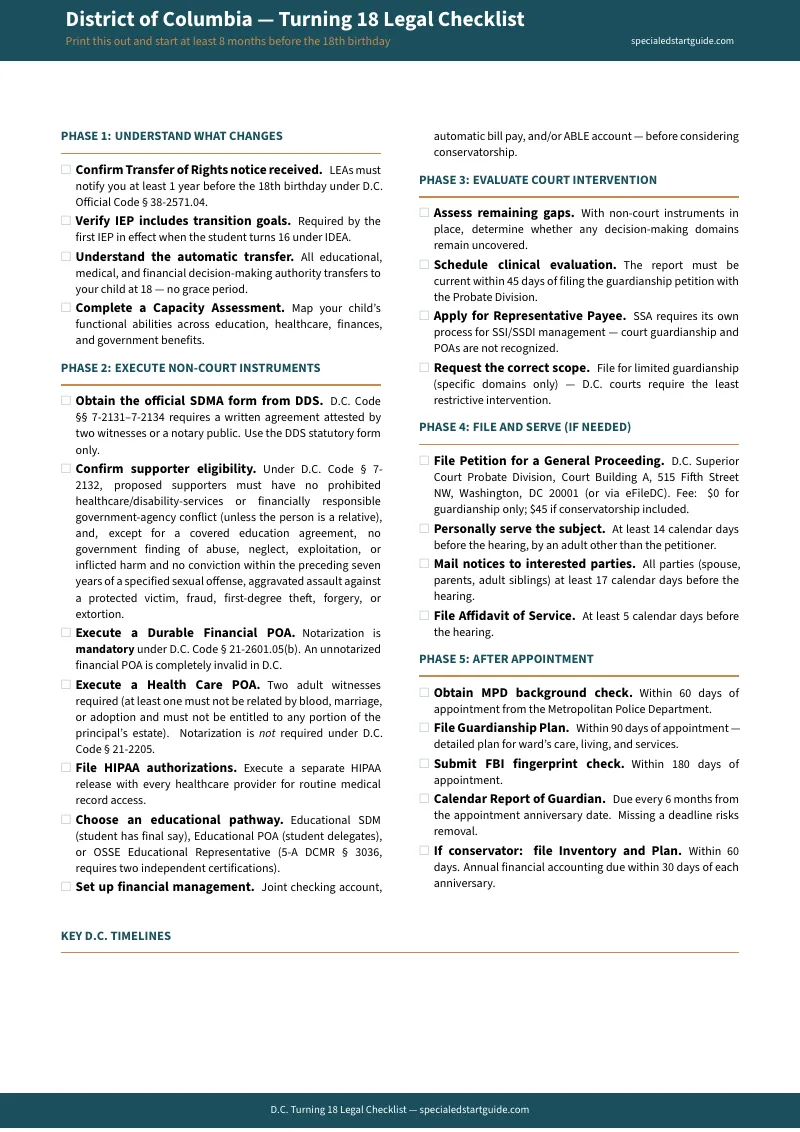
Download the free District of Columbia — Turning 18 Legal Checklist to see the milestones mapped across education, healthcare, finances, and government benefits. When you are ready for chapter-length coverage of each instrument, the Probate Division process, and structured decision worksheets — get the full toolkit for and start building your transition plan tonight.