
Your child is turning 18 in Alabama — and nobody is giving you straight answers
The school sends home a "transfer of rights" notice. Your pediatrician's office mentions something about HIPAA. A well-meaning neighbor says you need to "get guardianship" before the birthday. And suddenly you're staring down a probate court filing, wondering if you're about to strip your child of rights they haven't even had a chance to use yet.
Here's what makes Alabama uniquely confusing: your child's full age of majority is 19, not 18. Some rights shift at 18. Others don't transfer until 19. And since the Colby Act created Supported Decision-Making Agreements in 2023, there are now formal alternatives to guardianship that most families have never heard of — because the people who would benefit most from knowing about them are getting their information from school staff who default to "just file for guardianship."
The Transition Authority Blueprint —
The Alabama Adult Guardianship & Alternatives Guide is a step-by-step decision system that helps you figure out what your child actually needs — before you spend thousands on a probate attorney or sign away rights that didn't need to go.
It's built around Alabama's specific legal landscape: the dual-stage majority at 18 and 19, the Colby Act's supported decision-making framework, the 2025 medical consent changes, and the county-by-county variations in probate filing fees and procedures that can swing your upfront costs from $30 to over $1,500 depending on where you live.
What's Inside
- Six-Domain Decision Worksheet — systematically evaluate your young adult's capacity across medical, educational, financial, housing, employment, and legal domains so you choose the least restrictive option that actually protects them, not the one a school administrator suggested in a hallway conversation.
- Colby Act SDM Agreement Walkthrough — the complete requirements for a valid Supported Decision-Making Agreement under Alabama Code § 26-1B, including who qualifies as a supporter, what the notarization requirements are, and the exact statutory language about honoring the principal's "will and preference" over the supporter's opinion of their "best interest."
- Power of Attorney Execution Guide — how to set up durable financial POA, medical power of attorney, and HIPAA disclosure releases under Alabama's Uniform Power of Attorney Act, with the capacity threshold your child needs to meet in order to sign.
- County Probate Court Fee Comparison — filing fees, security deposits, and Guardian ad Litem costs for Alabama's county probate courts, so you know before you file whether your county requires a $37 filing fee or a $1,500 security deposit on top of it.
- Educational Representative Appointment Process — how Alabama's Department of Education allows parents to be appointed as educational representatives for students aged 19+ who cannot provide informed consent, including the 90-day advance window, the two-professional certification requirement, and the annual renewal process.
- Full Guardianship Court Process — every step from petition filing through Guardian ad Litem appointment, physician examination, investigator interview, and hearing, with the post-appointment obligations (45-day care plan, annual reports, conservator bonding and accounting) laid out so nothing blindsides you after the order is signed.
- Emergency Guardianship Procedures — when and how to petition for temporary emergency guardianship in crisis situations, including the evidence standards and timeline for converting to a permanent order.
- Special Needs Trust Overview — how an Alabama special needs trust works alongside guardianship or its alternatives to protect your child's eligibility for SSI, Medicaid, and other benefits while preserving supplemental resources.
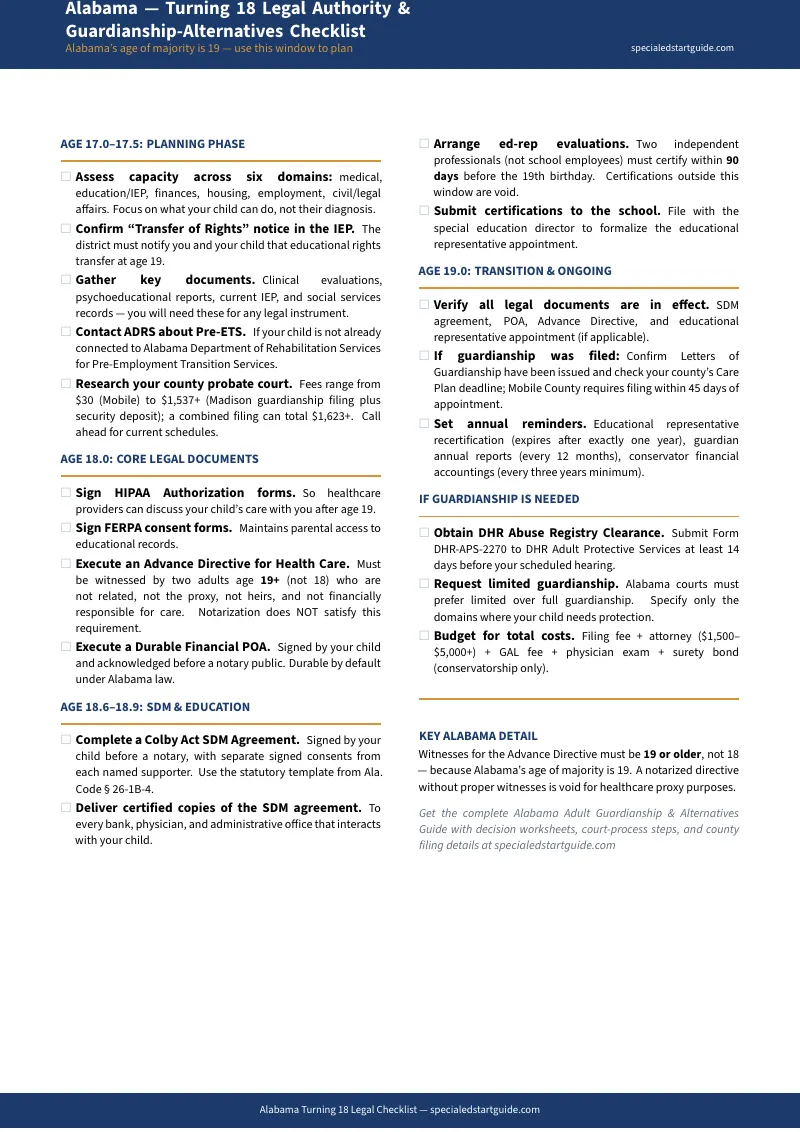
- Printable Transition Timeline — a month-by-month action plan from age 17 through 19+ with checkboxes for every milestone and a key dates tracker you fill in with your child's specific deadlines.
- Forms and Resources Directory — a one-page reference card listing every state form, statutory source, and key organization, with a quick-reference guide for when to contact whom.
Who This Is For
- Parents whose child's 18th birthday is approaching — and who are getting conflicting advice from school staff, family members, and the internet about whether they need guardianship.
- Parents who want to preserve their child's autonomy — and are looking for legally recognized alternatives that don't require a court order or stripping away civil rights.
- Parents facing a medical or behavioral health crisis — where their young adult's 19th birthday is approaching and they need to understand how to maintain medical decision-making authority under HIPAA.
- Families who've been told to "just get guardianship" — and want to make an informed decision about whether that's actually necessary, or whether a less restrictive and less expensive option covers what their child needs.
Why Free Resources Aren't Enough
Alabama has excellent free advocacy organizations — ADAP (Alabama Disabilities Advocacy Program) publishes pamphlets on guardianship alternatives, and APEC (Alabama Parent Education Center) runs parent workshops on transition planning. These resources explain what the legal options are.
What they don't do is help you execute. They don't include a systematic capacity assessment to determine which option fits your child. They don't compare county filing fees side by side. They don't walk you through the exact steps of the probate court process. They don't tell you about the 90-day advance window for the educational representative appointment or the annual renewal requirement that catches families off guard.
This guide fills the gap between "here are your options" and "here's how to actually do this in your county, with your child's specific needs, on your timeline."
The Cost of Getting It Wrong
File for full guardianship when a Colby Act SDM agreement would have covered it, and you've spent thousands in legal fees to take away rights your child could have kept. Skip the planning entirely and hit your child's 19th birthday without a medical power of attorney, and the first time they're hospitalized, you'll be standing in a waiting room while doctors refuse to tell you what's happening.
Neither mistake is easy to undo. The guide exists so you can make this decision with complete information instead of pressure and guesswork.
Satisfaction Guarantee
If the guide doesn't help you make a clearer, more confident decision about your child's transition to adulthood, reach out for a full refund. No questions, no hoops.
Start With the Free Checklist
Download the Alabama Turning-18 Legal Checklist — a one-page overview of every milestone, deadline, and decision point between now and your child's 19th birthday. If the checklist confirms you need deeper guidance, the full guide is ready when you are.