Your Child's IEP Team Handles School. Nobody Handles What Comes After.
Wyoming requires transition planning by the IEP year a student turns 16. Students on the Certificate of Completion track need a unique four-year plan drafted in eighth grade. Those timelines create a false sense of coverage — because the school district, the Division of Vocational Rehabilitation, and the Department of Health each handle one piece, and none of them is responsible for making the pieces fit together.
While your child is in school, every service runs under an entitlement — the district must provide a free appropriate public education regardless of budget. The moment your child exits, everything flips to an eligibility-based system with strict financial caps, functional assessments, and waitlists that can run for years. In a state where every county is designated a mental health provider shortage area and Direct Support Professional wages trail entry-level retail, the margin for application errors or missed deadlines is zero.
The Wyoming Transition Coordination Sequence — that's what this guide is. It takes every school-side decision and every adult-side preparation and puts them in one chronological master sequence, connected by the worksheets that make each step completable rather than just understandable.
What's Inside
- The Complete Age-by-Age Timeline — every milestone from the Certificate of Completion four-year plan in eighth grade through the final school exit at the end of the year the student turns 21, with the specific actions, deadlines, and responsible agencies at each stage. Not a summary — the full operational sequence your IEP team is supposed to follow but rarely explains.
- The Graduation Pathway Analyzer — a structured worksheet for evaluating the standard high school diploma against the Certificate of Completion. This matters because a standard diploma immediately terminates FAPE eligibility under IDEA — it's a change of placement that ends your child's right to school services. The Certificate of Completion preserves eligibility through the end of the school year in which the student turns 21, keeping access to transition academies, school-based therapies, and community-based instruction. The guide lays out what each pathway means for postsecondary access, employment, continued services, and adult agency eligibility.
- The Decision-Making Alternatives Workbook — Wyoming does not have a comprehensive Supported Decision-Making statute, which means families need to construct their own framework. This workbook walks you through drafting a non-statutory Supported Decision-Making agreement, setting up limited powers of attorney for healthcare and financial decisions, and evaluating whether limited guardianship is appropriate — so your child retains as much autonomy as possible while you maintain the practical involvement their situation requires. It includes guidance on filing a guardianship petition in a Wyoming district court when capacity limitations make full legal protection necessary.
- The DVR Pre-ETS Enrollment Guide — Pre-Employment Transition Services are available to students with disabilities ages 14 to 21 through Wyoming's Division of Vocational Rehabilitation, covering career exploration, workplace readiness, work-based learning, postsecondary counseling, and self-advocacy. DVR transition navigators can participate in IEP meetings when invited with prior written consent. The guide shows you how to request a school referral, how to self-refer, and how to coordinate the Discovery Process for students with complex needs — particularly important in rural counties where community-based work experiences require creative planning around geographic distance.
- The Waiver Intake & ICAP Preparation Workbook — the Department of Health administers the Supports Waiver (adult day services, supported employment, respite, community support within annual budget caps of $27,010 for adults and $23,171 for children) and the Comprehensive Waiver (intensive 24/7 residential habilitation, emergency-priority access). Both require an institutional level of care determination through the ICAP functional assessment and strict financial eligibility ($2,982 monthly income cap, $2,000 resource cap). The workbook walks you through the full intake packet and the evidence preparation that ensures the ICAP score accurately reflects your child's actual level of need — because in a system with approximately 282 people on the Supports Waiver waitlist, how your child's needs are documented determines when services start.
- The Financial Planning Worksheets — SSI application timing and the age-18 redetermination where parental income is no longer deemed to the individual, Miller Trust (Irrevocable Income Trust) setup if income exceeds the Medicaid cap, ABLE account contribution limits and the ABLE-to-Work exception, the $100,000 SSI disregard threshold, Special Needs Trust structures, and the impact of the Social Security Fairness Act (signed January 2025) on disabled adult child benefits. One savings account opened without understanding the resource rules can cost your child their entire benefits eligibility.
- The Rural Service Strategy Section — participant-directed service models that let you hire your own support staff, the University of Wyoming's WATR assistive technology program through WIND, regional provider options (Ark Regional Services, Big Horn Enterprises, Community Entry Services), and strategies for building a local support network when the nearest agency office is two hours away.
- The Multi-Agency Handoff Checklist — coordinates the transfer of records and services from the school district to DVR, the Department of Health, and SSA. Includes the mandatory Summary of Performance, transition IEP meeting prep sheets, and the specific steps to keep adult services active from the day school services end.
- 9 Standalone Printable Tools — the Transition Timeline Tracker mapping every age-specific milestone with a date-done column, the Graduation Pathway Analyzer for the diploma-versus-certificate decision, the Decision-Making Worksheet matching capabilities to legal frameworks, the Waiver Intake & ICAP Preparation Workbook for organizing the full intake packet, the Financial Planning Worksheet covering SSI, ABLE, and trust setup, the Multi-Agency Handoff Checklist coordinating records and services at school exit, the Agency Communication Log recording who promised what, a Key Contacts Directory for every state and regional agency (DVR, Department of Health, WPIC, P&A, WIND, SSA field offices) with fillable space for local contacts, and the Financial Thresholds Quick Reference card with every 2026 dollar figure in one place.
Who This Is For
This is for Wyoming parents navigating the IEP transition to adulthood — whether your child is in eighth grade and the school just mentioned a four-year plan for the Certificate of Completion, or your child is 19 and you're staring down the service cliff with no plan for what replaces school.
- You need to choose between the standard diploma and the Certificate of Completion — and nobody has clearly explained what each pathway means for your child's future beyond graduation day
- Your child is approaching 17 and you received the transfer-of-rights notice — and Wyoming doesn't have a comprehensive SDM statute, so you don't know what alternatives exist besides full guardianship
- Someone mentioned Pre-ETS or Vocational Rehabilitation but your county doesn't have a DVR office within an hour's drive, and you don't know how to access services remotely
- You've heard about DD waivers but the Supports Waiver has an approximately 282-person waitlist, the Comprehensive Waiver admits by emergency priority, and nobody has explained the ICAP assessment or the intake packet
- You're worried about SSI, the $2,000 resource cap, and ABLE accounts and you can't find a clear explanation of how they interact
- You've visited WDE, DVR, the Department of Health's HCBS portal, and the Parent Information Center's webinar schedule, and each gave you useful information about their specific piece — but nobody gave you the complete sequence
Why the Free Resources Aren't Enough
The Wyoming Parent Information Center, Protection & Advocacy System, DVR, and the Department of Health all produce genuinely valuable information. The problem isn't quality — it's fragmentation. WPIC runs webinars and peer-to-parent consulting on IEP rights but stops at the adult-services handoff. P&A handles civil rights investigations and systemic advocacy but doesn't publish step-by-step transition planning tools. DVR manages Pre-ETS enrollment and vocational planning but says nothing about guardianship alternatives or benefit preservation. The Department of Health's HCBS portal explains waiver eligibility but doesn't link it to the school exit sequence or SSI timing.
What doesn't exist anywhere in the public system is the single document that connects all of these into one chronological sequence — from the Certificate of Completion plan in eighth grade through the day your child exits school and adult services need to be in place. That's the gap this guide fills.
Special education attorneys in Wyoming charge $250 to $500 per hour, and private advocates charge $50 to $75 per hour. A Special Needs Trust setup runs $2,500 to $5,000. This guide costs a fraction of a single professional consultation — and it gives you the organized sequence that lets you handle most of the coordination yourself, and hand professionals an organized case when you do need them.
Satisfaction Guarantee
Money-back guarantee, no time limit. If the guide doesn't change how you prepare for your child's transition, you get a full refund. No conditions, no hoops.
Get Started
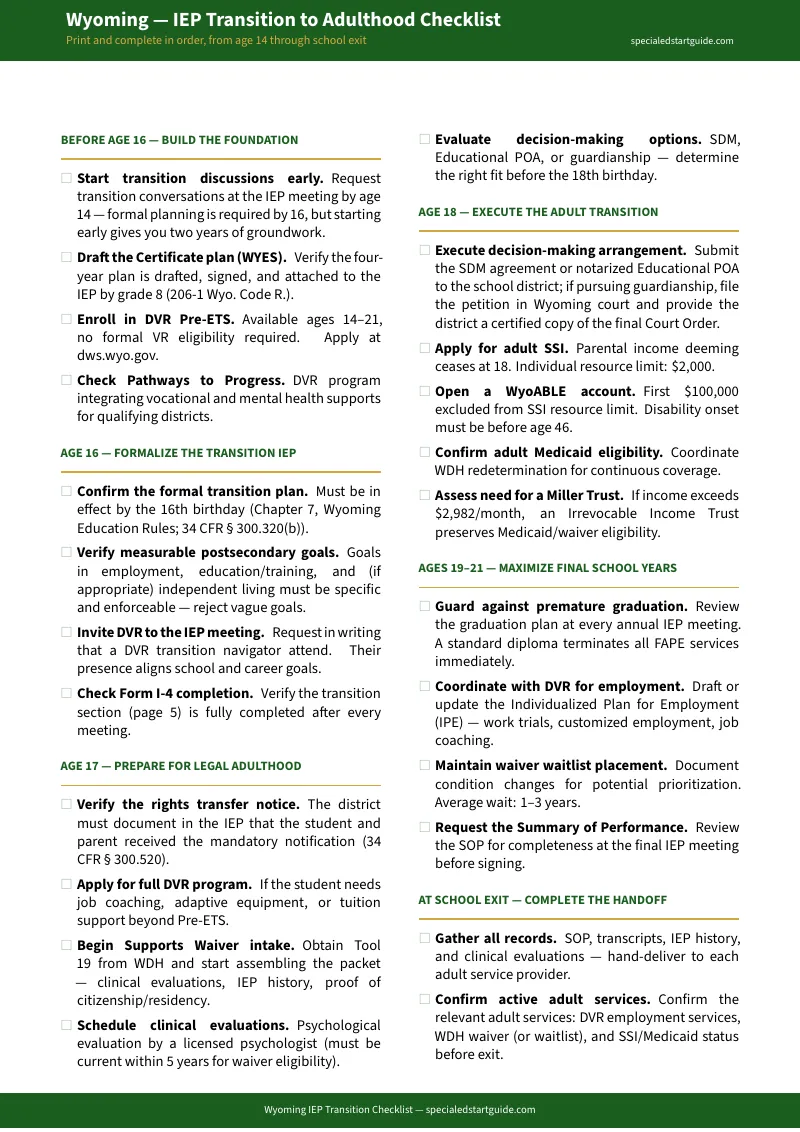
Download the free Wyoming Transition Planning Checklist — a 25-item printable timeline organized by age milestone with the critical actions, deadlines, and responsible agencies at each stage. Or get the complete Wyoming IEP Transition to Adulthood Guide — the full 12-chapter guide plus 9 standalone printable tools: the Graduation Pathway Analyzer, the Decision-Making Worksheet, the Waiver Intake & ICAP Preparation Workbook, the Financial Planning Worksheet, the Transition Timeline Tracker, the Multi-Agency Handoff Checklist with IEP meeting prep, the Agency Communication Log, the Key Contacts Directory, and the Financial Thresholds Quick Reference — everything you need to coordinate the transition that no single public agency will coordinate for you.
Frequently Asked Questions
What if the rules change after I buy?
We update the guide when the rules change. Email us any time, even years later, and we'll send you the current edition free.