Your child turns 18 and suddenly the system treats them like a stranger
You built a safety net over years of IEP meetings, CLTS waiver renewals, and childhood SSI reviews. Then your child's eighteenth birthday arrives and every rule changes at once. The SSA sends a redetermination letter that evaluates your child under adult clinical criteria — the childhood disability standard that kept them covered no longer applies. Parental income deeming disappears, the $2,000 asset limit matters differently, and the school district hands you a folder of agency brochures and tells you to "contact the ADRC."
You call. The ADRC says enrollment takes 45 to 90 days. The SSA schedules a callback three weeks out. You search for help online and find policy manuals that assume you already know the difference between an MCO and an ICA, between a functional screen and a financial screen, between categorical Medicaid and medically needy spenddown.
Every week without an adult SSI application is a week without cash benefits. Every month without EBD Medicaid conversion is a month where a coverage gap could cost your child the therapy, medication, or attendant care they depend on. The free resources exist — ADRC counselors, DBS specialists, DHS portals — but none of them give you a single document that sequences every federal and state step in the order your family actually faces them.
The Transition Pipeline System — every agency, every deadline, one chronological path
This guide maps the entire federal-to-state benefits pipeline that Wisconsin families navigate when a child with a disability turns 18. It is not a list of programs or a collection of links to state websites. It is the chronological sequence of decisions, applications, and enrollment steps — organized by the order they happen and the deadlines that govern each one.
Where a free ADRC brochure describes Family Care in isolation and a DHS portal explains SSI in policy language, this guide shows you how the SSA determination feeds into the ACCESS portal application, how the ACCESS result triggers the ADRC functional screen, and how the functional screen leads to either Family Care or IRIS enrollment — with the financial thresholds, clinical criteria, and appeal windows documented at every handoff point.
What's inside
- The age-18 SSI redetermination walkthrough — how the SSA converts your child's case to adult criteria, what medical evidence strengthens the adult application, the 90-day early filing window before the 18th birthday, and the 60-day appeal timeline if the adult claim is denied
- Wisconsin's three-pillar benefits map — federal SSI ($994/month base) plus the Wisconsin State Supplementary Payment ($92.16/month independent living), EBD Medicaid through the ACCESS portal ($1,086.16 income limit, $2,000 asset limit), and adult long-term care through Family Care or IRIS — with the handoff points between agencies marked so you know which office owns each piece
- The "Worst-Day" Functional Screen preparation system — a structured worksheet for documenting your child's Activities of Daily Living and Instrumental Activities of Daily Living in the clinical language the ADRC screener uses, so the assessment reflects actual support needs rather than best-day performance
- Family Care vs. IRIS side-by-side comparison — what MCO-managed care actually coordinates versus what self-direction through an ICA and FEA actually requires, including the cost-share calculation differences and the process for switching programs if you choose wrong
- The ABLE account tax-compliance tracker — the federal $20,000 contribution limit, Wisconsin's $19,000 state tax deduction cap, and the penalty structure that activates when the two limits diverge — with a contribution ledger designed to prevent triggering state tax liability
- DAC benefits navigator with WEP/GPO repeal guidance — how Disabled Adult Child benefits interact with SSI, the benefit calculation (50% of living parent's PIA, 75% of deceased parent's PIA), Wisconsin's safe-harbor Medicaid rule, and the January 2025 Social Security Fairness Act changes that eliminated offsets for families of public-sector workers
- Supported Decision-Making vs. guardianship comparison — Wisconsin Chapter 52's SDM framework, the practical differences from full guardianship, Representative Payee requirements for SSI funds, and how to choose the right level of legal authority without overreaching
- Work incentives reference with Wisconsin-specific thresholds — Student Earned Income Exclusion ($2,410/month), 1619(b) Medicaid protection up to $51,711 annual earnings, Plan to Achieve Self-Support, and how each incentive interacts with the SSI payment, Family Care cost-share, and ABLE contributions
- The CLTS-to-adult-services bridge — coordinating the Children's Long-Term Support waiver exit with Family Care or IRIS enrollment, DVR referral timing, and the school-to-adult transition calendar that prevents gaps in attendant care, therapy, and adaptive equipment
- Dispute resolution protocols — the four-level SSI appeal process, ADRC complaint procedures, Disability Rights Wisconsin Ombudsman access, and county DBS assistance for free help with applications and appeals
- 9 standalone printable worksheets — functional screen preparation log, Family Care vs. IRIS comparison worksheet, ABLE contribution tracker, SSI redetermination checklist, clinical evidence tracker, asset inventory and spend-down planner, transition timeline planner, agency communication log, and appeal deadline tracker — each designed to print separately so you can bring exactly the right tool to each agency appointment
Who this guide is for
This is for Wisconsin parents whose child is approaching 18, has just turned 18, or recently received an SSI redetermination notice — and who need a single document that sequences the federal and state steps in chronological order with current dollar amounts and real deadlines.
- Your child's 18th birthday is approaching and you just learned that childhood SSI rules will be replaced by adult criteria nobody explained to you
- The SSA denied the adult SSI claim and you have 60 days to appeal — but you are not sure what additional evidence to submit or whether to use the free DBS at your county ADRC
- The CLTS waiver services your child relied on for years are ending and nobody has explained whether Family Care or IRIS replaces them or how to enroll
- The ADRC scheduled a Long-Term Care Functional Screen and you have no idea what the screener will ask or why everyone says to describe your child's hardest days
- You want to open an ABLE account but the federal and Wisconsin contribution limits do not match and you are worried about triggering state tax penalties
- Your child wants to work and you need to understand which earnings thresholds trigger benefit reductions and which protections keep Medicaid in place
- You assumed legal guardianship would cover SSI management and then learned the SSA requires a separate Representative Payee appointment
Why not just use the free resources?
The free resources in Wisconsin are real and valuable — ADRC options counselors, county Disability Benefit Specialists, DHS program portals, Disability Rights Wisconsin publications. The problem is not that the information does not exist. The problem is that it exists in separate silos that do not talk to each other.
The SSA website explains SSI rules without referencing Wisconsin's State Supplementary Payment. The DHS ACCESS portal describes EBD Medicaid without explaining how the SSI determination feeds into categorical eligibility. The ADRC brochure describes Family Care without showing how the functional screen result connects to the Medicaid financial eligibility you just established through ACCESS. Each agency describes its piece accurately — but no agency describes the pipeline.
A special needs attorney in Milwaukee or Madison can walk you through the whole picture for $400 to $435 an hour, with trust drafting starting at $2,000. A private case manager charges $500 to $1,500 for initial intake and transition planning. These professionals exist for a reason — some families genuinely need bespoke legal or administrative help.
This guide is for the families who need the roadmap first. It covers the chronological sequence, the agency handoffs, the financial thresholds, and the deadlines — so you can organize your own transition and reserve professional help for the moments that truly require it.
Satisfaction guarantee
If the guide does not help you organize your child's transition to adult benefits, email us for a full refund. No forms, no hoops.
Start your child's transition with the right roadmap
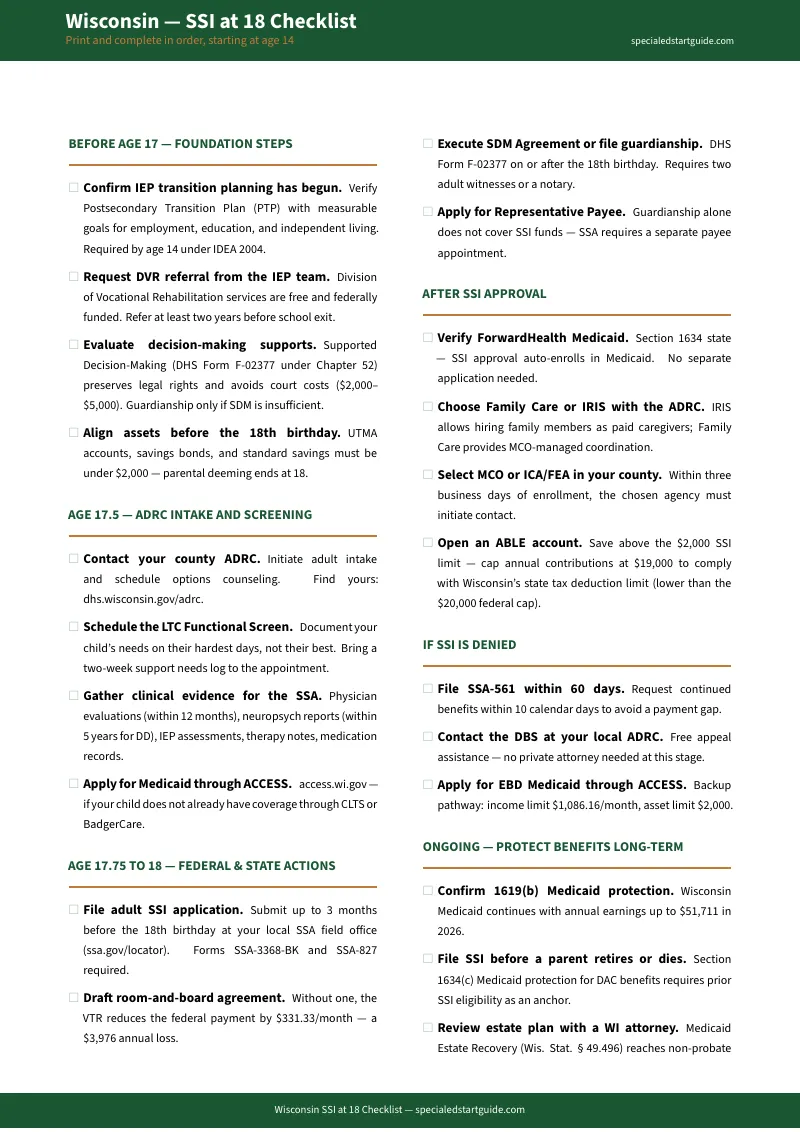
Download the free Wisconsin SSI at 18 Checklist for the chronological milestone map — key ages, filing windows, and agency handoff points on two printable pages. Or get the full Wisconsin SSI at 18 & Adult Disability Benefits Guide for — the complete Transition Pipeline System with 9 standalone printable worksheets, comparison tools, financial trackers, and dispute resolution protocols.
Frequently Asked Questions
What if the rules change after I buy?
We update the guide when the rules change. Email us any time, even years later, and we'll send you the current edition free.