
Your Child Turns 18 in West Virginia. Without a Plan, You Lose Every Legal Right Overnight.
On your child's 18th birthday, West Virginia law presumes they are a fully competent adult. Doctors stop sharing medical records with you. Schools lock you out of IEP meetings. Banks refuse to let you manage their accounts. None of this requires a disability diagnosis to change — it happens to every family, automatically, the moment the birthday arrives.
The difference between families who navigate this smoothly and families who scramble is one thing: a structured legal authority plan built before the deadline. Not forty browser tabs. Not a "we'll figure it out" conversation. A plan that identifies exactly which legal instruments your child needs, in the right combination, executed correctly under West Virginia law.
The Complete Legal Authority Framework — Built for West Virginia Families
This guide covers the full spectrum of legal tools available to West Virginia families, organized from least restrictive to most restrictive. It's built around what makes West Virginia's framework distinct: the state's bifurcated guardianship and conservatorship model under Chapter 44A, the narrow 17-year-and-10-month filing window for minor transition petitions, the specific witness and notarization requirements for Medical Powers of Attorney under the Health Care Decisions Act, and the absence of a comprehensive Supported Decision-Making statute — which means families need to know exactly how to structure informal SDM arrangements that hospitals and banks will actually honor.
Most families don't need full guardianship. But "you probably don't need full guardianship" isn't a plan. This guide gives you the decision framework to determine precisely what your child does need — and the preparation tools to execute it correctly.
What's Inside
- The Decision-Making Spectrum — every West Virginia legal tool from informal supports through full guardianship, side by side, with scope, court involvement, rights implications, and execution requirements for each, so you can identify the least-restrictive combination that actually protects your child
- Advance Directive Preparation — step-by-step instructions for executing a Medical Power of Attorney (dual-witness-plus-notary under W. Va. Code § 16-30-4, with witness disqualification rules) and a Durable Financial Power of Attorney (notary-only under Chapter 39B), plus HIPAA authorization and educational consent forms
- Healthcare Surrogate Framework — how the statutory surrogate hierarchy under W. Va. Code § 16-30-8 works as an automatic backup, who qualifies, and why a properly executed Medical POA gives you stronger legal standing than relying on the default priority list
- Supported Decision-Making Blueprint — practical structure for building an informal SDM arrangement in a state without a comprehensive SDM statute, pairing HIPAA disclosures, educational releases, and voluntary support agreements into a documented framework that third parties accept
- Circuit Court Filing Preparation — the complete petition process under Chapter 44A: GC01 petition, GC04 physician/psychologist evaluation, GC06 financial statement, GC11 education affidavit, the $110 filing fee, service costs, Mental Hygiene Commissioner procedures, Guardian ad Litem appointment, and hearing timeline rules for minor transition petitions filed at age 17 years and 10 months
- Policy 2419 Educational Strategy — the mandatory transfer-of-rights notice at age 17, how to draft a voluntary educational delegation maintaining IEP participation, and when the educational surrogate parent appointment process applies
- SSI & WVABLE Financial Planning — age-18 redetermination preparation, Representative Payee setup as a free alternative to conservatorship, SSI countable-resource rules, Third-Party Special Needs Trust structures, and WVABLE account contribution limits with Medicaid interaction rules
- Guardian and Conservator Obligations — ongoing annual reporting requirements (GC31 guardian reports, GC30 conservator financial accountings), surety bond requirements, fiduciary commissioner oversight, and the modification/termination process under W. Va. Code § 44A-4-6
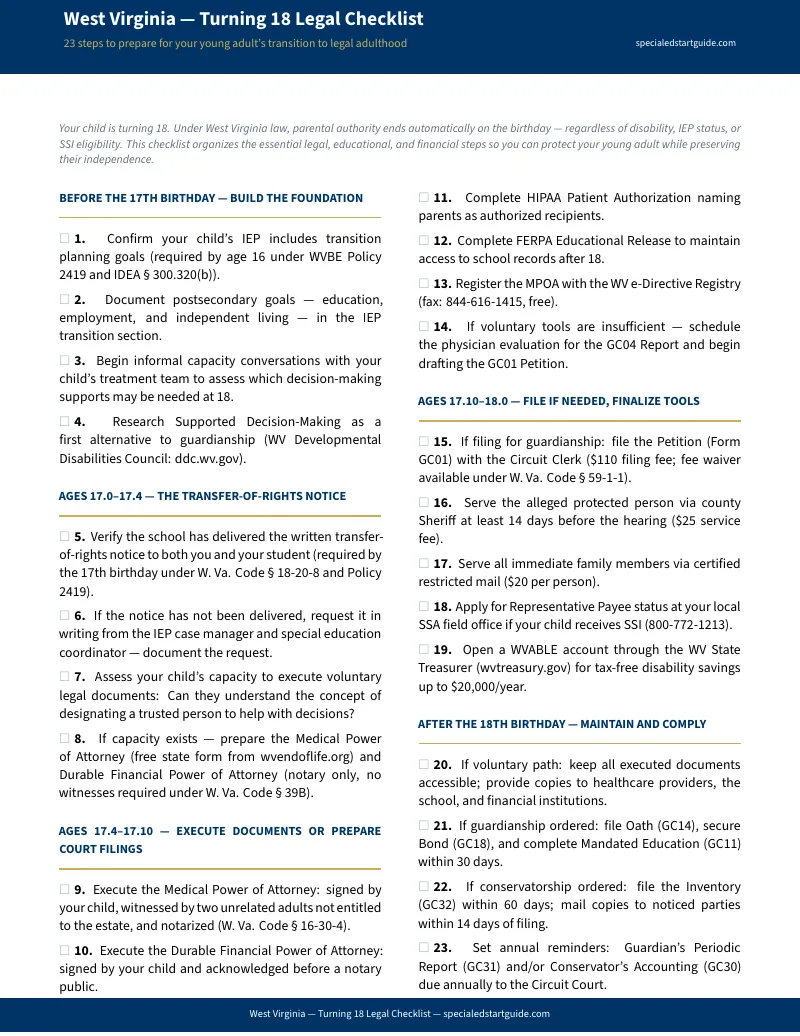
- Turning-18 Legal Checklist — chronological timeline from the 17th birthday through the first year of adulthood, organized by phase so you never miss a deadline
- Six Standalone Planning Tools — printable Capacity Assessment Worksheet, Transition Timeline Planner, Document Execution Tracker, Agency Communication Log, Court Filing Checklist, and Annual Compliance Calendar, designed for attorney consultations, IEP conferences, SSA interviews, and court filings
Who This Is For
This guide is for West Virginia parents whose child's 18th birthday is approaching — whether that's eight months away or four years — and who need a clear, structured way to evaluate the legal options.
- Your child's IEP team raised the age-of-majority transition and you need to determine whether voluntary instruments, limited guardianship, or full guardianship is the right path
- You've been told "just get guardianship" but suspect your child could manage with a Medical Power of Attorney paired with a Durable Financial POA and HIPAA authorization — and you want to evaluate that properly before hiring a $2,500–$5,000 attorney
- Your child receives SSI or will apply at 18 and you need to understand how a free Representative Payee designation compares to a court-ordered conservatorship with its annual accountings and surety bond
- You need to know the real costs — not just the $110 filing fee, but evaluations, GAL fees, attorney fees, bonds, and the mandatory annual reporting that continues for years
Why Not Free Resources?
Disability Rights of West Virginia, Legal Aid of West Virginia, and the WV Developmental Disabilities Council provide authoritative free information. But their resources are structurally fragmented — the SDM overview doesn't explain how to pair informal supported decision-making with advance directives so hospitals accept them in a state without an SDM statute, the educational transition resources don't coordinate with SSI redetermination timelines, and none provide the full cost picture across the entire process. This guide places every tool on a single timeline and fills the gaps between those free resources — particularly the voluntary-instruments pairing strategy and the benefits coordination that no single free resource covers end-to-end.
Everything You Need, Ready Tonight
Instant PDF download. The main guide covers the complete legal authority spectrum with West Virginia statutes and circuit court procedures throughout. The turning-18 legal checklist and standalone planning tools are designed to print and bring to attorney meetings, IEP conferences, and SSA interviews.
Money-back guarantee, no time limit — if the guide doesn't give you a clear path forward for your child's 18th birthday transition, you get a full refund.
Get the free checklist to see the chronological timeline, or get the full guide — — to start the capability evaluation and build your child's legal authority plan tonight.