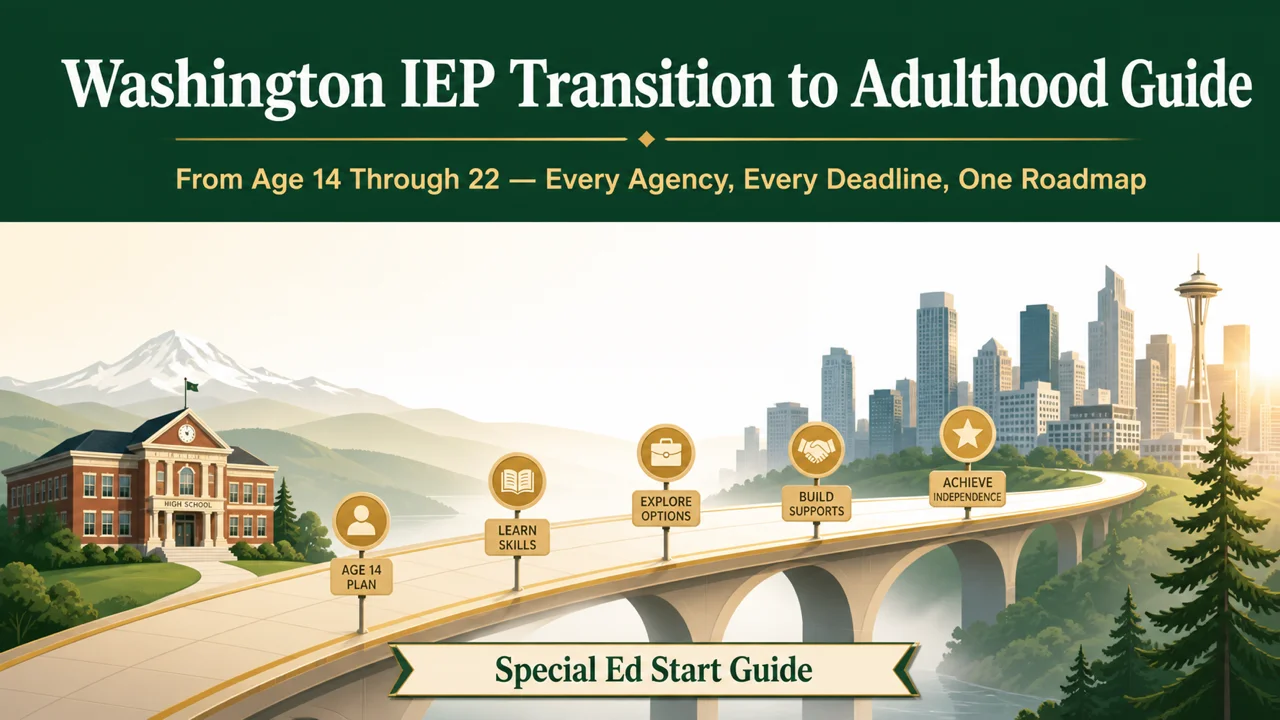
The school district, DVR, DDA, Apple Health, and the SSA — five agencies, zero coordination, and your child's entire future in the gap between them
Your child's IEP meeting introduced the word "transition," and suddenly there's a second system behind the one you've been navigating for years. The school district handles the IEP. The Division of Vocational Rehabilitation handles job training. The Developmental Disabilities Administration handles long-term adult services. The Health Care Authority manages Apple Health. The Social Security Administration processes SSI. Each one has its own intake forms, eligibility windows, and waitlists — and not one of them will tell you what to do with the other four.
Meanwhile, Washington changed the rules three times in two years. SSB 5253 extended special education eligibility through age 22. SSB 5394 restricted DDA's obligation to proactively contact families on the No-Paid Services caseload — over 20,000 individuals who may stop hearing from their caseworker. And Senate Bill 5883 shifted the burden of proof in due process hearings onto the school district. Most online resources haven't caught up with any of these.
The Five-Agency Coordination System
The Washington IEP Transition to Adulthood Guide is built around the problem that makes transition planning in this state so difficult: five government agencies control different pieces of your child's future, and you're the only person with a reason to connect them. The guide gives you a single chronological roadmap that shows which agency to contact, when to contact them, and what to bring to the meeting.
This isn't a generic IEP checklist that starts at age 16 and covers only federal IDEA minimums. Washington requires the High School and Beyond Plan in middle school, and the practical deadlines for DDA eligibility, DVR referrals, and SSI applications fall years before graduation. The Five-Agency Coordination System puts every Washington-specific step — from the age-14 Pre-ETS referral through the final DDA waiver handoff — into a single timeline you can follow from start to finish.
What's Inside
The full guide includes a 53-page walkthrough plus six standalone printable worksheets — tools you can print and bring to IEP meetings, agency appointments, and SSA visits.
- WAC-Compliant SMART Goal Templates — customizable transition goal language for postsecondary education, employment, and independent living that meets WAC 392-172A-03090 requirements, because generic "will explore job options" goals don't survive an IEP review and leave your child without enforceable commitments
- Kevin's Law Diploma Strategy Guide — step-by-step instructions for invoking RCW 28A.155.170 so your child can walk at graduation and receive a Certificate of Attendance while preserving eligibility for 18–22 transition services, because accepting a standard diploma ends the district's obligation to provide FAPE immediately
- The Supported Decision-Making Toolkit — a model SDM agreement template aligned with RCW 11.130.700, plus education and medical authorization releases that keep you involved in IEP meetings and healthcare decisions after your child turns 18, without the cost or restrictions of full court-ordered guardianship
- DVR Pre-ETS Application Walkthrough — the referral process for all five core Pre-Employment Transition Services, how to get the DVR transition counselor invited to your IEP meeting, and how to write Pre-ETS goals directly into the transition plan so the district is accountable for coordination
- DDA Waiver Navigation Guide — CARE assessment preparation, the five HCBS waiver options (Basic Plus, IFS, Core, CIIBS, Community Protection), county-level bridge programs like Job Foundation and School-to-Work, and the exact steps to proactively request services under the SSB 5394 caseload changes
- SSI, Apple Health, and ABLE Account Coordination — the adult SSI application timeline, the Student Earned Income Exclusion, Healthcare for Workers with Disabilities enrollment, and ABLE account setup so your child can work and save without losing Medicaid coverage
- Age-by-Age Planning Timeline — every action item from age 14 to 22, mapped to the specific WAC rule, RCW statute, or agency deadline that triggers it, including the SSB 5253 eligibility extension through the school year in which the student turns 22
- Dispute Resolution Roadmap — Washington's state complaint, IEP facilitation through Sound Options Group, mediation, and due process hearing procedures, including how the 2024 burden-of-proof shift under Senate Bill 5883 changes your leverage at every stage
Who This Guide Is For
- Parents whose child's IEP team just introduced "transition" and you need to understand the full Washington-specific timeline before the next meeting
- Families of students aged 16–17 who realize the school's transition plan is generic and compliance-only — you need to know what a compliant plan actually requires so you can push for better
- Parents approaching the age-18 transfer of rights who want alternatives to full guardianship but aren't sure what's legally available in Washington
- Families of young adults aged 19–22 navigating the handoff from school services to DVR, DDA, and Apple Health — especially those on the DDA No-Paid Services caseload who can no longer count on proactive outreach
- Anyone trying to coordinate five agencies without paying a special education attorney $300–$500 per hour or an advocate $150–$250 per hour
Why Free Resources Aren't Enough
Washington has excellent free resources. OSPI publishes transition guidelines. PAVE offers parent training and workshops. The Arc of Washington and Informing Families maintain toolkits and planning checklists. Disability Rights Washington provides legal resource guides. The problem isn't that any single resource is bad — it's that they're siloed.
OSPI's documents explain special education rules but don't address DDA waiver eligibility. PAVE's workshops cover transition principles but don't walk you through a CARE assessment. DVR's materials focus exclusively on employment and don't mention diploma timing or guardianship alternatives. And national sites like Understood or PACER Center? They rely on federal IDEA baselines and miss Washington-specific rules entirely — Kevin's Law, the SSB 5253 extension, the SSB 5394 caseload restrictions, and the burden-of-proof shift.
The guide bridges those gaps. It takes what each agency publishes separately and organizes it into a single workflow where step 12 follows step 11 and you can see where all five systems intersect. Special education attorneys charge $300–$500 per hour with retainers starting at $3,000. Independent advocates run $150–$250 per hour. This guide gives you the same planning detail — available the moment you download it.
100% Satisfaction Guarantee
If the guide doesn't help you take clear, informed action on your child's transition, email us and we'll refund your purchase. No conditions, no time limit.
Start With the Free Checklist — or Get the Full Guide
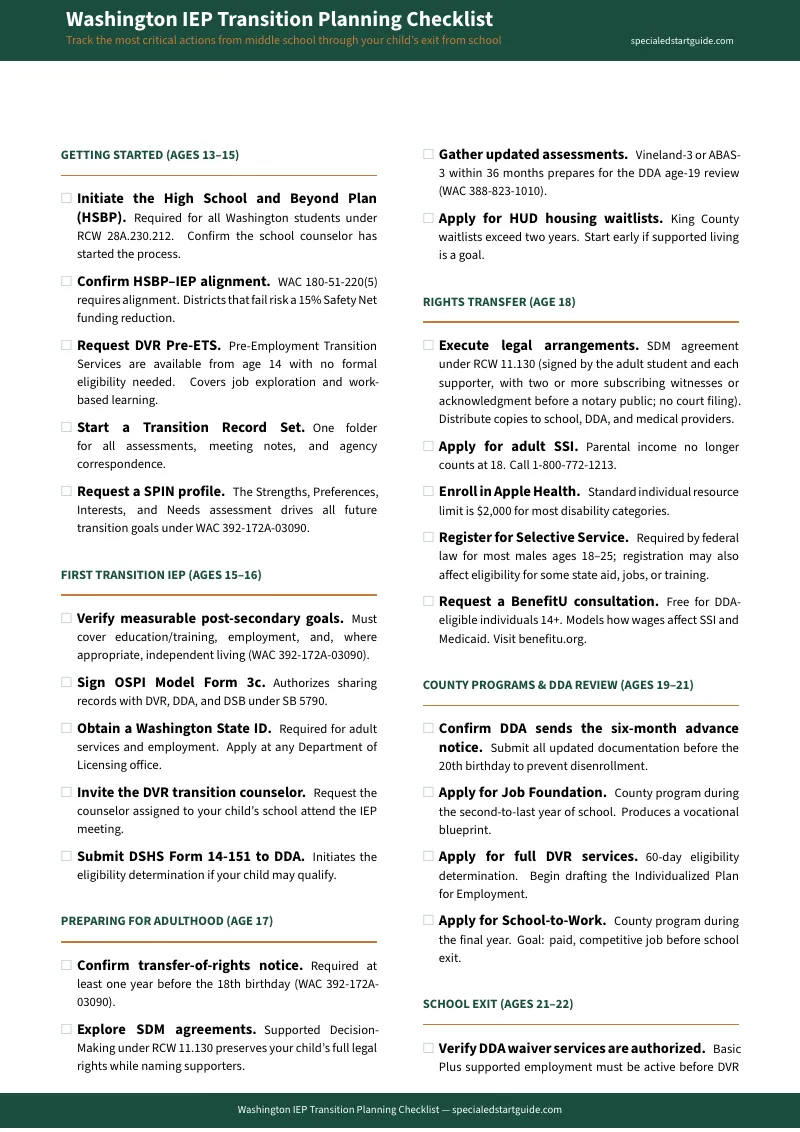
Download the free Washington — Transition Planning Checklist to see the milestones and action items at a glance. When you're ready for the complete step-by-step system — with templates, application walkthroughs, and the full Five-Agency Coordination timeline — the full guide is waiting.
Get the Washington IEP Transition to Adulthood Guide →
Frequently Asked Questions
What if the rules change after I buy?
We update the guide when the rules change. Email us any time, even years later, and we'll send you the current edition free.