Your teenager's school team just said "transition" — now what?
Virginia starts transition planning at age 14, two years before most states. That sounds like a head start — until you realize nobody handed you a map. The IEP team checks a few boxes. The school counselor talks about diploma tracks. And somewhere between "measurable postsecondary goals" and "transfer of rights," you're supposed to figure out how three separate state agencies, a statewide waitlist, and the Social Security Administration all fit together.
Most Virginia families discover the gaps the hard way: at age 18, when parental authority vanishes overnight, or at 22, when school ends and "the cliff" drops your child into a landscape of eligibility forms and waiting lists with no coordinated support in sight.
The Virginia IEP Transition to Adulthood Guide is a Coordinated Handoff System — a single-source planning tool that maps every regulatory trigger, agency referral, and legal decision point across your child's transition, in the order Virginia families actually face them.
What's Inside the Guide
This is not a motivational booklet or a glossary of acronyms. It is a structured, chapter-by-chapter system for navigating Virginia's transition pipeline — school division, DARS, CSBs, Medicaid, SSI — without the $125-to-$500-per-hour professional fees.
- The Virginia Transition Timeline (Ages 14–22) — every regulatory trigger mapped to what your IEP team owes, what you need to request, and when each agency handoff should happen. Not generic federal timelines — Virginia-specific deadlines under 8VAC20-81.
- Diploma Pathway Decision Framework — Standard vs. Advanced Studies vs. Applied Studies, with the FAPE consequences of each choice explained plainly. Includes credit accommodations and what happened to the old Modified Standard Diploma.
- Transfer of Rights Toolkit — the full hierarchy of alternatives to court-ordered guardianship at age 18: Supported Decision-Making Agreements under Va. Code § 37.2-314.3, the VDOE Educational Representative, and Educational Powers of Attorney.
- DARS Pre-ETS and VR Coordination Guide — how to access free Pre-Employment Transition Services starting at 14, when to open a formal VR case (hint: 11th grade), and how to get your DARS counselor into the IEP meeting.
- CSB Intake and DD Waiver Navigator — step-by-step preparation for the VIDES screening, how the needs-based (not first-come) waitlist works, and what distinguishes the Building Independence, Family & Individual Supports, and Community Living waivers.
- The September 30 Cutoff Calculator — a plain-math breakdown of how Virginia determines your child's last year of FAPE eligibility, including ESY rights for students who turn 22 after September 30.
- SSI Adult Redetermination and Medicaid Setup — the income-deeming shift at 18, how to time the application, and why Medicaid enrollment is a prerequisite for every DD waiver.
- Measurable Goal Templates — VDOE-aligned postsecondary goal examples in education, training, employment, and independent living that meet Indicator 13 compliance standards.
- The Late-Start Triage Plan — a recovery checklist for families who are 16, 17, or 18 and behind on transition planning, prioritizing the most time-sensitive referrals and applications.
Who This Guide Is For
- Parents of 13- and 14-year-olds whose IEP team just introduced "transition" and who want to make informed diploma and assessment decisions from the start
- Parents approaching the age-17 transfer of rights notice who need to understand their legal options before decision-making authority shifts to their child
- Families navigating the 18th birthday — SSI applications, Medicaid enrollment, Selective Service registration, and the CSB waiver intake all converge in the same window
- Parents of students aged 19–22 who are negotiating exit plans with the school division and need to understand the September 30 cutoff and Applied Studies Diploma protections
Why Not Free Resources?
Virginia has excellent free organizations — PEATC, The Arc of Virginia, dLCV, VCU's Center on Transition Innovations. The problem is not quality. The problem is fragmentation.
PEATC publishes dozens of individual fact sheets and checklists, each covering one slice of the transition. The Arc focuses on DD waivers but does not cover school-based IEP compliance. dLCV handles legal rights but not step-by-step planning. VDOE's own guidance documents are written for compliance officers, not parents sitting at a kitchen table trying to figure out what to do next Tuesday.
You could spend 40 hours pulling these sources together, cross-referencing timelines, and hoping nothing slipped through a gap between agencies. Or you could open one guide that already did that work — organized chronologically, written in plain language, and structured around the specific decisions Virginia families face at each stage.
Satisfaction Guarantee
If the guide does not help you navigate your child's transition planning, email [email protected] and we will refund your purchase — no questions, no hoops.
Get the Free Checklist — or the Complete System
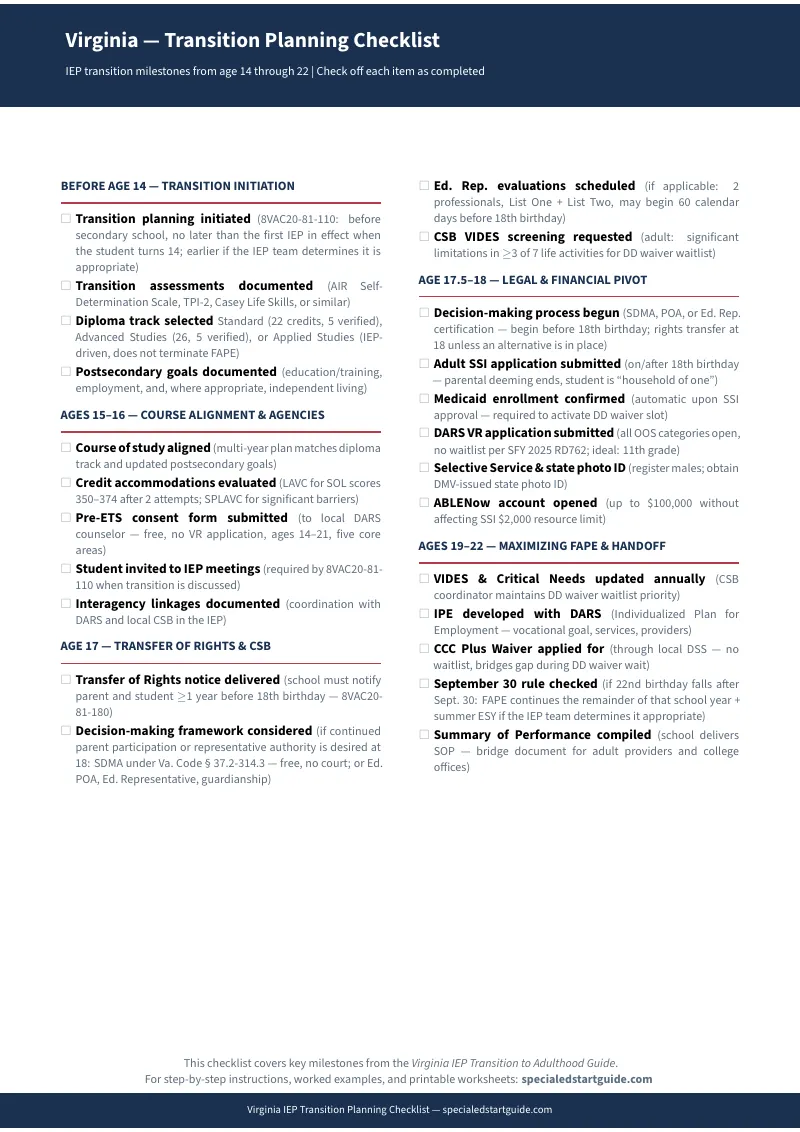
Download the Virginia Transition Planning Checklist for free — a single-page chronological overview of every critical milestone from age 14 to 22. It shows you what to do. The full guide shows you how, with step-by-step instructions, decision frameworks, goal templates, and agency navigation for every handoff.
Ready for the complete Coordinated Handoff System? Get the full Virginia IEP Transition to Adulthood Guide — for a fraction of what one hour with a special education advocate would cost — and walk into your child's next IEP meeting knowing exactly what to ask for, when to ask for it, and which agency call to make next.