Your Child's IEP Team Handles School. Nobody Handles What Comes After.
Utah starts transition planning at age 14 — two years earlier than the federal minimum. That sounds like an advantage until you realize what the IEP team actually does with that time: they draft postsecondary goals, check a compliance box, and move on. Meanwhile, the adult service system your child is heading toward runs under completely different rules. School services are an entitlement — the district must provide them. Adult services are eligibility-based, budget-capped, and rationed through a waitlist that ranks by assessed need, not by how long you've been waiting.
No single agency coordinates the handoff. USOR handles vocational rehabilitation and Pre-ETS but not developmental disability waivers. DSPD manages the Community Supports and Limited Supports Waivers but not employment. The Social Security Administration handles SSI but not school records. Each one tells you "that's not our responsibility." Because technically, it isn't. The coordination falls entirely on you.
The Utah Transition Coordination Sequence — that's what this guide is. It takes every school-side decision and every adult-side preparation and puts them in one chronological master sequence, connected by the worksheets that make each step completable rather than just understandable.
What's Inside
- The Complete Age-by-Age Timeline — every milestone from the first transition IEP at age 14 through the final school exit under R277-419, with the specific actions, deadlines, and responsible agencies at each stage. Not a summary — the full operational sequence your IEP team is supposed to follow but rarely explains.
- The Graduation Pathway Analyzer — a structured worksheet for evaluating the regular high school diploma (24 credits), the alternate diploma (for students accessing core standards through Essential Elements), and the certificate of completion. This matters because a regular diploma terminates FAPE eligibility under IDEA — it's a change of placement that ends your child's right to school services. The alternate diploma and certificate of completion preserve eligibility through age 21. The guide lays out what each pathway means for college access, employment, continued services, and adult agency eligibility under R277-705.
- The Supported Decision-Making Drafting Workbook — Utah formally recognizes Supported Decision-Making Agreements under H.B. 334 (effective May 2025). The state has specific statutory requirements: the agreement must be voluntary and written, signed in the presence of two witnesses or a notary, and all decision-making authority stays with the individual. Paid providers cannot serve as supporters unless they're a parent, stepparent, or sibling. Third parties are legally required to accept valid SDMAs. This workbook walks you through constructing a compliant agreement under UCA §§ 75-5-701 to 75-5-709 and pairing it with healthcare directives and financial powers of attorney — so your child retains full legal capacity while you maintain practical involvement.
- The USOR Pre-ETS Enrollment Guide — Pre-Employment Transition Services are available to students with disabilities ages 14 to 21 without requiring a full VR case, covering all five core areas: job exploration, work-based learning, postsecondary counseling, workplace readiness, and self-advocacy. But USOR operates under an Order of Selection — Priority Category 1 (Most Significant Disabilities) is currently open, while Categories 2 and 3 are on delayed status with 90-day check-ins. The guide shows you how to request a school referral or self-refer, and why getting an approved IPE before an OOS closure can grandfather your child into continued services.
- The DSPD Intake & NAQ Preparation Workbook — DSPD enforces a strict 90-day deadline to complete the intake process. Miss it and the application goes inactive. The workbook walks you through the full intake packet: psychological evaluations, documentation of disability onset before age 22, evidence of substantial limitations in at least three major life domains, and the Needs Assessment Questionnaire that scores your child's position on the needs-based waitlist. The NAQ weighs severity of need (50%), caregiver support (30%), and time on the waitlist (20%) — the evidence organizer helps you compile documentation so the assessment accurately reflects your child's actual level of need.
- The Financial Planning Worksheets — SSI application timing and the current federal benefit rate, the age-18 redetermination where parental income is no longer deemed to the individual, ABLE account contribution limits and the ABLE-to-Work exception, the $100,000 SSI disregard threshold, and the impact of the Social Security Fairness Act (signed January 2025) on disabled adult child benefits. Because one savings account opened without understanding the rules can cost your child their entire benefits eligibility.
- The Multi-Agency Handoff Checklist — Utah's age-22 exit dates under R277-419 depend on your child's birthday: students turning 22 between September 2 and December 31 exit at the start of winter recess; those turning 22 between January 1 and September 1 exit at the end of the fiscal year (June 30). The handoff checklist coordinates the transfer of records and services from the school district to USOR, DSPD, and SSA, including the mandatory Summary of Performance, the transition IEP meeting prep sheets, and the specific steps to keep adult services active from the day school services end.
- Decision Worksheets and Contact Sheets — the Transition Timeline Tracker that maps every age-specific milestone with a date-done column, the Decision-Making Options Worksheet that matches your child's capabilities to a legal framework, the Agency Communication Log that records who promised what across every agency, IEP meeting prep built into the handoff checklist, a Key Contacts Directory for every state and local agency involved (USOR, DSPD, Utah Parent Center, Disability Law Center, SSA field offices) with fillable space for your local contacts, and the Financial Thresholds Quick Reference card with every 2026 dollar figure in one place.
Who This Is For
This is for Utah parents navigating the IEP transition to adulthood — whether your child is approaching 14 and the school just mentioned "transition" for the first time, or your child is 19 and you're staring down the service cliff with no plan for what replaces school.
- You need to choose between the regular diploma, the alternate diploma, and the certificate of completion — and nobody has clearly explained what each pathway means for your child's future beyond graduation day
- Your child is approaching 17 and you received the transfer-of-rights notice — and you don't know that Utah now recognizes Supported Decision-Making Agreements under H.B. 334 as a legal alternative to guardianship
- Someone mentioned Pre-ETS or Vocational Rehabilitation but you don't know how to access it, whether your child qualifies, or what the Order of Selection means for actually getting services
- You've heard about DSPD waivers but the waitlist is strictly needs-based, not chronological, and nobody has explained the 90-day intake deadline or how the NAQ scoring determines your child's priority
- You're worried about SSI, asset limits, and ABLE accounts and you can't find a clear explanation of how they interact
- You've visited the Utah Parent Center, the Disability Law Center, USOR, and DSPD's website, and each gave you useful information about their specific piece — but nobody gave you the complete sequence connecting everything in chronological order
Why the Free Resources Aren't Enough
The Utah Parent Center, the Disability Law Center, USOR, and DSPD all produce genuinely valuable information. The problem isn't quality — it's fragmentation. The Utah Parent Center's Choices manual and Transition University courses cover school-side planning but read like dense policy books and stop at the adult-services handoff. The Disability Law Center publishes legally precise fact sheets and template SDM agreements but doesn't connect them to school transition timelines or financial planning. USOR's portal handles vocational rehabilitation and Pre-ETS enrollment but says nothing about guardianship alternatives or benefit preservation. DSPD's website explains waiver eligibility but doesn't link it to the school exit sequence or SSI timing.
What doesn't exist anywhere in the public system is the single document that connects all of these into one chronological sequence — from the age-14 IEP where you select a graduation pathway through the day your child exits school and adult services need to be in place. That's the gap this guide fills.
An uncontested adult child guardianship in Utah runs $2,500 to $5,000 through a special needs attorney. Trust planning costs $1,500 to $4,000. An independent special education advocate charges $100 to $175 per hour. This guide costs a fraction of a single professional consultation — and it gives you the organized sequence that lets you handle most of the coordination yourself, and hand professionals an organized case when you do need them.
Satisfaction Guarantee
Money-back guarantee, no time limit. If the guide doesn't change how you prepare for your child's transition, you get a full refund. No conditions, no hoops.
Get Started
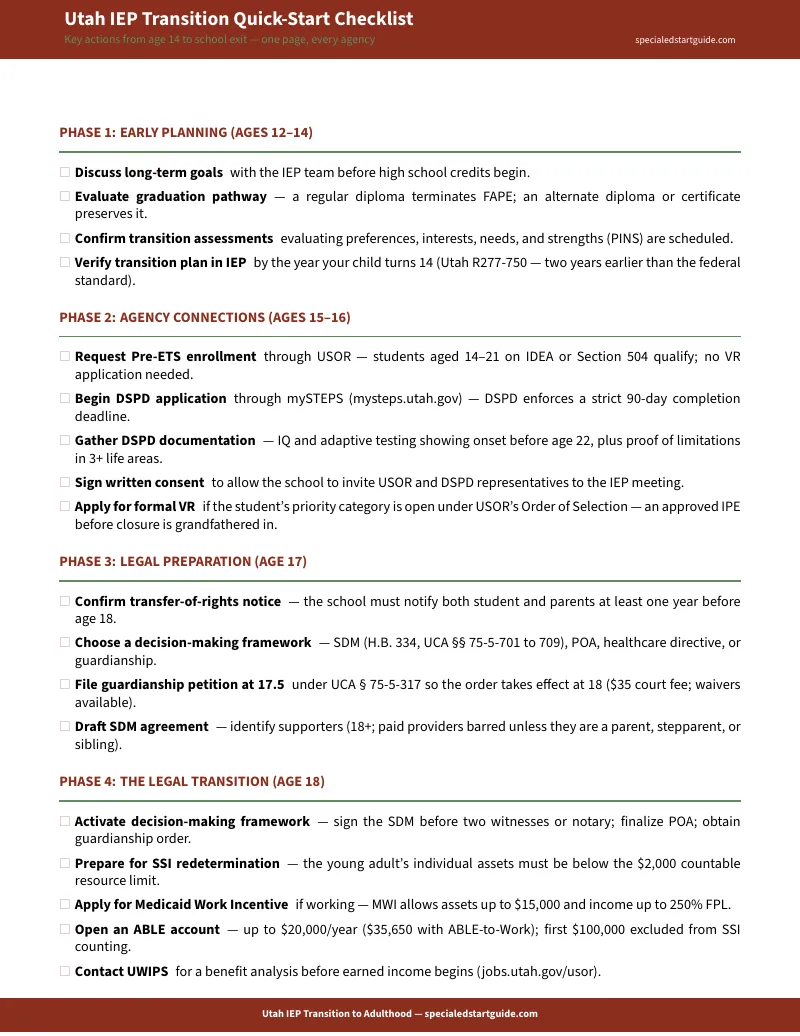
Download the free Utah Transition Planning Checklist — the printable timeline organized by age milestone with the critical actions, deadlines, and responsible agencies at each stage. Or get the complete Utah IEP Transition to Adulthood Guide — the full guide, the Graduation Pathway Analyzer, the Supported Decision-Making drafting workbook, the DSPD Intake & NAQ Preparation Workbook, the financial planning worksheets, the Transition Timeline Tracker, the Agency Communication Log, the Multi-Agency Handoff Checklist with IEP meeting prep sheets, the Financial Thresholds Quick Reference, and the Key Contacts Directory — everything you need to coordinate the transition that no single public agency will coordinate for you.