Your teenager's ARD committee just said "transition" — now what?
Texas starts transition planning at age 14, two full years before the federal minimum. That sounds like a head start — until you realize three separate state agencies, a county-level waiver gatekeeper, and the Social Security Administration all play a role in your child's post-school future, and none of them talk to each other. The school handles the IEP paperwork. Everything else — the TWC-VRS self-referral, the LIDDA intake, the SSI application, the Supported Decision-Making Agreement — falls on you. And the deadlines don't wait.
Most Texas families discover the gaps the hard way. At 18, when decision-making rights transfer and nobody drafted an SDMA. At graduation, when the diploma your child accepted turns out to be the kind that terminates FAPE eligibility. At 22, when school services end and the HCS waiver you registered for still has a 17-year queue ahead of it.
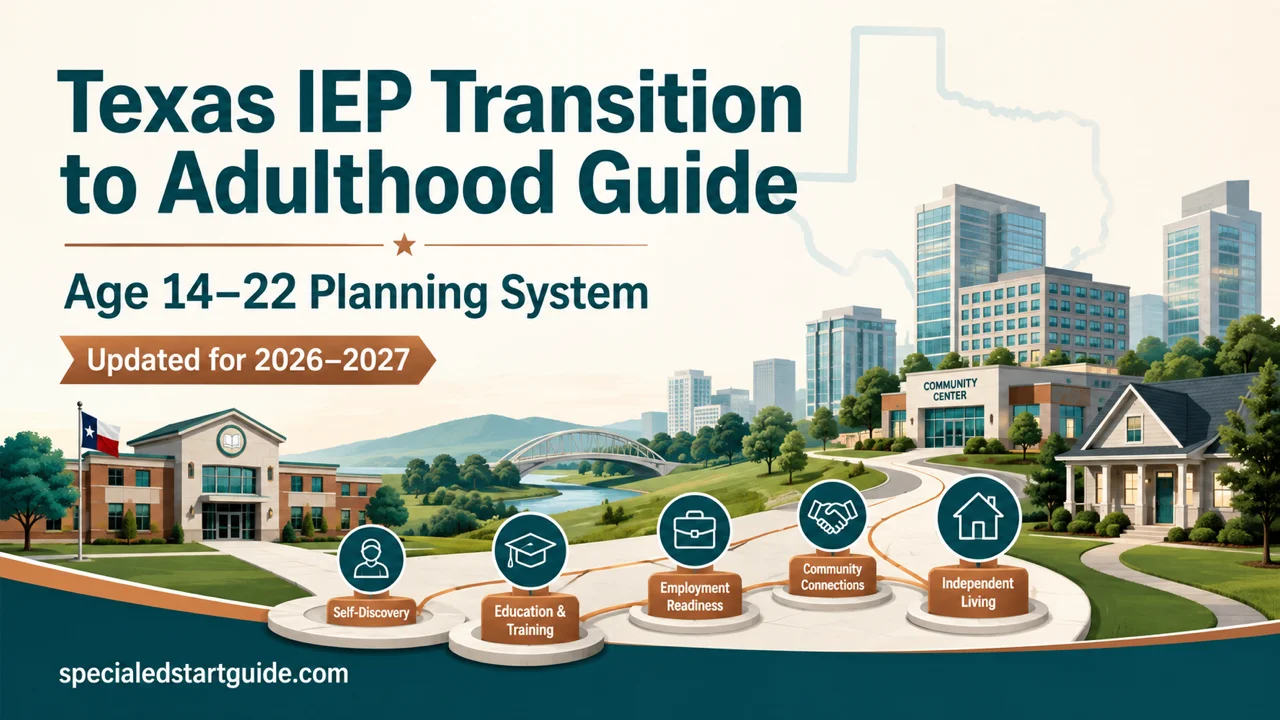
The Texas IEP Transition to Adulthood Guide is a Coordinated Handoff System — a single-source planning tool that maps every regulatory trigger, agency referral, and legal decision point across your child's transition, in the order Texas families actually face them.
What's Inside the Guide
This is not a motivational booklet or a glossary of IEP acronyms. It is a structured, chapter-by-chapter system for navigating Texas's transition pipeline — TEA, TWC-VRS, HHSC, the local LIDDA, SSA — without the $125-to-$200-per-hour professional advocacy fees.
- The Texas Transition Timeline (Age 14–Age 22) — every statutory trigger mapped to what the ARD committee owes, what you need to request, and when each agency handoff should happen. Built on Texas Education Code § 29.011 and 19 TAC § 89.1055 — not generic federal timelines that miss the age-14 mandate.
- 2026 Graduation Pathway Decision Framework — standard, modified assessment, and modified curriculum routes under 19 TAC § 89.1070, with the April 2026 amendments (HB 2, SB 568) reflected. Explains which diploma types terminate FAPE, which preserve eligibility through age 22, and the § 89.1070(j) right to resume services even after accepting a diploma under modified conditions.
- Transfer of Rights Toolkit — Texas's age of majority is 18, not 19 like some neighboring states. The guide covers the full hierarchy: Supported Decision-Making Agreements under Estates Code Chapter 1357 (Texas was the first state to recognize these), powers of attorney, and guardianship — with the statutory SDMA form, witness and notary requirements, and integrated FERPA and HIPAA releases.
- TWC-VRS Pre-ETS and Vocational Rehabilitation Guide — how to self-refer using the "Start My VR" portal at twc.texas.gov, the five Pre-ETS service areas (available from age 14 at no cost), the Summer Earn and Learn (SEAL) program, and how to transition from Pre-ETS into a formal Individualized Plan for Employment with the 60-day eligibility and 90-day IPE timelines.
- LIDDA and Waiver Interest List Navigator — step-by-step intake for your county LIDDA. HCS and TxHmL registration on the Community Services Interest List (CSIL), CARE IDs, the biennial verification cycle that keeps your spot, and honest guidance on managing a queue of 198,000+ people across the state — because missing one verification notice can drop your family from the list entirely.
- SSI and Financial Planning System — the income-deeming shift at 18, the age-18 medical redetermination under adult disability standards, the Student Earned-Income Exclusion, Disabled Adult Child benefits (including the impact of the Social Security Fairness Act repealing WEP and GPO), and 2026 ABLE account expansions (age-of-onset now 46, $20,000 annual contribution limit, ABLE-to-Work provision for up to $15,650 additional).
- The September 1 Cutoff Rule — exactly how the age-22 eligibility endpoint works, the one-day birthday difference that can mean an entire additional school year of transition services, and how to plan around the 18-plus program window.
- The 2026 Service Intensity Funding Model — Texas is replacing the old instructional-setting system with service-intensity tiers under HB 2 and SB 568. The guide explains what this means for how ARD committees allocate and report transition resources, including 18-plus programs and community-based vocational instruction.
- Standalone Printable Worksheets — a transition timeline planner, diploma pathway comparison, decision-making options worksheet, LIDDA and waiver interest list tracker, financial planning worksheet, VR referral tracker, IEP meeting preparation checklist, agency communication log, and exit portfolio checklist — nine separate PDFs you can print, fill in, and bring to meetings.
- Dispute Resolution Roadmap — IEP facilitation, state complaints, mediation, and due process hearings, with guidance on building the paper trail before you need it and free advocacy resources including Disability Rights Texas, Texas Project First, and Partners Resource Network.
Who This Guide Is For
- Parents of 13- and 14-year-olds whose ARD committee just introduced "transition" and who want to make informed graduation-pathway and assessment decisions from the start — before course selections become difficult to reverse
- Parents approaching the 17th birthday who need to understand the transfer of rights timeline, evaluate Supported Decision-Making against guardianship, and prepare for the legal shift before their child turns 18
- Families navigating ages 15–17 — TWC-VRS self-referral, LIDDA intake, Pre-ETS enrollment, and the SEAL application all converge in the same critical window
- Parents of students aged 18–22 in 18-plus transition programs who are navigating the service intensity model, the September 1 cutoff, and the handoff from school-based to community-based adult services
Why Not Free Resources?
Texas has strong free organizations — TEA's SPEDTex portal, Texas Project First, Partners Resource Network, Navigate Life Texas. The problem is not quality. The problem is fragmentation.
SPEDTex publishes compliance-focused regulatory materials written for school administrators, not parents making real-time decisions at ARD meetings. Texas Project First offers individual topic pages and training materials, each covering one slice of the transition. Partners Resource Network provides excellent workshop content, but it is structured as training sessions, not as a step-by-step planner you can bring to a meeting. Navigate Life Texas organizes information by topic but does not give you a single document that coordinates the TEA timeline, TWC-VRS referral, LIDDA intake, SSI application, and SDMA execution into one actionable sequence.
You could spend 40 hours pulling these sources together, cross-referencing timelines, and hoping nothing slipped through the gap between one agency's website and another's. Or you could open one guide that already did that work — organized chronologically, written in plain language, and structured around the specific decisions Texas families face at each stage.
Satisfaction Guarantee
If the guide does not help you navigate your child's transition planning, email [email protected] and we will refund your purchase — no questions, no hoops.
Get the Free Checklist — or the Complete System
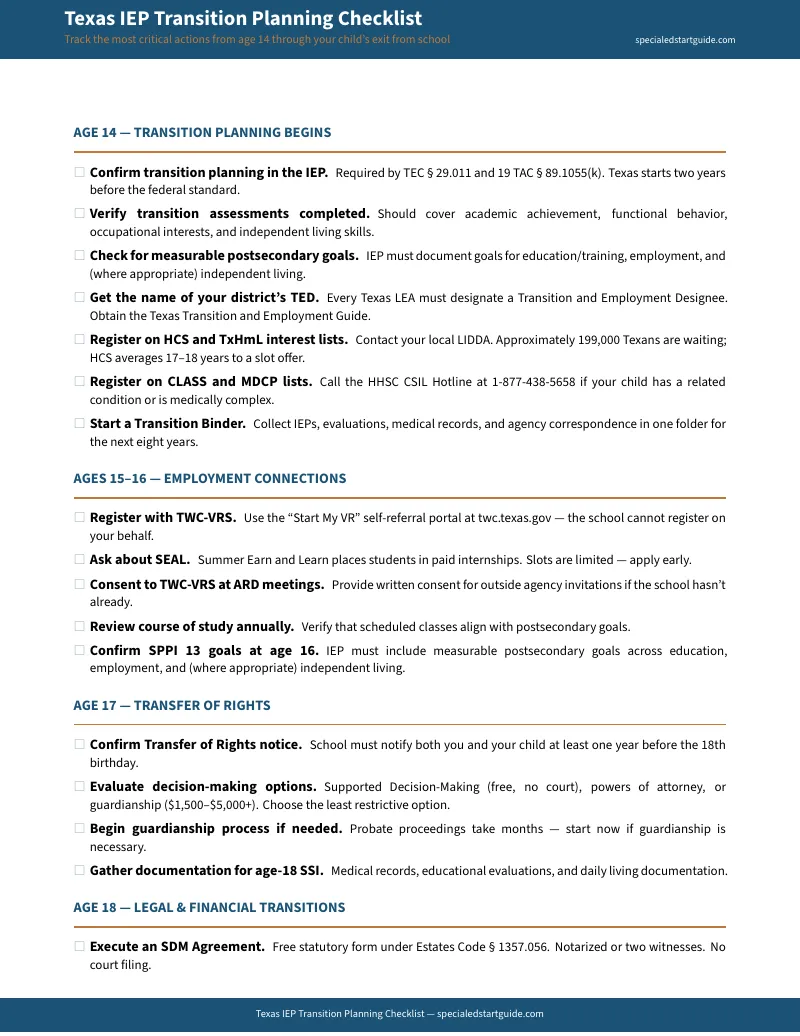
Download the Texas — Transition Planning Checklist for free — a chronological overview of every critical milestone from age 14 to age 22. It shows you what to do. The full guide shows you how, with step-by-step instructions, decision frameworks, printable worksheets, and agency navigation for every handoff.
Ready for the complete Coordinated Handoff System? Get the full Texas IEP Transition to Adulthood Guide — for less than what one hour of a special education advocate's time would cost — and walk into your child's next ARD meeting knowing exactly what to ask for, when to ask for it, and which agency call to make next.
Frequently Asked Questions
What if the rules change after I buy?
We update the guide when the rules change. Email us any time, even years later, and we'll send you the current edition free.