
Don't Sign at the ARD Table Until You Read This.
You walked into that ARD meeting prepared — or you thought you did. You read the Procedural Safeguards notice. You printed your child's progress reports. You wrote down your concerns. And then the diagnostician, the LSSP, and the district representative smiled, used phrases you'd never heard before, and slid a fully drafted IEP across the table. They told you to sign at the bottom.
You left the meeting with a document you didn't fully understand and a sinking feeling that everything had been decided before you sat down. You were right. When the ARD committee cannot reach mutual agreement on required IEP elements and you disagree, Texas rules require the district to offer one opportunity to recess and reconvene within no more than 10 school days unless you and the district agree to a longer period (TAC §89.1055(z)(1)). The opportunity is not required when the student's presence on campus presents a danger of physical harm, or the student committed an expellable offense or an offense that may lead to DAEP placement. If the committee still cannot agree after that recess, the district must implement the IEP it has determined is appropriate — and the window to push back on inadequate goals, missing services, or a 504 downgrade narrows fast. Nobody at the table told you that.
The problem isn't that you're uninformed. The problem is that Texas special education runs on a bureaucratic framework — TAC Chapter 89 for IEPs, TEC Chapter 29 for governance, the 2024 Dyslexia Handbook for dyslexia evaluation and instruction — that was built to be navigated by administrators and diagnosticians, not parents. In 2025–26, Texas served 903,072 students in special education, 16.6% of all students, with the fastest-growing category being dyslexia after HB 3928 changed the state's dyslexia evaluation, identification, and instruction requirements. TEA counted 1,208 public school districts and charter operations in 2024–25. The former 8.5% identification-rate indicator was a monitoring threshold, not a legal cap: the U.S. Department of Education reported that districts reduced identification to no more than 8.5%, potentially depriving children of services, and that Texas later eliminated the indicator. Districts now face a tidal wave of referrals with insufficient staff and deep institutional resistance. Special education attorneys charge $300 to $500 per hour. Private advocates charge $400 to $600 just to attend one ARD meeting. This is not a collaborative system. This is an adversarial one.
The Texas IEP & 504 Blueprint is the ARD Defense System — the tactical enforcement toolkit that bridges the gap between knowing your rights under Texas law and actually exercising them at the table, with every template, script, and checklist grounded in TAC Chapter 89, TEC Chapter 29, and IDEA.
What's Inside the Blueprint
The 10-Day Recess Playbook
When mutual agreement on required IEP elements isn't reached and you disagree, TAC §89.1055(z)(1) requires the district to offer one opportunity to recess and reconvene within no more than 10 school days unless both sides agree to a longer period. The opportunity is not required when the student's presence on campus presents a danger of physical harm, or the student committed an expellable offense or an offense that may lead to DAEP placement. The recess is more useful when you know what to do during that time. The Blueprint gives you a day-by-day action plan: how to request Prior Written Notice of a refusal, gather outside clinical data, request an Independent Educational Evaluation at public expense if you disagree with the district's evaluation, and jointly request a state-appointed TEA facilitator with the district within 10 school days of the disagreement. This isn't theory — it's the step-by-step protocol that turns a bureaucratic pause into your strongest negotiating position.
The FIIE Translation Matrix
The Full Individual and Initial Evaluation is typically a 20- to 30-page document packed with psychometric data — cognitive processing scores, standard deviations, WJ-IV subtests, CTOPP phonological awareness results. Without a translation matrix, you can't connect a deficit in working memory to a specific IEP goal or a particular STAAR accommodation. The Blueprint walks you through every section of the FIIE, explains what each score means in plain English, and shows you exactly how to use specific data points to justify accommodations and specialized instruction at the ARD table.
The Dyslexia 504-to-IEP Transition Roadmap
Following HB 3928 and the 2024 Dyslexia Handbook update, when a school suspects dyslexia and has reason to suspect a student may be eligible for special education, it must follow IDEA evaluation procedures. If the ARD committee determines that a student with dyslexia needs evidence-based dyslexia instruction, Texas treats that instruction as specially designed instruction; an IEP follows when the committee finds the student eligible under IDEA. The instructor must be trained in the district's evidence-based dyslexia program, but Texas does not require a Certified Academic Language Therapist credential. If your child has dyslexia and receives only accommodations on a 504 plan, the Blueprint explains how to request an IDEA evaluation, understand the eligibility process, and prepare a comprehensive FIIE request.
The Copy-Paste Advocacy Letter Library
Every letter cites the exact Texas regulation. Request a formal evaluation in writing to the special education director or a district administrator; the district then has 15 school days to provide consent paperwork or issue a refusal. The 45-school-day FIIE timeline begins after the district receives your written consent. If you disagree with the district's evaluation, request an Independent Educational Evaluation at public expense; without unnecessary delay, the district must either ensure the IEE or file for due process to defend its evaluation. Request the 10-school-day recess when the law applies. Request a Functional Behavioral Assessment. Document service non-delivery. These aren't generic federal templates — they're Texas tools that create a documented paper trail when you send them.
ARD Meeting Scripts and Checklists
What to say when the team tells you your child doesn't qualify because their grades are passing. What to say when they push a 504 instead of an IEP. What to say when the LEA representative claims they can't add service minutes "because of staffing." Each script cites the TAC Chapter 89 regulation that proves them wrong — so you're not arguing opinions at the ARD table, you're citing law. The pre-meeting checklist covers Texas's one-party consent rule and district recording-policy considerations, required ARD committee composition under TAC §89.1050, and the specific documents to bring.
The 45-Day Timeline Tracker
After the district receives written consent, the FIIE report is generally due within 45 school days. If the student is absent at least three school days during that period, the deadline extends by the number of school days missed. If consent arrives 35 to 44 school days before the last instructional day, the report is due by June 30 unless the student misses at least three school days before then, in which case the 45-school-day timeline applies. If fewer than 35 school days remain, the 45-school-day timeline applies. After the report is complete, the ARD committee generally has 30 calendar days to decide initial eligibility and, if appropriate, the IEP and placement. If day 30 falls during summer, the meeting is due by the 15th school day of the next school year, unless the report indicates ESY is needed that summer, in which case it must meet as soon as possible. School days exclude summer break. The Blueprint maps milestones, gives you follow-up language, and provides an escalation template when a deadline passes.
Goal-Tracking Worksheets
IEPs must include measurable annual goals and explain how progress will be measured. Under Endrew F., the IEP must be reasonably calculated to enable progress appropriate in light of the child's circumstances. The worksheets give you fields for baselines, targets, and mastery criteria so you can track data between meetings, compare school-reported progress with your observations, and arrive at the annual ARD review with documentation that either confirms the program is working or proves it isn't.
The Dispute Resolution Escalation Ladder
When informal advocacy fails, Texas offers formal options: TEA State Complaints (a 60-calendar-day investigation and resolution timeline that may be extended), IEP facilitation through the TEA, mediation, and due process hearings through SOAH. The Blueprint explains when each option is appropriate, the timeline and costs involved, and how to build the paper trail — including that TEA State Complaints are free, don't require an attorney, and frequently produce faster results than due process.
Who This Blueprint Is For
- Parents preparing for their first ARD meeting who don't want to walk in blind against a team that does this every day — and who need to understand the FIIE before it's discussed at the table
- Parents whose child has been pushed into a 504 plan when they should be receiving Specially Designed Instruction under an IEP — especially dyslexia families caught in the HB 3928 transition
- Parents in Houston, Dallas, Austin, San Antonio, or Fort Worth navigating adversarial ISDs that pressure parents to sign at the table
- Parents in rural Texas districts where staffing shortages mean ARD meetings don't happen on schedule, services aren't delivered, and there's no local advocate to call
- Parents whose child has ADHD, autism, dyslexia, or anxiety and was told they're "too smart for SPED" or "grades are too high" — and who need to understand that academic performance is not the legal standard
- Parents who feel railroaded at ARD meetings — who sit at a table where the IEP was pre-drafted by staff before they arrived and the meeting feels like a rubber-stamp ceremony
- Parents approaching an annual ARD review or triennial reevaluation (REED) whose child's goals were vague, unmeasured, or routinely ignored by general education teachers
- Parents whose child is being repeatedly suspended for behavior related to their disability — and who need to understand the 10-day removal rule and Manifestation Determination Review procedures
- Parents whose child attends a Texas open-enrollment charter school and whose IEP is not being implemented
Why Not Just Use the Free Resources?
Texas has substantial free special education resources. The TEA provides the Procedural Safeguards and the Parent's Guide to the ARD Process. SPEDTex offers the Notice of Procedural Safeguards in over 30 languages. Partners Resource Network runs federally funded parent training centers. Disability Rights Texas publishes a 90-page IDEA manual. Here's why parents still struggle after consulting all of them:
- The TEA Procedural Safeguards protect the district, not your child. The document the school hands you at every ARD meeting is designed by lawyers to fulfill federal notification requirements. It outlines complaint procedures and mediation guidelines in dense legalese. It offers zero instruction on how to negotiate a measurable goal, how to analyze your child's FIIE scores, or what to do when the committee ignores your requests.
- Partners Resource Network is collaborative by design — they can't teach you to fight. PRN operates the federally funded parent training centers (PACT, PATH, PEN, TEAM). PACT offers individual assistance by phone and in person, as well as workshops and webinars. The Blueprint gives you ready-to-use scripts and templates for the next ARD meeting.
- The Disability Rights Texas manual is 90 pages of legal text. The DRTx IDEA Manual is legally exhaustive and accurate. It is also paralyzing to read the night before a meeting. It explains what the law is — it does not give you fill-in-the-blank email templates for enforcing it. Its coverage of the 10-school-day recess under TAC §89.1055(z)(1) is surprisingly brief and lacks an action plan for what to do during that period.
- Wrightslaw is a national IDEA resource. It also includes some Texas-specific material, including the 45-school-day evaluation timeline. The Blueprint adds a Texas workflow for TAC Chapter 89, FIIE decoding, the LSSP role, and the current recess rule. If you use national terminology like "IEP Team" in a Texas school district, they know you don't fully grasp the local rules.
- TPT and Etsy planners organize paperwork — they don't enforce rights. A pastel IEP binder helps you keep documents in order. It won't explain what the FIIE scores mean, why the district is pushing a 504, or how to cite TAC §89.1055(z)(1) to request the recess. The overwhelming majority of these products are designed for special education teachers, not parents.
- Private advocates cost $100–$200 per hour in Texas metro areas. Attorneys run $300–$500. Most families can't afford $500 for a single ARD meeting — and advocates prefer cases where a solid paper trail already exists. The Blueprint is how you build that trail.
The free resources explain what Texas law says. The Blueprint gives you the tools to make the district follow it.
— Less Than One Hour of a Special Education Advocate
Special education advocates in Texas charge $100–$200 per hour. Private attorneys run $300–$500. If you hand an advocate a disorganized pile of papers, you'll spend $400 just for them to review the file and formulate a strategy. The Blueprint teaches you how to organize the binder, decode the FIIE, and draft the initial requests — either empowering you to win at the ARD table without an advocate, or saving hundreds in billable hours if you do hire one.
Your download includes the complete Blueprint guide plus standalone printable PDFs — every template, worksheet, script, and reference card, ready to print and bring to your next ARD meeting.
- Complete Blueprint Guide — 16 chapters covering the Texas special education landscape, IEP vs. 504, referral and evaluation timelines (45-school-day FIIE and 30-calendar-day initial ARD decision, with exceptions), ARD meeting strategies, the one recess opportunity of up to 10 school days unless both sides agree to a longer period, subject to safety and discipline exceptions, the dyslexia-504-IEP eligibility process, IEP document analysis, Independent Educational Evaluations, ESY and service specifics, dispute resolution, school discipline protections, transition planning starting at age 14, transfer student rules, special populations, paper trail documentation, and Texas advocacy resources
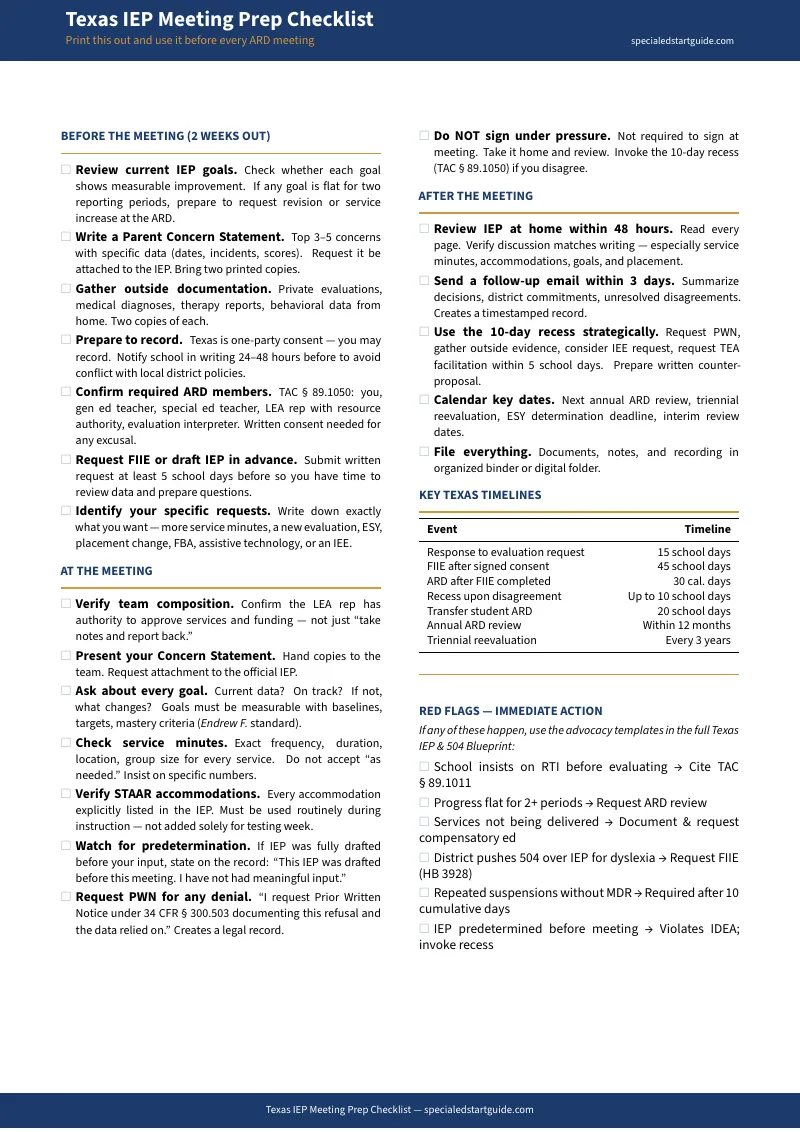
- ARD Meeting Prep Checklist — the before/during/after checklist with Texas timelines and TAC Chapter 89 citations for every step
- Advocacy Letter Templates — copy-paste letters citing exact TAC Chapter 89 and TEC Chapter 29 regulations for evaluation requests, IEEs, recess requests, FBA requests, and formal disagreements
- Goal-Tracking Worksheet — structured fillable worksheet for measurable progress monitoring between annual ARD reviews
- Texas Timeline Cheat Sheet — key deadlines on one page: 15-school-day district response to a written FIIE request, 45-school-day FIIE after written consent, 30-calendar-day initial ARD decision, annual reviews, triennial reevaluations, and one recess opportunity of up to 10 school days unless both sides agree to a longer period, subject to safety and discipline exceptions
- ARD Meeting Scripts — word-for-word responses to common ARD committee pushback tactics, each citing the specific TAC Chapter 89 regulation
- FIIE Decoding Guide — plain-English translation of psychometric scores, cognitive processing data, and how to connect evaluation results to specific IEP goals and STAAR accommodations
- Dispute Resolution Roadmap — your formal options: TEA State Complaint, IEP facilitation, mediation, and due process through SOAH — with escalation guidance for Texas
- 504 vs. IEP Decision Matrix — side-by-side comparison of protections with the dyslexia evaluation and eligibility flowchart under HB 3928
Instant PDF download. Print the templates tonight. Walk into tomorrow's ARD meeting with the law on your side.
Full refund, no time limit. If the Blueprint doesn't change how you approach ARD meetings in Texas, email us for a full refund. No questions asked.
Not ready for the full Blueprint? Download the free Texas IEP Meeting Prep Checklist — a printable pre-meeting checklist with Texas timelines, ARD committee composition requirements, Texas's one-party consent rule and district recording-policy considerations, and red flags that require immediate action. It's enough to walk into your next meeting prepared, and it's free.
Your child's education is a legal right, not a favor. The district knows TAC Chapter 89. After tonight, so will you.
Frequently Asked Questions
What if the rules change after I buy?
We update the guide when the rules change. Email us any time, even years later, and we'll send you the current edition free.