Your child's IEP team just said "transition." Nobody mentioned the three other agencies you need to manage.
You walked out of that IEP meeting with a stack of new vocabulary — Pre-ETS referrals, measurable postsecondary goals, transfer of rights notifications, BHDDH eligibility packets — and a sinking feeling that nobody in that room has a plan for what happens after high school ends.
They're right about one thing: Rhode Island special education services stop on your child's 22nd birthday. Not at the end of the school year — on the exact birthday. That's the K.L. ruling, and it creates a mid-year cliff that catches families off guard every semester. Between now and then, your family has to coordinate with three separate state agencies, each with its own applications, its own eligibility rules, and its own timeline that doesn't wait for the others.
The school handles the IEP. But nobody at the school can apply for your child's BHDDH adult services, manage the Katie Beckett-to-adult-Medicaid transition at age 19, prepare documentation for the Supports Intensity Scale assessment, file an SSI application at 18, or draft a Supported Decision-Making agreement under Rhode Island's SDM Act. That work falls to you — and there's no master checklist for any of it.
The Multi-Agency Coordination System
This guide replaces the scattered notes, downloaded PDFs, and half-remembered conversations from IEP meetings with a single, structured system for managing Rhode Island's entire transition process from age 14 through 22.
It's not a motivational workbook. It's not a summary of federal law. It's a state-specific operational manual that maps every deadline, every application, and every agency handoff your family needs to manage — organized chronologically so you always know what's due next and which agency handles it.
What's Inside
- Age-by-age transition timeline — every milestone from age 14 through 22, mapped to the specific Rhode Island agency responsible (RIDE/LEA, ORS, BHDDH, DHS, probate court), so you never confuse which deadline belongs to which system
- The DiMario IEP Consent Act — Rhode Island's new parental consent law (effective July 2026) explained in plain language: what it requires schools to do, how document delivery timelines work, and what happens when you withhold consent during transition planning
- ORS Pre-ETS and VR walkthrough — the operational difference between Pre-ETS (available at age 14, no formal application) and a traditional VR case (formal eligibility, IPE development), including how to maximize the five Pre-ETS service categories before your child exits school
- BHDDH adult services application — step-by-step instructions for the "eligibility by 17" policy, clinical eligibility requirements, the Supports Intensity Scale assessment, and how to navigate the DHS-2 Medicaid LTSS waiver application
- Graduation and the K.L. ruling — how Rhode Island's diploma, certificate, and alternate assessment pathways affect continued FAPE eligibility, and why the 22nd-birthday termination date makes graduation timing a strategic decision
- Transfer of rights and decision-making guide — the mandatory notification, plus a plain-language comparison of Supported Decision-Making (with the statutory witness exclusion rules), Power of Attorney, Healthcare Power of Attorney, and probate court guardianship
- SSI, ABLE accounts, and benefits coordination — how the adult redetermination changes eligibility at 18, the resource limit, the Student Earned-Income Exclusion for working students, and how Rhode Island ABLE accounts protect savings without jeopardizing benefits
- Katie Beckett and the age-19 Medicaid off-ramp — what happens when pediatric Medicaid ends and how to transition to adult Medicaid LTSS without a gap in coverage that delays BHDDH services
- Federal consent decree protections — the 2014 integrated employment decree and the 2025 children's behavioral health decree, explained in terms of what they mean for your child's legal right to community-based services
- Dispute resolution procedures — RIDE complaints, mediation, due process hearings, ORS Client Assistance Program, BHDDH Administrative Fair Hearings, and Medicaid appeals — organized by which system you're challenging
- Eight planning worksheets — fillable PDFs including a transition IEP meeting prep worksheet, BHDDH application assembly checklist, SIS-A preparation guide, SSI and earned-income tracker, ABLE account contribution log, agency communication log, decision-making comparison worksheet, and document execution tracker
Who This Is For
- Parents of Rhode Island students with IEPs who are approaching or already in the transition window (ages 14–22)
- Families who just heard "transition" for the first time at an IEP meeting and need to understand what it actually requires beyond the school system
- Parents managing the age-18 legal threshold — transfer of rights, SSI applications, Medicaid, and the guardianship-vs-SDM decision
- Families approaching the age-19 Katie Beckett cliff who need to coordinate the pediatric-to-adult Medicaid transition
- Anyone coordinating with multiple Rhode Island agencies (RIDE, ORS, BHDDH, DHS, SSA, probate court) and losing track of which application goes where
Why the Free Resources Aren't Enough
Rhode Island has strong free resources — RIPIN, the Sherlock Center at Rhode Island College, Disability Rights Rhode Island, and the state agencies themselves all publish valuable material. But each one covers only its own piece of the system.
RIPIN provides comprehensive peer support and training, but their guides are distributed across dozens of separate PDFs and webinars. The Sherlock Center's transition timeline guides are written in academic prose without fillable worksheets or calendar trackers. DRRI focuses strictly on legal rights and self-advocacy — they don't cover BHDDH applications, Medicaid LTSS paperwork, or benefits coordination. And the agency sites themselves (ORS, BHDDH, DHS) each explain only their own process, without reference to the deadlines running in parallel at the other agencies.
None of these resources coordinates across all three systems simultaneously. That's the gap this guide fills — a single document that tracks the IEP transition plan, the ORS case, and the BHDDH application together, with the deadlines cross-referenced so you can see when a school milestone triggers an action at a different agency.
Private advocates charge $80–$150 per hour. The first thing they'll ask for is an organized file.
If you eventually hire a special education attorney or transition advocate, the first thing they'll request is a complete history — IEP records, transition assessments, VR logs, clinical evaluations, BHDDH correspondence. If you hand them loose paperwork, you'll spend hours of billable time on sorting before any strategy work begins. This guide helps you build that organized record from the start, so if you do bring in a professional, your budget goes to strategy rather than administration.
Satisfaction Guarantee
If the guide doesn't help you build a clearer picture of your child's transition timeline, email us and we'll refund you — no questions, no forms, no waiting period.
Start With the Free Checklist
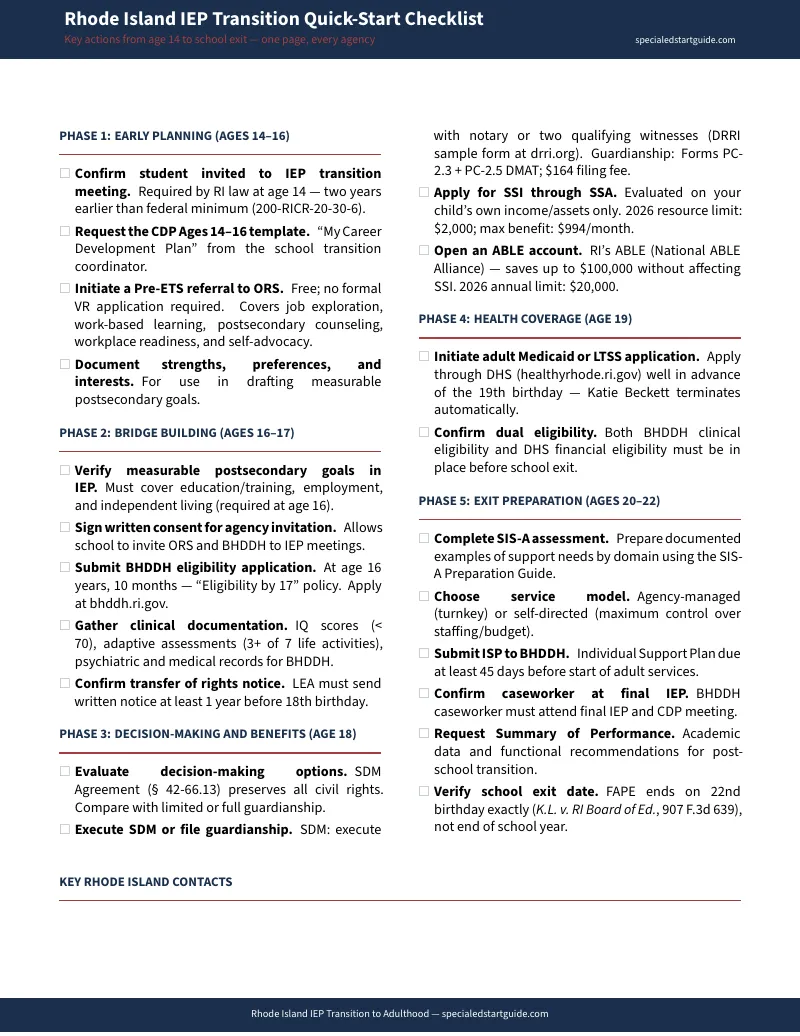
Download the free Rhode Island Transition Planning Checklist — a milestone tracker covering ages 14 through 22, with every key deadline and the agency responsible. Use it to see exactly where your family stands in the process.
When you're ready for the full system — the detailed walkthrough, the agency coordination framework, the worksheets and decision tools — the complete guide is available for instant download. For less than the cost of a single hour with a transition advocate, you get a permanent reference you can use through every IEP meeting, every agency application, and every deadline from now through your child's exit from special education.