
Free Guides Tell You What the Law Says. This Playbook Shows You How to Use It Against the District.
You've called RIPIN and got encouragement but no tactical plan. You've downloaded every tip sheet from RIDE and spent evenings parsing 200-RICR-20-30-6 without knowing which sections actually force a district to act. You've been to the IEP meeting where you were outnumbered six to one, and the team decided everything before you walked in the room.
You didn't fail at advocacy. The free resources failed you. RIPIN provides family education, peer support, and special-education guidance. This Playbook adds ready-to-use Rhode Island dispute templates for parents preparing to file a State Complaint or request an Independent Educational Evaluation. Disability Rights Rhode Island has limited resources, accepts individual cases that align with its focus areas, and cannot take every request for legal assistance. RIDE's procedural safeguards notice is 36 pages. When your child was sent home early again with no consent form and no Prior Written Notice, none of that helped.
That's the gap between knowing your rights and enforcing them. And in a state with only 36 districts where everyone knows everyone, the district profits from that gap every single day.
The Rhode Island IEP & 504 Advocacy Playbook is a tactical enforcement system — fill-in-the-blank templates, dispute strategies, and meeting scripts, each pre-loaded with Rhode Island regulatory citations that explain the district's obligations in the situations they address.
What's Inside the Playbook
The Dispute Letter Arsenal
Every letter cites the Rhode Island regulation that governs the request or procedure. A referral for evaluation starts the 10-school-day Evaluation Team process under 200-RICR-20-30-6; after parental consent, R.I.G.L. Section 16-24-1.1(g) sets a 63-calendar-day deadline for the initial evaluation and eligibility meeting. Request Prior Written Notice when the district proposes or refuses to initiate or change your child's identification, evaluation, placement, or provision of FAPE under 34 CFR Section 300.503, with the elements required by that rule. Request an Independent Educational Evaluation at district expense under 34 CFR Section 300.502 and cite Rhode Island hearing decision LL-22-10 (Smithfield), where funding was denied because the parent had not disagreed with the district's evaluations. File a RIDE State Complaint alleging a specific regulatory violation. These aren't polite requests — they cite the procedures that apply and create a timestamped paper trail when you send them.
The S2526A Consent Law Defense
In 2024, the Rhode Island General Assembly enacted S 2526 Substitute A (Public Law 2024, Chapter 236), which shifts the balance of power from the district to the parent. Effective July 1, 2026, districts must obtain written consent before reevaluations or changes to an existing IEP, subject to the law's nonresponse exception. If a parent does not respond, the district may proceed with a proposed reevaluation or IEP change only after documenting at least three contact efforts using at least two of the listed methods. A written rejection cannot be overridden under that exception; if a district believes refusing consent would deny FAPE, it may seek mediation or due process. Parents must receive evaluation reports and other relevant written materials to be considered at an eligibility or IEP meeting — including proposed goals and objectives if drafted — at least three calendar days before the meeting, unless they agree to a shorter period. Parents of an eligible child may request to observe a proposed placement. Districts may set reasonable limits and may bar observations with students present only when necessary to protect safety, program integrity, or confidentiality; they must allow a visit without students present and explain the restriction in writing. The Playbook includes the fill-in-the-blank scripts that invoke these protections by statute, plus the documentation strategy to prove the district violated the law if they skip any step.
The Early Intervention Transition Defense
Rhode Island's Part C to Part B transition is one of the most acute failure points in the state. RIDE's regulations require an IEP or IFSP to be in effect for an eligible child by the third birthday; if the birthday falls during summer, the IEP team determines when services begin. A federal class-action lawsuit (Parents Leading for Educational Equity v. Providence Public School Department) alleged that the proposed class included more than 300 Providence preschool children: over 100 awaiting timely identification, evaluation, or eligibility decisions, and over 200 with IEPs but without the services specified in them. If your child is approaching age three and the district hasn't completed the evaluation, the Playbook teaches you how to document transition delays, seek compensatory education through available dispute-resolution processes, and escalate to RIDE when delays cause educational loss.
The Small-State Advocacy System
Rhode Island's "everyone knows everyone" dynamic actively suppresses formal complaints. Parents fear being labeled "difficult" when the special education director coaches your neighbor's kid in soccer and the superintendent's spouse teaches at the elementary school. This Playbook teaches collaborative assertiveness — how to build an airtight legal paper trail that forces district compliance without resorting to hostility. When the district proposes or refuses a covered change, the templates let you say "I'm requesting Prior Written Notice documenting this refusal" and the regulation does the confrontation for you.
The RIDE Dispute Resolution Strategy
When letters and meetings don't work, you have formal options: mediation through RIDE, State Complaints with RIDE OSCAS, and due process hearings. Most parents never learn how these actually work because the district handbook steers you toward informal resolution — which protects the district's budget, not your child's rights. The Playbook explains when each option is appropriate, how to file, what evidence to gather, and how the paper trail you've been building becomes the case that wins. The RIDE State Complaint is especially powerful: RIDE issues a written Findings Letter within 60 calendar days after receiving a complaint unless an extension is granted. If RIDE finds a violation, the district must develop and implement a corrective action plan. Filing is free.
Manifestation Determination Defense
When a student with a disability is suspended for more than 10 cumulative school days, the district must hold a Manifestation Determination Review within 10 school days. Districts routinely botch this process — ignoring the relationship between the disability and the behavior, pressuring parents to waive rights, counting informal removals and early pickups as "not suspensions." The Playbook gives you the preparation checklist, the questions to ask, and the legal arguments that protect your child from being punished for symptoms of their disability.
Compensatory Education Claims
If the district denied, delayed, or failed to deliver services your child was legally entitled to, your child may be owed compensatory education — additional services to make up for what was lost. This is especially relevant in Rhode Island, where staffing shortages have become a chronic excuse for missed speech therapy sessions, absent aides, and unfilled specialist positions. The Playbook explains how to document the deficit, quantify the violation, and present the claim. Under IDEA, administrative staffing shortages cannot legally justify denying FAPE — and the Playbook gives you the exact language to say so.
Who This Playbook Is For
- Parents whose district is violating Rhode Island regulations — ignoring evaluation requests, delaying IEP meetings, or failing to deliver services written in the IEP
- Parents whose child aged out of Early Intervention with no preschool IEP in place, and who need compensatory education for the transition delay
- Parents in Providence navigating PPSD after its return to local control on July 1, 2026, in Cranston or Warwick fighting budget-driven program cuts, or in any of Rhode Island's 36 districts where staffing shortages are weaponized as excuses
- Parents preparing to file a RIDE State Complaint or explore due process — who need the filing strategy without the $5,000 attorney retainer
- Parents whose child was suspended or threatened with expulsion and who need manifestation determination protections before the district pushes for removal
- Parents pursuing an Independent Educational Evaluation at district expense after the school's evaluation missed critical areas of need
- Parents in tight-knit Rhode Island communities who need advocacy tools that enforce compliance without burning social bridges — collaborative assertiveness, not courtroom warfare
Why Not Just Use the Free Resources?
Rhode Island has valuable free special education resources. RIPIN, Disability Rights Rhode Island, RIDE guidance, and national sites like Understood.org all provide information. Here's why parents still lose at the IEP table after consulting all of them:
- RIPIN provides family education and peer support; the Playbook adds ready-to-use dispute tools. As the state's Parent Training and Information Center, RIPIN offers workshops, peer support, and resources on topics from Prior Written Notice to Specific Learning Disabilities. The Playbook adds a Rhode Island-specific State Complaint walkthrough and ready-to-use dispute letters for parents preparing a formal complaint or evaluation dispute.
- Disability Rights Rhode Island has limited resources. DRRI accepts individual cases that align with its focus areas and cannot take every request for legal assistance. If your IEP meeting is in three days, you cannot count on receiving individual representation before then.
- RIDE guidance documents are written by the regulator, for the regulator. Procedural safeguards and 200-RICR-20-30-6 explain compliance procedures to district administrators. They do not explain how to use those procedures as leverage against the district that's violating them.
- National resources miss every Rhode Island nuance. Wrightslaw covers federal IDEA law but contains zero 200-RICR-20-30-6 citations, zero information about the S2526A consent law, zero Part C transition crisis tactics, and zero small-state advocacy strategy. If you quote vague federal statutes when stricter Rhode Island Administrative Rules apply, the district knows you're operating blind.
Free guides tell you what the law says. This Playbook gives you the exact scripts to use the law when the district tells you "no."
— Less Than 5 Minutes with a Rhode Island Special Education Attorney
A special education attorney in Rhode Island charges $300 to $500 per hour, with retainers starting at $5,000 or more. Non-attorney advocates charge $100 to $200 per hour, with typical engagements running $1,500 to $2,500. Even if you eventually need professional representation, the meticulous paper trail you build with this Playbook saves thousands in billable hours — because you're handing your attorney an organized case built on Rhode Island regulatory violations, not a stack of unsigned IEP copies and half-remembered conversations.
Your download includes the complete Playbook guide plus 7 standalone printable tools:
- Complete Advocacy Playbook (guide.pdf) — 10 chapters covering Rhode Island's legal framework (200-RICR-20-30-6, R.I.G.L. Chapter 16-24, S2526A consent law), building a bulletproof paper trail, evaluation enforcement, IEP meeting tactics, discipline protections, RIDE State Complaints, mediation and due process, OCR complaints, and a Rhode Island resources directory
- Dispute Letter Templates (letter-templates.pdf) — Fill-in-the-blank letters with Rhode Island regulatory citations: initial evaluation request, IEE request, Prior Written Notice demand, RIDE State Complaint, records request, S2526A consent objection, and post-meeting follow-up email
- Rhode Island Parent Rights One-Pager (parent-rights-one-pager.pdf) — every critical timeline, core rights, red flags, and Rhode Island-specific resources on one printable page
- IEP Meeting Preparation Checklist (iep-meeting-checklist.pdf) — printable checklist to complete before every IEP meeting
- Key Rhode Island Timelines (timeline-reference.pdf) — every special education deadline in one printable reference card for your IEP binder
- Communication Log (communication-log.pdf) — fillable tracking sheet for every school interaction — print multiple copies and build your evidence trail
- Manifestation Determination Defense (manifestation-determination-checklist.pdf) — MDR preparation checklist with removal tracker, key questions, and legal references for disciplinary hearings
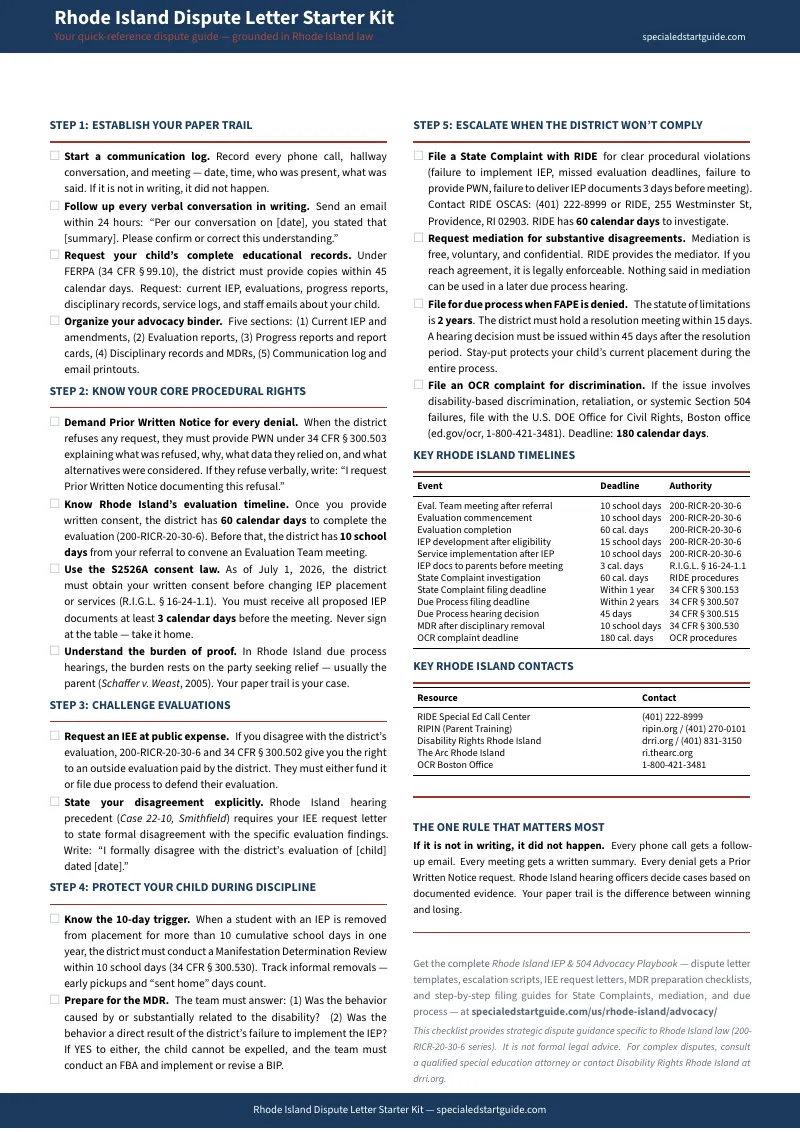
- Rhode Island Dispute Letter Starter Kit (checklist.pdf) — quick-start templates plus the Parent Rights One-Pager (also available as a free download)
Instant PDF download. Fill in the first template tonight. Send it before the district's next deadline expires.
Full refund, no time limit. If the Playbook doesn't change how you handle disputes with your Rhode Island school district, email us for a full refund. No questions asked.
Not ready for the full Playbook? Download the free Rhode Island Dispute Letter Starter Kit — quick-start dispute letter templates with Rhode Island regulatory citations for evaluations, Prior Written Notice demands, and RIDE complaints. Enough to start building your paper trail tonight, and it's free.
The district is counting on you not knowing Rhode Island law. After tonight, they'll have to deal with someone who does.
Frequently Asked Questions
What if the rules change after I buy?
We update the guide when the rules change. Email us any time, even years later, and we'll send you the current edition free.