Six Agencies. Three Years of Deadlines. One Roadmap That Connects Them All.
Your child's transition IEP meeting introduced a term — "postsecondary goals" — and a set of deadlines that span from age 14 to age 22. What nobody handed you was a map showing how the school district's transition plan connects to an OVR vocational referral, how that referral connects to an ODP waiver intake at your county office, and how all of it has to sequence around your child's 18th birthday — when medical consent, financial authority, and SSI eligibility shift simultaneously.
The Pennsylvania IEP Transition to Adulthood Guide is an interagency sequencing system. It does what no single agency resource can do: it maps the chronological handoff across all six systems your family will navigate — the school district, OVR, ODP, COMPASS/Medicaid, Social Security, and the Orphans' Court — so you know which document from one agency becomes the intake paperwork for the next, and which deadlines are real versus which ones the district invented to push a premature diploma.
What's Inside
- The Age-14 to Age-22 Transition Timeline — Pennsylvania starts transition planning two years earlier than the federal requirement, during the academic year your child turns 14. The guide walks through every milestone from that first Section III entry in the IEP through the day before the 22nd birthday, with the interagency referrals mapped to each stage.
- Diploma Deferral Decision Kit — school districts under budget pressure may push a NOREP accepting a standard diploma at the end of fourth year. Accepting that diploma permanently terminates the right to FAPE. The guide includes a decision worksheet for weighing deferral and a template response letter you can bring to the IEP meeting.
- OVR Pre-ETS and School-to-Work Referral Sequence — most families learn about OVR too late to use it well. The guide covers the Potentially Eligible referral at age 14, the five core Pre-ETS services, and the critical shift to a formal individualized School-to-Work case two years before exit — where the real funding for college tuition, assistive technology, and customized employment coaching lives.
- PUNS Face-to-Face Preparation Kit — the Prioritization of Urgency of Need for Services form determines whether your family lands in the Emergency, Critical, or Planning category on the ODP waiting list. The guide walks through the clinical and home-life documentation you need for the county meeting and explains how the three waiver tracks (P/FDS, Community Living, and Consolidated) differ in scope, funding caps, and the 2026 assistive technology policy change.
- Age-18 Legal Alternatives Toolkit — Pennsylvania law requires the Orphans' Court to reject guardianship if less restrictive alternatives can meet the individual's needs. The guide explains every instrument in the portfolio — Educational and Medical Powers of Attorney, Act 169 health care representatives, Representative Payee, and Supported Decision-Making — and the kit includes a fillable Supported Decision-Making agreement template aligned with the In re Peery precedent plus a portfolio checklist that tracks each instrument from "discussed" to "signed and filed."
- SSI Redetermination and ABLE Account Planner — at 18, SSA evaluates your adult child under stricter criteria while ignoring your income. The guide covers the redetermination process, the $2,000 countable resource limit, Disabled Adult Child benefit rules, and 2026 ABLE account provisions — including the expanded age-of-onset threshold and the ABLE-to-Work earned income allowance.
- Pennsylvania's Age-of-Majority Exception Explained — unlike most states, Pennsylvania maintains the educational age of majority at 21, meaning parents retain educational decision-making authority even after the child turns 18. The guide explains this exception, how it interacts with the civil age of majority, and what it means for IEP participation, medical consent, and financial authority.
Who This Guide Is For
- Parents whose teenager with an IEP is between ages 13 and 21 and attending a Pennsylvania school district
- Families navigating the transition from school-based special education to adult disability services for the first time
- Parents who want to understand the diploma decision, ODP waiver options, and guardianship alternatives before the IEP team asks them to sign paperwork
- Advocates and transition coordinators who need a single-document reference for the full Pennsylvania interagency pathway
Why Free Resources Don't Solve This
PaTTAN publishes the official state transition guide — but it reads like a compliance manual, not a parent action plan. The PEAL Center offers excellent advocacy checklists — but they focus on the IEP meeting and don't walk you through ODP waiver intake or SSI redetermination. OVR's website explains Pre-ETS — but it doesn't tell you how to connect a vocational trial to an ODP-funded job coach after the OVR case closes. Each agency resource is accurate within its own silo. None of them map the handoffs between silos — and those handoffs are where families lose months, miss deadlines, and watch waiver slots go to families who documented their needs more precisely.
This guide connects the silos. It shows you how an OVR vocational assessment at age 16 feeds the clinical documentation you'll need for your county PUNS meeting at 17, how that meeting's outcome determines which waiver track funds adult services, and how the whole sequence has to coordinate with SSI and Medicaid eligibility at 18.
Satisfaction Guarantee
If the guide doesn't help you navigate Pennsylvania's transition pathway more confidently, email us for a full refund. No forms, no justification needed.
Get Started
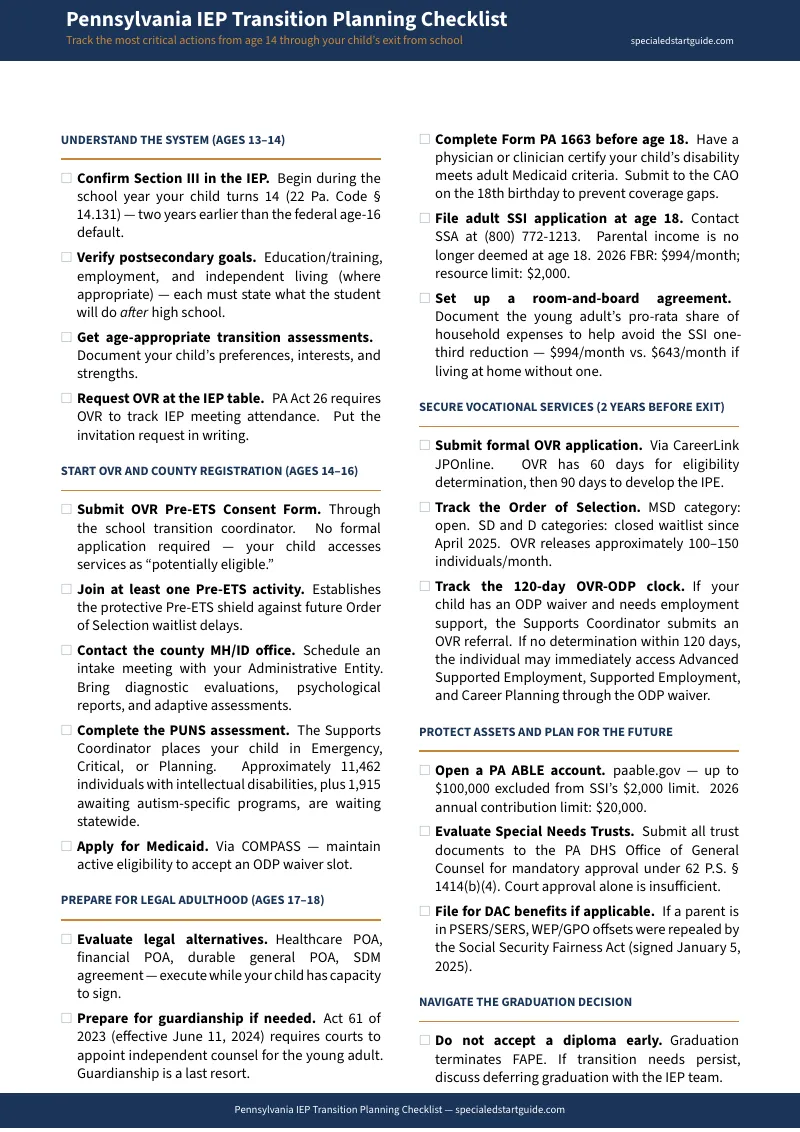
Download the free Pennsylvania Transition Planning Checklist for a milestone-by-milestone overview of what to do and when. Ready for the full interagency roadmap, decision worksheets, and template letters? Get the complete guide for — less than a single hour of a special education attorney's time.