Your child's IEP team just said "transition plan" — and nobody handed you a roadmap
Oregon requires transition planning by age 16, but the real timeline starts at 14. Between now and your child's 21st birthday, you'll navigate four state agencies, four completion pathways, the age-18 transfer of rights, county-level developmental disability programs, Medicaid enrollment, SSI redetermination, and a direct-support-worker shortage that's been called a statewide crisis.
The free resources exist — scattered across ODE fact sheets, ODHS portals, county CDDP intake pages, and FACT Oregon toolkits. But none of them tell you the sequence. They explain individual programs. They don't coordinate the handoff between them. Miss one deadline and your child can lose eligibility for services that don't come back.
The Coordinated Transition Handoff System
This guide organizes every Oregon-specific step into a single chronological action sequence — from the first transition IEP at age 14 through the final adult-services handoff at 21. Instead of reading six agency websites and hoping you connected the dots correctly, you follow one timeline that tells you exactly what to do, which form to file, and which office to call at each age milestone.
It's designed for the parent who doesn't have a special education attorney on retainer — and shouldn't need one just to understand the process.
What's Inside
- Age-by-age action sequence (14 through 21) — every milestone, notification deadline, and agency referral mapped to the year it needs to happen, so nothing falls through the gap between school and adult services
- Diploma pathway comparison — standard, modified, extended, and certificate of attendance, with the FAPE implications of each track and the written-consent requirements under Oregon law
- Transfer of rights decision framework — the full spectrum from Supported Decision-Making through OAR 581-015-2325 educational surrogates to full probate guardianship, with guidance on which option fits your family
- Pre-ETS and VR enrollment walkthrough — how to access Oregon's five core Pre-Employment Transition Services starting at age 14, including the DHS 1723 request form and Youth Transition Program referrals
- CDDP vs. Brokerage comparison — the practical differences between county Service Coordinators and nonprofit Personal Agents, with a fillable worksheet for comparing the brokerages serving your county
- K Plan services guide — how the Community First Choice entitlement works (no waitlist), what the Oregon Needs Assessment determines, and strategies for navigating the provider capacity shortage in rural areas
- 2026 financial thresholds — current SSI limits, Student Earned Income Exclusion, ABLE contribution caps, Disabled Adult Child benefit eligibility (updated for the WEP/GPO repeal), and Oregon Health Plan income pathways
- SDM agreement template — a fillable Supported Decision-Making agreement you can present to schools, doctors, and financial institutions without going through probate court
- District petition letters — templates for requesting educational surrogate or conditional surrogate parent appointment under OAR 581-015-2325
- Dispute resolution reference — IEP facilitation, mediation, and due process options through ODE and Disability Rights Oregon, plus key advocacy contacts by region
- Estate planning checklist — special needs trust considerations, ABLE account setup, and letters of intent specific to Oregon families
- Planning worksheets — 10 fillable tracking tools in all, including the Transition Timeline Tracker, Decision-Making Options Comparison Worksheet, Pre-ETS and VR Application Checklist, Provider Recruitment Tracker, Benefit Threshold Quick Reference Card, and Agency Communication Log
Who This Is For
- Parents whose teenager just got their first transition IEP — you heard "postsecondary goals" and "age-appropriate transition assessments" for the first time and need to understand what Oregon requires before the next meeting
- Families approaching the age-18 transfer of rights — the district sent the mandatory one-year notice and you're weighing guardianship against alternatives you didn't know existed
- Parents of standard-diploma students with hidden transition needs — your child has an IEP or 504 for ADHD or Level 1 Autism, they're academically capable, but you're worried about the gap between graduating and functioning independently as an adult
- Rural Oregon families without local advocates — the nearest special education attorney is three hours away, and a single consultation costs more than this entire guide
Why Free Resources Don't Solve This
FACT Oregon's toolkits explain your rights. Disability Rights Oregon's guides explain the law. ODE's fact sheets explain individual programs. County CDDP pages explain their own intake process. Each one covers its own piece — none of them coordinate the handoff between pieces.
The result: parents read five different agency guides and still don't know whether to contact VR or the CDDP first, whether to file the SSI redetermination before or after OHP enrollment, or what "conditional surrogate parent" means in practice versus full guardianship. A private special education attorney answers all of these questions — for $350 to $500 an hour.
This guide gives you the same sequential coordination plan at a fraction of what a single consultation costs.
Our Guarantee
If the guide doesn't give you a clearer picture of your child's transition timeline within 30 minutes of opening it, email us for a full refund. No forms, no conditions.
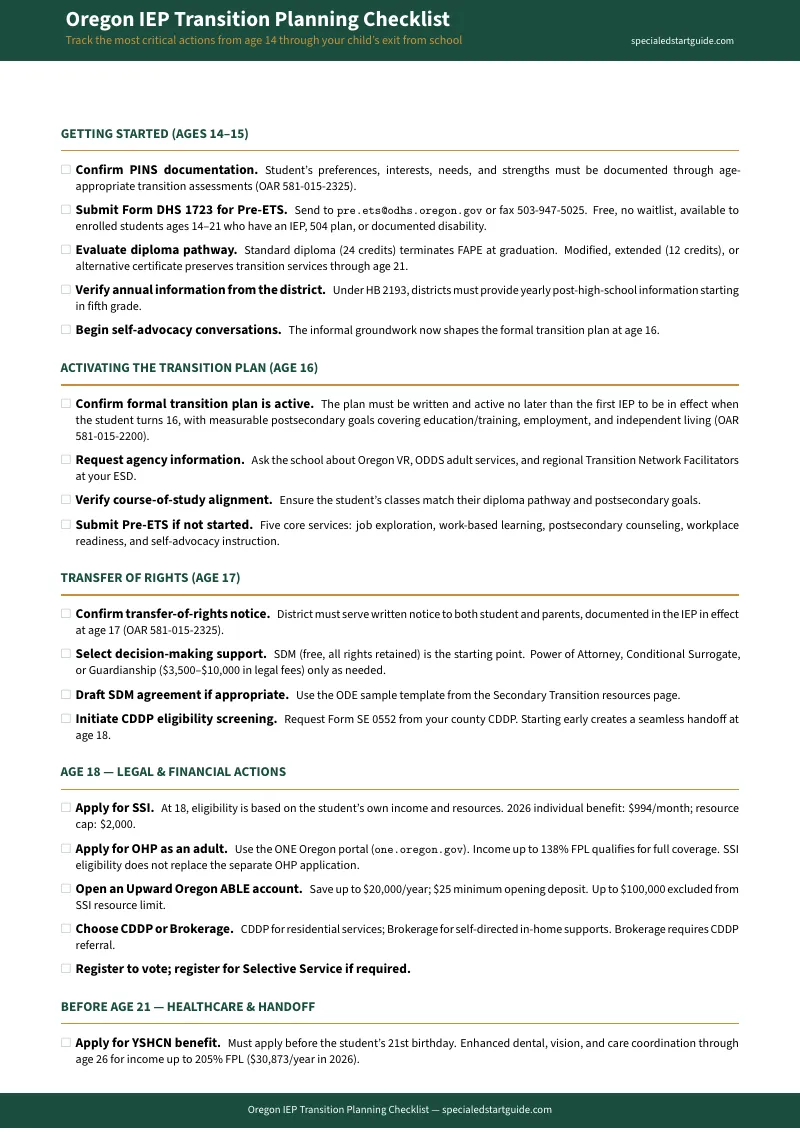
53-page guide + 22-item planning checklist + 10 fillable worksheets, templates, and tracking tools — instant PDF download.
Or start with the free Oregon Transition Planning Checklist to see the milestone timeline before you commit.