
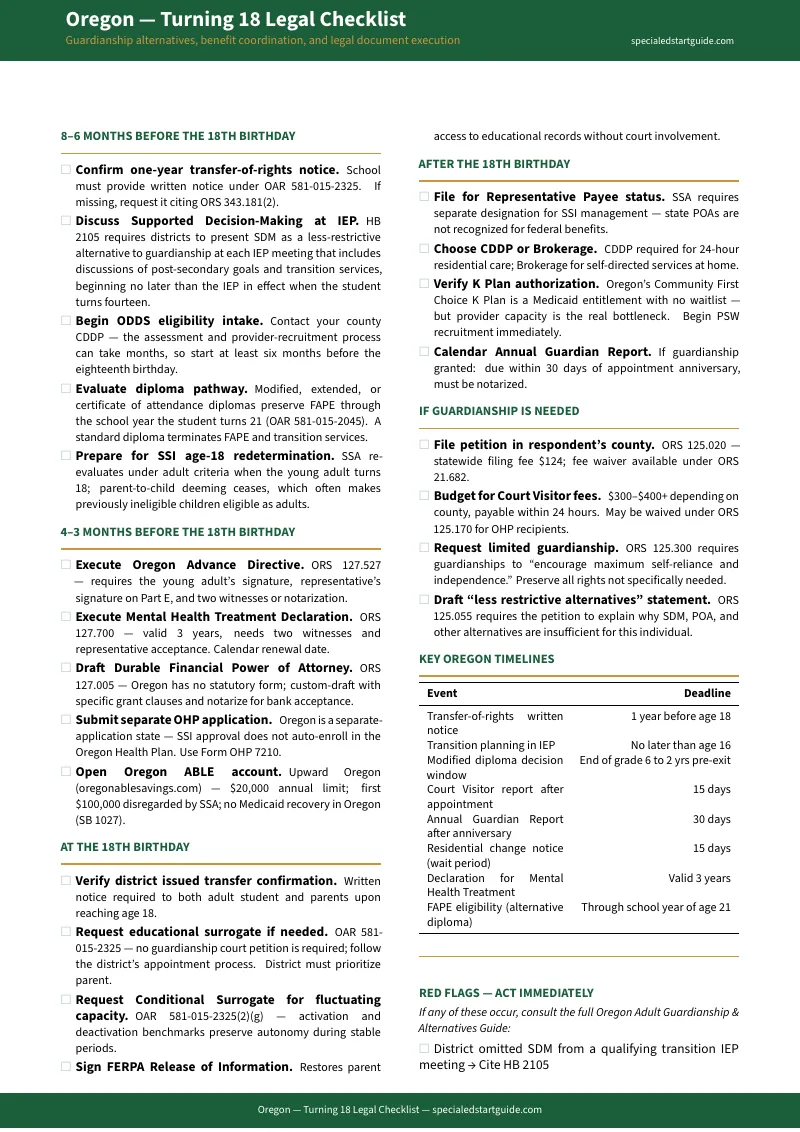
Your child turns 18. Oregon gives you zero transition period.
One day you sign the IEP, manage SSI, and speak with every doctor. The next day — the day your child turns 18 — Oregon law transfers every procedural right directly to them. No hearing. No notice beyond the one-year IEP warning at 17. No automatic carryover of your authority.
If your young adult can't yet manage medical decisions, bank accounts, or benefit renewals independently, you're facing a gap between what the law says and what your family needs. And the window to fill that gap before the birthday is shorter than you think.
The Oregon Transition Authority Framework
This isn't a generic guardianship primer. The Oregon Adult Guardianship & Alternatives Guide is a state-specific decision system that maps every legal authority tool Oregon offers — supported decision-making under HB 2105, educational surrogate appointments under OAR 581-015-2325, durable financial powers of attorney under ORS 127.005, advance directives under ORS 127.527, representative payee designation, and limited or full guardianship through circuit court — against your young adult's actual abilities and needs.
You get a structured process: assess capacity across four domains (medical, financial, educational, daily living), match each domain to the least restrictive legal tool, execute the documents, and know exactly when court intervention is necessary and when it isn't.
What's Inside
- Decision-Making Authority Comparison Worksheet — because "does my child need a guardian?" is the wrong question. The right question is which specific decisions need support, and which tool covers each one without removing more autonomy than necessary.
- Supported Decision-Making Framework — Oregon's HB 2105 mandates SDM education in IEP transition planning, but the state has no comprehensive multi-sector SDM statute. The guide shows you how to build a practical SDM framework using the tools Oregon law actually recognizes — healthcare proxies, financial POA, and educational surrogates working together.
- Educational Surrogate & Conditional Surrogate Guidance — the two administrative pathways under OAR 581-015-2325 that let you stay involved in IEP decisions without going to court. Includes the conditional surrogate option for young adults whose capacity fluctuates.
- Power of Attorney Drafting Guide — Oregon has no statutory financial POA form and hasn't adopted the Uniform Power of Attorney Act. The guide walks you through drafting a durable financial POA under ORS 127.005 that financial institutions will actually accept, including when to notarize (always recommended, legally required for real estate).
- Advance Directive Execution Checklist — a printable for Oregon's statutory form under ORS 127.527: Part E healthcare representative acceptance, two-witness or notary execution, and a distribution log for the physician, representative, and clinic (Oregon has no central registry).
- Court Process Roadmap with Court Petition Cost Estimator — $124 statewide filing fee plus documented Court Visitor fees (Lane $300, Coos $300–$350, Columbia $400; confirm your county with the clerk), the visitor's 15-day report deadline, the mandatory less-restrictive-alternatives statement under ORS 125.055, and fee waiver instructions under ORS 21.682.
- Benefits Protection System — SSI age-18 redetermination prep, representative payee setup, Oregon ABLE accounts ($20,000/year contribution limit), ODDS K Plan enrollment, and the Customer-Employer Program for hiring family members as personal support workers when agency providers aren't available. Includes the ABLE Account Funding Planner.
- Printable kit + free checklist — Transition Planning Timeline, Agency Communication Log, and Annual Guardian Report Preparation Checklist, plus the free turning-18 action checklist covering the age-17 IEP transfer notice through ODDS K Plan enrollment and SSI redetermination.
Who This Guide Is For
You're an Oregon parent whose child with an intellectual or developmental disability is approaching 18. You've received the school's transfer-of-rights notice or you're about to. You know something needs to be in place legally, but you're not sure whether that means a power of attorney, an SDM arrangement, a guardianship petition, or some combination — and you'd rather not pay $2,500–$5,000 to an attorney to find out.
The guide covers the full spectrum: young adults who can sign documents and direct most of their own decisions with informal support, young adults who need structured support across multiple domains, and young adults with profound cognitive limitations who may need court-appointed protection. It tells you where on that spectrum each legal tool applies and where it doesn't.
Why the Free Resources Aren't Enough
Oregon's free guardianship resources are fragmented by agency. Disability Rights Oregon publishes a guardianship handbook but doesn't cover how to avoid guardianship through SDM, POA, and educational surrogates working together. The Oregon Department of Education explains transition goals but says nothing about SSI redetermination or healthcare directives. The court system offers blank probate forms with zero instructional context — no guidance on drafting the mandatory less-restrictive-alternatives statement that ORS 125.055 requires. FACT Oregon provides peer support and webinars but no fillable legal documents or court filing guides.
Each agency handles its own narrow slice. Nobody integrates the school transition, the healthcare handoff, the benefits shift, and the legal authority question into a single timeline. That integration is what this guide does.
What You're Protected By
Every purchase is backed by our satisfaction guarantee. If the guide doesn't give you a clear path forward for your family's situation, reach out and we'll make it right.
The guide includes clear referral triggers — specific situations where your family's circumstances (contested guardianship, complex assets, active exploitation concerns) genuinely require an attorney. We'd rather tell you when to hire a professional than pretend a guide can replace one.
Get Started
Download the free checklist to see the turning-18 timeline and the decisions you need to make. When you're ready for the complete decision system — the 50-page guide, seven fillable worksheets, court process roadmap, benefits protection strategies, and county-specific cost breakdowns — get the full kit for .
Frequently Asked Questions
What if the rules change after I buy?
We update the guide when the rules change. Email us any time, even years later, and we'll send you the current edition free.