
The District Knows Oklahoma's Special Education Rules. After Tonight, So Will You.
You walked into that IEP meeting as prepared as you could be. You called the Oklahoma Parents Center. You downloaded the OSDE's Procedural Safeguards notice. You even found the Super 6 Guidebook online and tried to piece together what IDEA actually means for your child in your district.
So you sat across from the special education coordinator, the school psychologist, the LEA representative, and the general ed teacher — and they used Oklahoma acronyms you'd never heard before. MEEGS. OAC 210:15. RED. PLAAFP. LRE. They smiled. They said your child was "responding to interventions" and the team needed "more data" before they could consider an evaluation. And you didn't know enough to tell them that federal law gives you the right to request a formal evaluation at any time — regardless of what their intervention data says.
You left with no evaluation timeline, no formal referral, and no written explanation of why they refused your request — because you didn't know to demand Prior Written Notice.
The problem isn't that you lack effort. The problem is that Oklahoma's special education system is engineered for compliance officers, not parents. The 2025 KIDS COUNT Data Book ranked the state 48th in education, ahead of only Alaska and New Mexico. OSDE counted 4,937 emergency certificates statewide for FY2024, the highest count in its 2020–2025 report. Roughly 90% of school districts classified as partly or entirely rural — many lacking a full-time speech-language pathologist, occupational therapist, or school psychologist. Districts in Bixby fighting parents of children with Down syndrome over basic inclusion. Districts in Tulsa with understaffed self-contained classrooms where student injuries go unreported. And Oklahoma's state-established 45-school-day initial-evaluation timeline that most parents have never heard of.
The Oklahoma IEP & 504 Blueprint is the tactical enforcement toolkit that bridges the gap between knowing your rights exist and actually exercising them — with templates, scripts, and checklists organized around Oklahoma's special-education process and federal IDEA rights.
What's Inside the Blueprint
The 45-School-Day Timeline Enforcement System
The federal evaluation period is 60 calendar days when a state has not set its own timeline; Oklahoma's initial-evaluation deadline is 45 school days from the date you sign consent. IDEA exceptions apply if a parent repeatedly fails or refuses to produce the child for evaluation, or if the child enrolls in a new district after evaluation begins but before eligibility is determined. In that transfer case, the receiving district must make sufficient progress, and the parent and district must agree to a specific completion date. These timelines use different day counts. If your child is eligible, the district must hold the initial IEP meeting within 30 calendar days of the eligibility determination; services begin only after your written consent. The Blueprint includes a pre-written evaluation-request letter and a one-page timeline cheat sheet listing key deadlines. Count the 45 school days using your district's instructional calendar.
The Copy-Paste Advocacy Letter Library
The letter library provides copy-paste requests for evaluations, Prior Written Notice, IEEs, and service-delivery records. Request Prior Written Notice when the district refuses to initiate or change your child's identification, evaluation, placement, or FAPE — the notice records what was refused and why. Request an Independent Educational Evaluation at public expense when you disagree with the district's assessment. Formally request service delivery logs to verify whether the therapy minutes written in the IEP are actually being delivered. These aren't generic national samples — they're Oklahoma-focused advocacy tools that create a dated written record when you send them.
The LNH Scholarship Playbook
The Lindsey Nicole Henry Scholarship allows eligible Oklahoma students to use state funds for approved private school tuition. An IEP or Individualized Service Plan is one eligibility route; other routes include IDEA eligibility, a military family's PCS transfer to Oklahoma, qualifying out-of-home placements, and enrollment in a school that exclusively serves students experiencing homelessness. Senate Bill 105, effective July 2025, removed the prior-year public-school attendance requirement for students with disabilities. The Blueprint explains how IEP documentation can support eligibility, which private schools are approved, and what the expanded eligibility categories cover. Your IEP is not just a public school document anymore. It's a financial passport to private education.
The SoonerStart Transition Survival Guide
When your child turns three, SoonerStart early intervention ends and the school district takes over. Parents describe this as falling off a cliff — the family-centered IFSP disappears and the school-centered IEP replaces it, often with dramatically reduced services or an outright denial of special education eligibility. The Blueprint maps the exact transition timeline, explains why school-based eligibility criteria differ from medical diagnoses, and provides specific arguments for demonstrating that therapies your child received under Part C remain educationally necessary under IDEA.
IEP Meeting Scripts and Checklists
What to say when the team tells you your child is "making progress" but the data shows otherwise. What to say when they offer a 504 instead of an IEP. What to say when the LEA representative claims the district "doesn't have the resources" for your requested services — because a district's staffing shortage doesn't eliminate its obligation to provide FAPE. Each script gives you Oklahoma-focused wording for a common pushback scenario, so you can state what you are requesting and why. The pre-meeting checklist covers one-party recording consent (Okla. Stat. tit. 13, §176.4), team composition verification under OAC 210:15, and the specific documents to bring.
The OSTP Accommodation Guide
Oklahoma's statewide assessments carry real consequences for school accountability ratings. The Strong Readers Act makes reading proficiency a factor in grade progression; districts set their own third-grade retention policies. OSTP accommodations must be documented in the IEP or 504 Plan and used regularly during instruction and/or classroom testing under OAC 210:10-13-2. The Blueprint explains the difference between standard and non-standard accommodations, how to ensure every accommodation is explicitly listed before testing season, and your right to challenge a district that refuses accommodations your child uses regularly in class.
The Behavior Crisis Toolkit
When a child faces suspension for behavior caused by their disability, federal and state law trigger specific protections. The Blueprint covers Functional Behavioral Assessment requirements, Behavior Intervention Plans, the Manifestation Determination Review process when removals change placement — more than 10 consecutive school days or a qualifying pattern totaling more than 10 school days — and Oklahoma's restraint and seclusion rules. It also addresses shadow suspensions — schools sending children home early without formal documentation to avoid triggering protections. In Oklahoma, where parents report first-graders being suspended more days than they've attended school, this toolkit is not hypothetical. It's survival.
Goal-Tracking Worksheets
IEP goals must be measurable and the IEP must describe how progress will be measured. Oklahoma guidance describes each annual goal with a condition, target skill, and achievement criteria; under Endrew F., the IEP must be reasonably calculated to enable progress appropriate to the child's circumstances. The worksheets give you a structured format to track baselines, targets, and mastery criteria between meetings, compare school-reported progress against your own observations, and arrive at the annual review with documentation that either confirms the program is working or proves it isn't.
The Dispute Resolution Roadmap
When advocacy fails, you have three formal options in Oklahoma: filing a state complaint with the OSDE Special Education Services division, requesting mediation, or filing for a due process hearing. The Blueprint explains when each option is appropriate, the timeline and costs involved, and how the paper trail you've been building with the advocacy templates becomes the evidence that wins your case — or convinces the district to settle before you ever reach a hearing.
Who This Blueprint Is For
- Parents whose child is turning three and SoonerStart is ending — and who need to know exactly how to prevent therapy gaps when the school district takes over
- Parents stuck in an endless cycle of "we need more data" while the district delays an initial evaluation — and who need the legal citation to start its 45-school-day clock
- Parents in the Tulsa or Oklahoma City metro where evaluations are backlogged and meetings keep getting rescheduled — and the bureaucracy is too large to respond quickly
- Parents in rural Oklahoma — Cherokee, Pushmataha, Cimarron, Jefferson — where the nearest developmental clinic is ninety minutes away and the district claims they "don't have staff" for your child's services
- Parents who've been told their child "doesn't qualify" despite holding a medical diagnosis — and who need the legal language to challenge that determination under OAC 210:15
- Parents navigating the 504-to-IEP question — unsure whether their child's current plan is legally sufficient or whether they should push for a full special education evaluation
- Parents whose child was suspended and the behavior is clearly tied to the disability — but nobody mentioned a Manifestation Determination Review or a Functional Behavioral Assessment
- Military families at Tinker Air Force Base, Fort Sill, or Altus AFB navigating Oklahoma's system after a PCS move from another state — and who need to protect an out-of-state IEP from being unilaterally reduced
- Parents who've heard about the Lindsey Nicole Henry Scholarship and want to understand how IEP documentation fits into the eligibility rules for state-funded private school tuition
- Parents preparing for their first IEP meeting who don't want to walk in blind against a team that does this every day
Why Not Just Use the Free Resources?
Oklahoma has legitimate free special education resources. The Oklahoma Parents Center runs training workshops. Sooner SUCCESS provides family support. The OSDE publishes the Policies and Procedures Manual. Here's why parents still struggle after consulting all of them:
- The Oklahoma Parents Center is backlogged. The OPC is the federally authorized Parent Training and Information Center for the state. Their staff are knowledgeable and their Super 6 Guidebook is authoritative. But when your child was suspended yesterday, you cannot wait two weeks for a workshop slot or an email response. Their materials are spread across dozens of separate PDF brochures that a parent in crisis must locate, download, and synthesize into a coherent strategy. The OPC educates — it does not put enforcement language in your hand tonight.
- OSDE publications protect the state, not you. The official Policies and Procedures Manual and the Evaluation and Eligibility Handbook are written in dense bureaucratic prose for district compliance officers and special education directors. They are hundreds of pages of cross-referenced statutory citations. They tell you the rules exist. They provide zero tactical instruction on what to email your principal when the district is violating those rules.
- Sooner SUCCESS supports families — it doesn't fight districts. Operating through the OU Health Sciences Center, Sooner SUCCESS provides healthcare transition resources, sibling support, and community integration. Their mandate is medical and social, not adversarial educational advocacy. They will not hand you the email template that forces Prior Written Notice from a hostile special education coordinator.
- National guides get Oklahoma law wrong. The federal evaluation period is 60 calendar days when a state has not set its own timeline; Oklahoma sets 45 school days. Wrightslaw's state-by-state chart lists Oklahoma's deadline, but its federal-law book does not walk through the LNH Scholarship or Oklahoma's full procedures. The print-and-e-book combo for Wrightslaw: Special Education Law, 3rd Edition is $44.90 plus shipping.
- Etsy and TPT planners organize paperwork — they don't enforce rights. A pastel IEP binder helps you sort documents. It won't tell you what Prior Written Notice is, how to track Oklahoma's 45-school-day initial-evaluation deadline, or how IEP documentation fits into LNH eligibility. Generic templates miss every Oklahoma nuance that actually determines your outcome.
The free resources explain what the law says. The Blueprint gives you the tools to make the district follow it.
— Less Than 3 Minutes of a Special Education Attorney
Special education attorneys charge $300–$500 per hour. A private advocate runs $150–$300 per meeting. Even if you eventually need professional help, the meticulous paper trail you build with this Blueprint saves thousands in billable hours — because you're handing your attorney an organized case, not a shoebox of unsigned IEP copies and half-remembered conversations.
Your download includes the complete Blueprint guide plus 8 standalone printable PDFs — every template, worksheet, script, and reference card, ready to print and bring to your next meeting.
- Complete Blueprint Guide — 15 chapters covering your legal foundation, the IEP process, 504 plans, building your paper trail, dispute resolution, IEEs, the LNH Scholarship, school discipline, the SoonerStart transition, secondary transition and diploma pathways, special populations (tribal schools, military families, rural districts), Oklahoma support resources, ESY and assistive technology, and out-of-district transfers
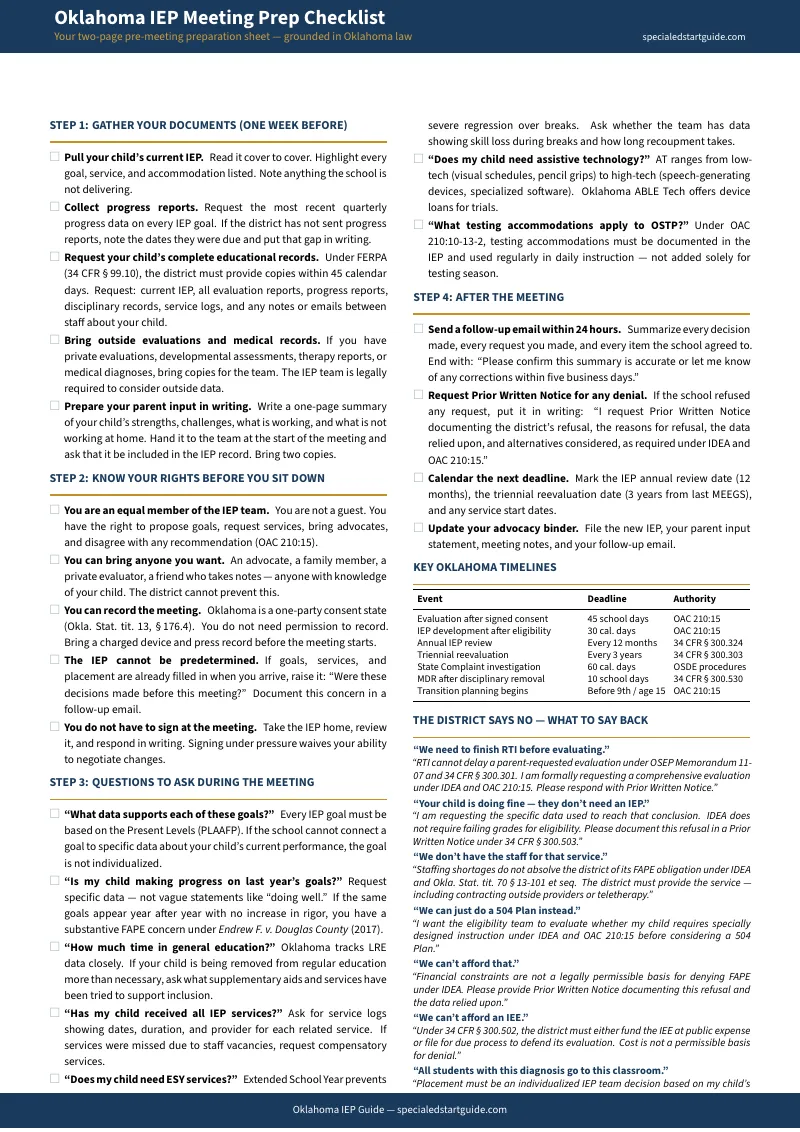
- IEP Meeting Prep Checklist — the before/during/after checklist with Oklahoma timelines, team composition requirements, and the questions that reveal whether your district is following the law
- Advocacy Letter Templates — 7 copy-paste letters for evaluation requests, RtI bypass, IEEs, Prior Written Notice, parent concerns, service failures, and OSDE state complaints
- IEP Meeting Scripts — word-for-word responses to 7 common district pushback scenarios
- Oklahoma Timeline Cheat Sheet — every legal deadline on one printable page: the 45-school-day initial-evaluation clock, IEP review dates, discipline triggers, dispute resolution windows, and LNH Scholarship eligibility
- Goal-Tracking Worksheet — structured progress log with baseline/target tracking, service delivery verification, and the Endrew F. red flags checklist
- Dispute Resolution Roadmap — your four escalation options (amendment, mediation through SERC, OSDE state complaint, due process) with timelines, costs, and a quick comparison table
- 504 vs. IEP Decision Matrix — side-by-side comparison of eligibility, services, protections, enforcement, and the LNH Scholarship difference
- Service Delivery Tracking Log — monthly session log with deficit calculator and modality codes for building a compensatory education case
Instant PDF download. Print the templates tonight. Walk into tomorrow's meeting with the law on your side.
Full refund, no time limit. If the Blueprint doesn't change how you approach IEP meetings in Oklahoma, email us. No questions asked.
Not ready for the full Blueprint? Download the free Oklahoma IEP Meeting Prep Checklist — a printable pre-meeting checklist with Oklahoma timelines, team composition requirements, and the questions that reveal whether your district is following the law. It's enough to walk into your next meeting prepared, and it's free.
Your child's education is a legal right, not a favor the district grants. The district knows Oklahoma law. After tonight, so will you.
Frequently Asked Questions
What if the rules change after I buy?
We update the guide when the rules change. Email us any time, even years later, and we'll send you the current edition free.