When They Turn 18, North Dakota Law Hands Them Every Decision — Whether They're Ready or Not
The moment your child turns eighteen, North Dakota doesn't ask whether they can manage a bank account, understand a medical consent form, or navigate a lease. The transfer is automatic: your authority to sign their IEP, consent to medical treatment, manage their finances, and make day-to-day decisions is gone. Not gradually reduced. Gone.
And unlike many states, North Dakota has something most families don't know about — a comprehensive Supported Decision-Making statute (NDCC Chapter 30.1-36) that can replace or reduce the need for guardianship entirely. The problem is that school districts and pediatric clinics rarely mention it. They hand you a transfer-of-rights letter and suggest you "look into guardianship." That's the expensive, rights-stripping path. This guide starts you on the other one.
The Decision-Making Spectrum System — Every Option, in Order
This guide is built around what we call the Decision-Making Spectrum System: a step-by-step framework that starts with the least restrictive option North Dakota law provides and works through every alternative before involving the courts. Instead of defaulting to full guardianship because a hospital told you to, the Spectrum System walks you through each instrument — so you only petition the district court when nothing else fits.
Here's why that matters: North Dakota courts are required to verify that you considered less restrictive alternatives before they'll grant a guardianship. If you file a petition without documentation of what else you tried, the judge can deny it. The Decision-Making Spectrum System builds that documentation as you work through each option.
What's Inside
Non-Court Alternatives (Chapters 2–8)
- Supported Decision-Making Agreement — North Dakota's 2019 SDM statute gives your child the legal right to choose supporters who help them understand information and communicate decisions. Schools, hospitals, and banks are required to honor it. The guide includes step-by-step drafting instructions, the witnessing requirements (notary or two qualified witnesses), and how to present the agreement to institutions that claim they've "never seen one."
- Durable Financial Power of Attorney — Under NDCC Chapter 30.1-30, your child can authorize you to handle financial matters. The guide walks you through the exact durability language your document must include — without it, the POA dies the moment your child loses capacity.
- Health Care Directive — North Dakota combines the healthcare power of attorney and living will into a single document under the Health Care Directive Act (NDCC Chapter 23-06.5). The guide covers the signing requirements, the statutory family surrogate hierarchy if no directive exists, and how to ensure your HIPAA authorization actually works at the clinic.
- Educational Representative Designation — After the transfer of rights at 18, your child can designate you to continue participating in IEP meetings and signing educational consent forms. This section explains the NDDPI-approved process so the school district accepts it without pushback.
- Representative Payee for SSI — If your child's primary asset is their SSI benefit, a Representative Payee designation through Social Security may eliminate the need for a conservatorship entirely. No court appearance. No filing fee. No annual judicial reporting.
The Court Process (Chapters 9–12)
- Filing the Petition — A section-by-section walkthrough of the actual district court forms (Forms 1 through 11). You'll learn which county to file in, how to serve notice, what the mandatory training course covers, and how to prepare the three court-appointed evaluators' reports.
- Cost Breakdown — The filing fee is $160 — but it can be completely waived for treatment plan team members under NDCC § 30.1-28-03. The court also appoints a Guardian Ad Litem, a court visitor, and an expert medical examiner, with combined fees typically running $1,000 to $3,000. Private attorneys charge $3,500 to $6,000 or more. The guide helps you file as a self-represented litigant to keep costs manageable.
- The New Office of Guardianship and Conservatorship — Senate Bill 2029 established a new independent state agency that oversees all public guardianship programs. The guide explains the guardian registry, the complaint and review board system, and why family guardians don't need to worry about professional licensing requirements.
- Limited vs. Full Guardianship — A limited guardianship lets you handle specific decisions — say, medical consent and financial management — while your child retains every other civil right: the right to vote, marry, choose where to live, and direct their own education. The guide helps you determine exactly which of the seven statutory decision-making areas to include in your petition.
Financial Planning (Chapters 5–7)
- SSI Transition at 18 — Parental income deeming stops the month after your child's 18th birthday. Many families discover their child is newly eligible for the 2026 individual benefit rate of $994/month. The guide covers application timing, the $2,000 resource limit, and the Presumed Maximum Value rules for housing.
- ABLE Account Setup — Under the 2026 rules, the standard annual contribution limit is $20,000, and up to $100,000 in ABLE savings is disregarded for SSI purposes. North Dakota doesn't operate its own ABLE program, so the guide walks you through opening an account through the STABLE interstate partnership.
- Medicaid IID/DD HCBS Waiver — North Dakota's Traditional waiver currently has no waitlist, but actual service delivery depends on ICAP and SIS-A assessment scores that determine your child's resource allocation budget. Cass and Burleigh counties face temporary provider enrollment moratoria for QSP and DD agencies. The guide prepares you to document your child's support needs so the regional DD unit assigns accurate prioritization.
Who This Is For
- Families 6–18 months from the 18th birthday — You received the Transfer of Rights notice from the school district, and you need a clear plan before the birthday arrives.
- Families who want to avoid court if possible — The Decision-Making Spectrum System helps you build a non-court safety net first. Many families discover they don't need a guardianship at all.
- Families who know they need a court order — For situations where powers of attorney aren't sufficient, the guide walks you through every step of the district court process, including the filing fee waiver and self-represented filing instructions.
- Rural North Dakota families — If your nearest Human Service Center is two hours away and your regional DD unit covers half the state, this guide consolidates the information you'd otherwise need to gather from scattered offices across multiple trips.
Why Free Resources Aren't Enough
The Protection & Advocacy Project, Pathfinder Parent Center, and ND Court System all publish excellent free materials. We recommend reading them. But each organization covers its own piece of the puzzle: P&A focuses on rights and SDM, Pathfinder on IEP transition, the court system on legal forms.
None of them offers a single, sequential workbook that takes you from "my child is turning 18" to "all legal instruments are in place." That's what the Decision-Making Spectrum System does — it compiles the fragmented steps into one chronological action plan, with form walkthroughs, decision worksheets, and North Dakota-specific filing details.
And hiring a special needs attorney? Absolutely the right call for complex situations. But walking into that meeting unprepared means paying billable hours while the attorney explains concepts you could have learned in advance. This guide helps you arrive organized, with your goals clarified and your documents assembled — which can save hundreds in consultation time.
What You're Getting
- A 41-page comprehensive guide (instant PDF download)
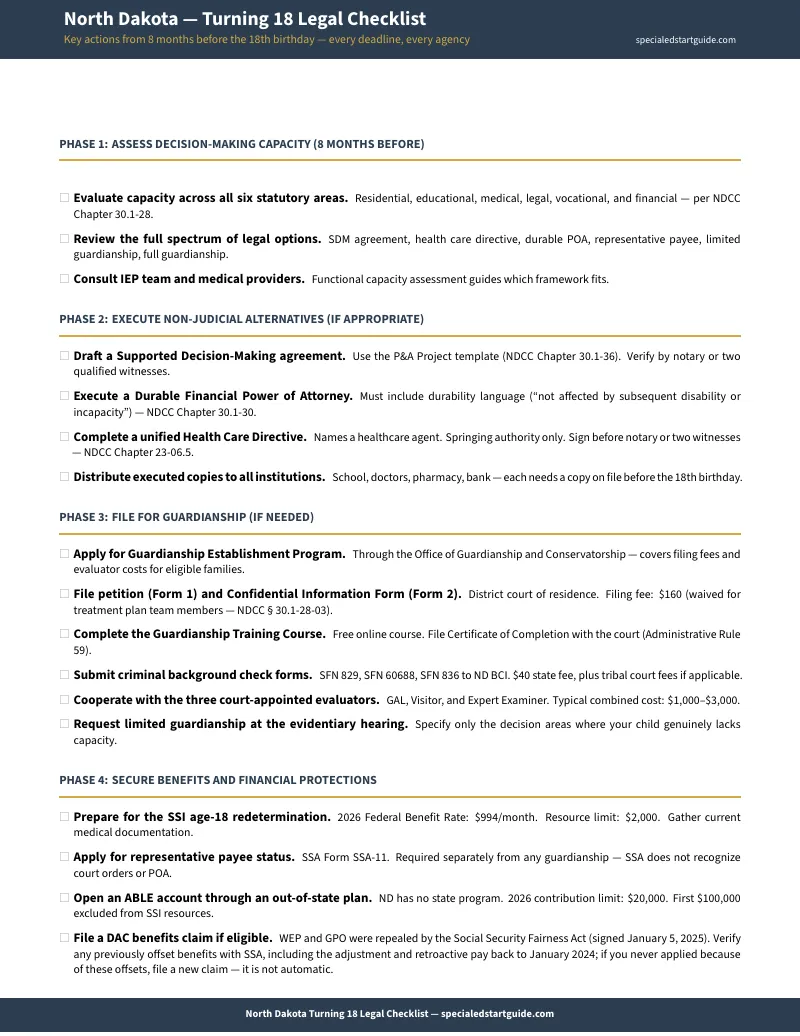
- A 21-item action checklist to track your progress through every phase of the transition
- Six fillable printables: Decision-Making Assessment Worksheet, Guardianship Petition Timeline Planner, SSI Redetermination Preparation Checklist, Agency Communication Log, Waiver Assessment Preparation Guide, and Legal Document Tracker
- 2026-current rules for SSI, ABLE accounts, Medicaid waivers, and the new Office of Guardianship and Conservatorship
The checklist is available as a free download — it covers what to do. The full guide covers how, with the step-by-step instructions, form walkthroughs, and decision frameworks that turn a checklist item into a completed action.
Satisfaction Guarantee
If the guide doesn't give you a clear path through the turning-18 transition, email us and we'll make it right. No time limits, no hoops.
Your young adult's 18th birthday is coming. The Transfer of Rights notice is already in your folder. The question isn't whether to plan — it's whether you plan with a system or piece it together from scattered PDFs and outdated forum posts.
Get the Full Guardianship & Alternatives Guide →
Frequently Asked Questions
What if the rules change after I buy?
We update the guide when the rules change. Email us any time, even years later, and we'll send you the current edition free.